


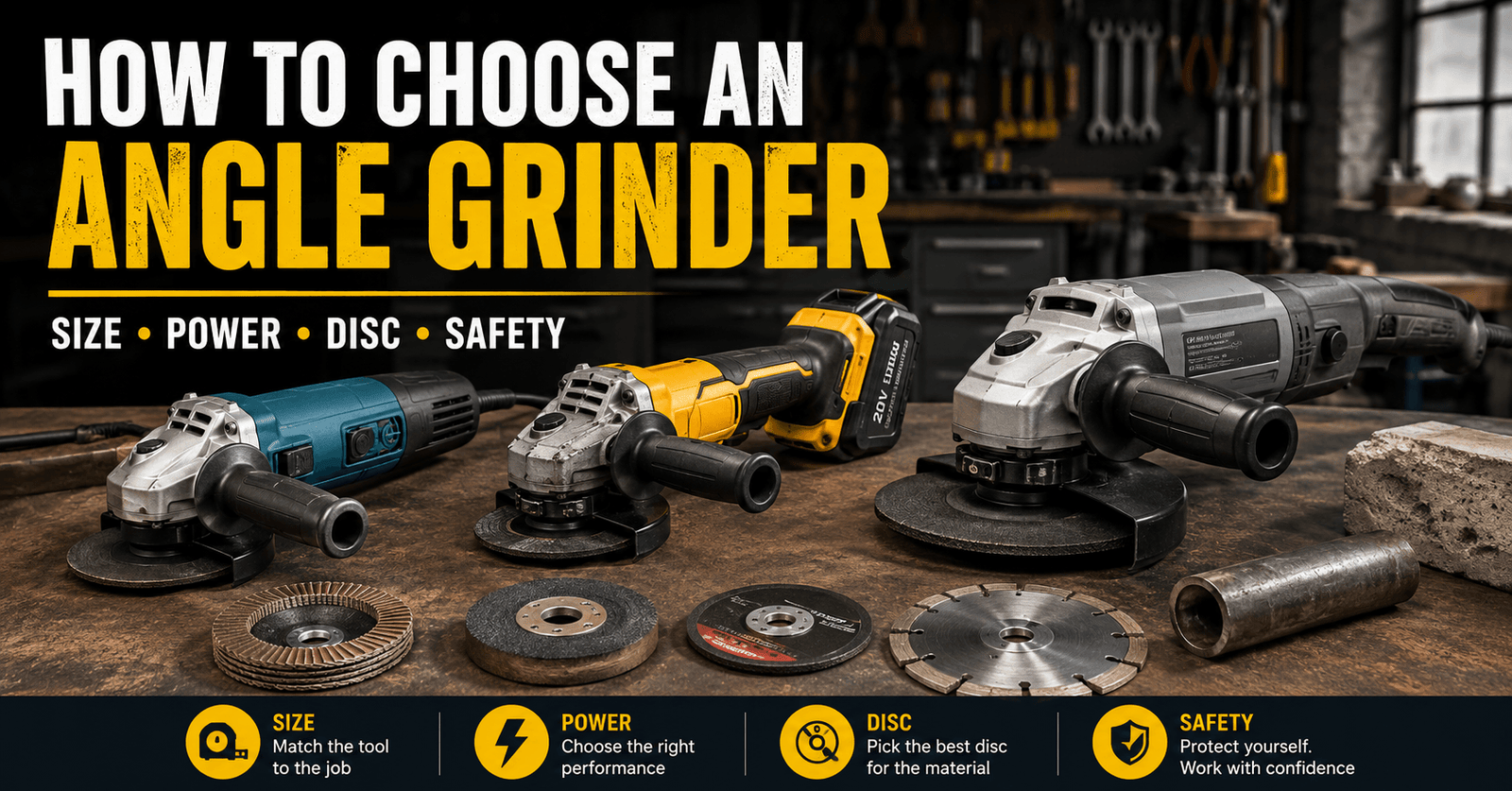
How to Choose an Angle Grinder
The best way to choose an angle grinder is to match the tool’s disc size, power, speed, safety features, and accessory compatibility to the materials you cut or grind most often. For most people, a 4½-inch or 5-inch grinder offers the best balance of control, price, and versatility.
An angle grinder is a handheld power tool that spins abrasive wheels, cutting discs, flap discs, diamond blades, wire brushes, and sanding attachments at high speed. It can cut steel, grind welds, remove rust, trim tile, cut brick, smooth concrete, sharpen tools, and prepare surfaces for paint or welding.
Choosing the wrong angle grinder can make simple work slower, rougher, and riskier. A grinder that is too large can feel clumsy. A grinder that is underpowered can bog down in metal or masonry. A cheap grinder with poor ergonomics can cause fatigue. A tool without modern safety features can be harder to control when a disc binds.
This guide is written for DIY users, homeowners, garage mechanics, welders, fabricators, contractors, construction workers, tile installers, and anyone comparing the best angle grinder options before buying.
You will learn how to choose the right angle grinder size, compare corded vs cordless angle grinders, understand motor power, choose accessories, evaluate safety features, and avoid common buying mistakes.
Quick Recommendation
For most homeowners and DIY users, choose a 4½-inch or 5-inch angle grinder with:
- 7–11 amps for corded models, or 18V/20V-class battery power for cordless models
- Paddle switch or dead-man switch
- Adjustable wheel guard
- Side handle
- Spindle lock
- Overload protection
- Good disc availability
- Comfortable grip and manageable weight
For professional metalworking, masonry, concrete cutting, or daily jobsite use, step up to a higher-power corded grinder or a premium brushless cordless grinder from brands such as DeWalt, Makita, Bosch, Milwaukee, Metabo, Hikoki, or similar professional-grade manufacturers.
Our Evaluation Methodology
This angle grinder buying guide evaluates grinders based on real-world tool selection factors:
- Disc size and cutting depth
- Motor power and torque
- Corded vs cordless performance
- RPM and speed control
- Safety features
- Accessory compatibility
- Ergonomics and weight
- Dust control
- Durability
- Long-term value
The goal is not to push one brand. The goal is to help you buy the right grinder for your actual work.
How Do Angle Grinders Work?
An angle grinder works by using an electric motor to drive a gearbox, which turns a spindle connected to a rotating abrasive wheel or disc. The disc spins at high RPM to cut, grind, sand, polish, or remove material depending on the accessory fitted to the grinder.
Inside an angle grinder, the motor generates rotational force. That force passes through a gearbox, usually positioned at a right angle to the body of the tool. The gearbox drives the spindle, and the accessory mounts onto that spindle using flanges, nuts, or threaded hubs.
The spinning disc does the work. The tool itself only supplies power, speed, and control.
Main Parts of an Angle Grinder
| Part | What It Does | Why It Matters |
|---|---|---|
| Motor | Provides power | Determines cutting and grinding strength |
| Gearbox | Transfers torque to the spindle | Affects durability and smoothness |
| Spindle | Holds the disc or accessory | Must match arbor/thread size |
| Wheel guard | Deflects sparks and debris | Essential safety feature |
| Side handle | Improves two-hand control | Reduces kickback risk |
| Switch | Turns tool on/off | Affects safety and comfort |
| Spindle lock | Helps change discs | Saves time during accessory changes |
| Brushes or brushless motor | Controls motor design | Affects maintenance and efficiency |
Cutting vs Grinding
Cutting and grinding are not the same job.
Cutting uses thin cut-off wheels or diamond blades to slice through materials such as steel, rebar, tile, brick, or concrete. Cutting requires good control and the correct disc.
Grinding uses thicker grinding wheels or flap discs to remove material from a surface. Common grinding jobs include smoothing welds, cleaning edges, removing burrs, and shaping metal.
Expert tip: Never use a cutting disc for heavy side grinding. Thin cutting wheels are designed for edge cutting, not sideways pressure.
RPM and Torque
Most small angle grinders run at high no-load speeds, often around 8,000–12,000 RPM. Larger grinders usually spin slower but deliver more torque and cutting depth.
- RPM affects disc speed.
- Torque affects the tool’s ability to keep spinning under load.
- Power-to-weight ratio affects how strong the grinder feels compared with how tiring it is to use.
A high RPM grinder can cut quickly, but only when matched with the right accessory and material.
What Can You Use an Angle Grinder For?
You can use an angle grinder for cutting metal, grinding welds, removing rust, cutting concrete, trimming tile, sharpening tools, stripping paint, sanding, and polishing. The grinder’s versatility depends less on the tool body and more on choosing the correct disc, wheel, brush, or attachment for each material.
Angle grinders are popular because one tool can do many workshop and jobsite tasks. With the right accessory, a grinder can move from steel fabrication to masonry cutting to surface preparation in minutes.
Common Angle Grinder Uses
Cutting Metal
An angle grinder with a cutting disc can cut steel, stainless steel, rebar, bolts, metal pipe, sheet metal, and angle iron. This is one of the most common uses for a 4½-inch or 5-inch grinder.
Grinding Welds
Welders use grinding wheels and flap discs to smooth weld beads, clean edges, remove spatter, and prepare metal before finishing.
Rust and Paint Removal
Wire cup brushes, wire wheels, flap discs, and sanding discs can remove rust, scale, old paint, and surface corrosion from steel and other metals.
Masonry Cutting
With a diamond blade, an angle grinder can cut brick, stone, concrete pavers, tile, and blocks. For deeper concrete cuts, larger grinders or dedicated saws are better.
Concrete Grinding
A grinder can smooth small concrete patches, remove high spots, or prepare a surface with the right diamond cup wheel and dust extraction setup.
Tile Cutting
Tile installers often use small grinders with diamond blades for curved cuts, notches, outlet openings, and small adjustments.
Polishing and Sanding
Variable speed grinders can use backing pads, sanding discs, and polishing attachments. Lower speed matters here because high RPM can burn finishes or overheat materials.
Task-to-Disc Recommendation Table
| Task | Best Accessory | Best Grinder Type |
|---|---|---|
| Cut steel pipe | Thin cutting wheel | 4½-inch or 5-inch grinder |
| Cut rebar | Metal cut-off wheel | Corded or high-output cordless |
| Grind welds | Grinding wheel or flap disc | 5-inch or 6-inch grinder |
| Smooth sharp edges | Flap disc | 4½-inch or 5-inch grinder |
| Remove rust | Wire cup brush or flap disc | Variable speed preferred |
| Remove paint | Sanding disc or wire wheel | Variable speed grinder |
| Cut brick | Diamond blade | 5-inch, 7-inch, or 9-inch grinder |
| Cut concrete | Diamond blade | 7-inch or 9-inch grinder |
| Grind concrete | Diamond cup wheel | Corded grinder with dust extraction |
| Cut tile | Diamond tile blade | 4½-inch or 5-inch grinder |
| Polish metal | Polishing pad | Variable speed grinder |
| Sharpen tools | Grinding wheel or flap disc | Small grinder with good control |
Pro note: The disc is not an afterthought. Cheap, wrong, or worn discs are the “budget tires on a sports car” problem of grinding. Technically it moves, but nobody should be proud of it.
What Size Angle Grinder Should You Choose?
A 4½-inch or 5-inch angle grinder is the best size for most buyers because it handles metal cutting, weld grinding, rust removal, tile trimming, and general DIY tasks without being too heavy. Choose 7-inch or 9-inch grinders only when you need deeper cuts or heavy masonry/construction work.
Angle grinder size refers to the maximum disc diameter the tool can safely accept. Bigger discs cut deeper and remove material faster, but they also add weight, reduce control, and increase risk if used carelessly.
Angle Grinder Size Guide
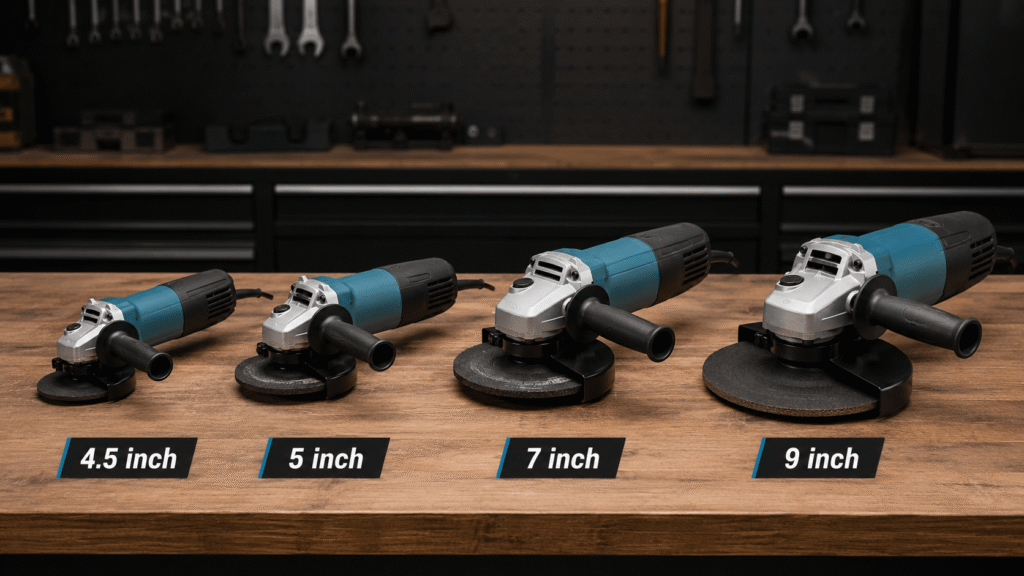
| Grinder Size | Typical Cutting Depth | Best For | Main Advantage | Main Disadvantage |
|---|---|---|---|---|
| 4-inch | Shallow cuts | Light DIY, tight spaces | Compact and easy to control | Limited cutting depth |
| 4½-inch | Around 1 inch | Home use, metal cutting, rust removal | Best accessory availability | Not ideal for deep concrete |
| 5-inch | Around 1¼ inch | DIY, automotive, fabrication | Better capacity than 4½-inch | Slightly heavier |
| 6-inch | Around 1½–2 inches | Fabrication, contractors | More reach and power | Less nimble |
| 7-inch | Around 2+ inches | Concrete, masonry, heavy grinding | Strong performance | Heavy for casual users |
| 9-inch | Around 3+ inches | Construction, deep masonry cuts | Maximum cutting depth | Large, heavy, less forgiving |
Cutting depth varies by disc type, guard design, flange setup, and material. Always follow the manufacturer’s instructions.
Best Size for DIY Users
A 4½-inch grinder is usually the best grinder for DIY. It is affordable, easy to control, widely supported by accessories, and powerful enough for home repairs, metal cutting, rust removal, and occasional masonry work.
Best Size for Metal Fabrication
A 5-inch or 6-inch grinder works well for steel fabrication, weld grinding, and repeated cutting. The extra disc size improves productivity without making the tool as bulky as a 7-inch or 9-inch grinder.
Best Size for Concrete and Masonry
For concrete, brick, stone, and masonry cutting, a 7-inch or 9-inch grinder gives deeper cuts. However, these tools are heavier and should be used with proper PPE, dust control, and experience.
DIY vs Professional Decision Table
| User Type | Recommended Size | Why |
|---|---|---|
| Beginner DIY user | 4½-inch | Easy control and low cost |
| Homeowner | 4½-inch or 5-inch | Best all-around versatility |
| Garage mechanic | 4½-inch or 5-inch | Great for bolts, exhaust, brackets |
| Welder | 5-inch or 6-inch | Better weld cleanup speed |
| Fabricator | 5-inch or 6-inch | Stronger for repeated metalwork |
| Tile installer | 4½-inch or 5-inch | Accurate trimming and notching |
| Concrete contractor | 7-inch or 9-inch | Better cutting depth |
| Professional tradesperson | 5-inch plus 7-inch | One compact grinder, one heavy-duty grinder |
Corded vs Cordless Angle Grinder
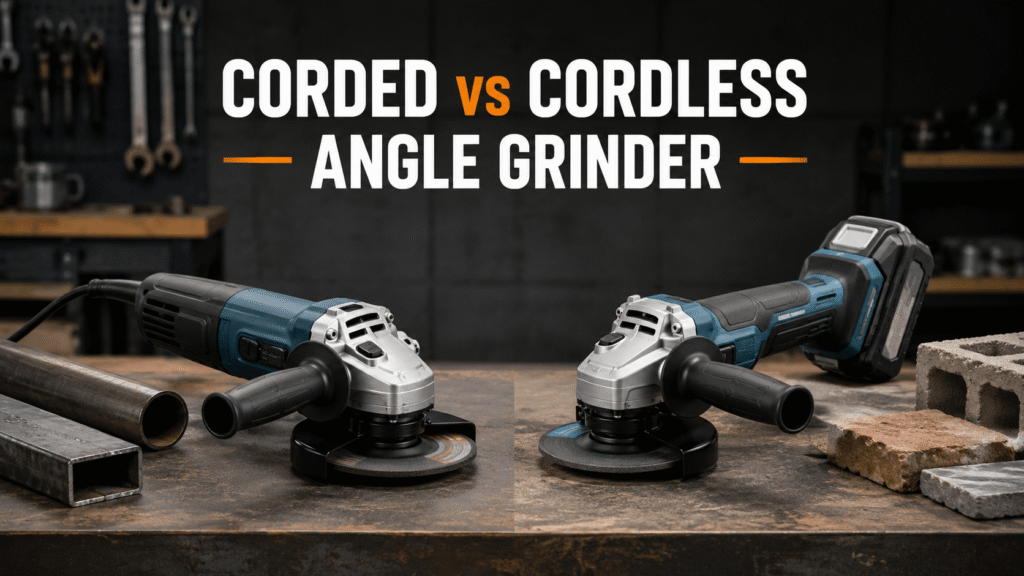
Choose a corded angle grinder if you need maximum continuous power, lower upfront cost, and long grinding sessions. Choose a cordless angle grinder if mobility, convenience, quick cuts, and jobsite flexibility matter more. For most homeowners, corded is best value; for tradespeople already on a battery platform, cordless is often worth it.
The corded vs cordless angle grinder debate comes down to runtime, power, convenience, and battery ecosystem.
Corded grinders plug into an outlet and deliver consistent power for long sessions. Cordless grinders use lithium-ion batteries and are easier to move around, especially outdoors or on jobsites without nearby power.
Corded Angle Grinder Pros
- Better value for money
- Unlimited runtime with power access
- Strong sustained grinding performance
- Good for concrete, masonry, and heavy metalwork
- No battery replacement cost
- Often lighter than cordless tools with large batteries attached
Corded Angle Grinder Cons
- Needs power outlet or generator
- Cord can get in the way
- Less convenient for quick outdoor work
- Not ideal for remote jobsites
Cordless Angle Grinder Pros
- Excellent mobility
- Great for quick cuts and field work
- No cord management
- Safer movement around ladders, vehicles, and outdoor spaces
- Best if you already own compatible batteries
Cordless Angle Grinder Cons
- Runtime depends on battery size
- High-output batteries can be expensive
- Heavy batteries can increase fatigue
- Sustained grinding drains batteries quickly
- Cheaper cordless grinders may feel underpowered
Corded vs Cordless Comparison Table
| Factor | Corded Grinder | Cordless Grinder |
|---|---|---|
| Power | Strong continuous output | Strong on premium brushless models |
| Runtime | Unlimited with power | Limited by battery capacity |
| Mobility | Limited by cord | Excellent |
| Weight | Often lighter | Heavier with battery |
| Cost | Lower upfront | Higher if batteries included |
| Maintenance | Simple | Battery care matters |
| Best for home use | Excellent | Great if already on platform |
| Best for professional use | Heavy-duty work | Jobsite mobility |
| Best value | Usually corded | Cordless if batteries owned |
Recommendations by User Type
- DIY homeowner: corded 4½-inch or 5-inch grinder
- Garage mechanic: corded for shop work, cordless for driveway repairs
- Welder: corded 5-inch or 6-inch grinder for long grinding sessions
- Contractor: brushless cordless grinder for mobility plus corded backup
- Concrete worker: corded 7-inch or 9-inch grinder with dust extraction
- Battery-platform user: cordless makes sense if you already own DeWalt, Makita, Milwaukee, Bosch, Hikoki, Ryobi, or similar batteries
How Much Motor Power Do You Need?
Most DIY users need a 7–11 amp corded grinder or an 18V/20V cordless grinder. Automotive, fabrication, and masonry users should look for stronger motors, brushless designs, higher torque, and better overload protection. More power helps under load, but too much power in a heavy tool can reduce control.
Angle grinder motor power is listed in amps, watts, volts, or battery platform ratings depending on the tool type.
Understanding Amps
For corded grinders, amps describe how much electrical current the motor draws. Higher amps usually indicate stronger performance, but tool design, cooling, gearing, and electronics also matter.
General corded power ranges:
| Use Case | Suggested Corded Power |
|---|---|
| Light DIY | 6–8 amps |
| General home/garage use | 7–11 amps |
| Automotive work | 8–12 amps |
| Metal fabrication | 10–15 amps |
| Masonry and concrete | 13–15 amps |
| Professional daily use | 11–15 amps |
Understanding Watts
In many markets, grinder power is listed in watts.
Approximate ranges:
| Use Case | Suggested Wattage |
|---|---|
| Light home use | 600–900 W |
| General DIY | 800–1,200 W |
| Metalwork | 1,000–1,500 W |
| Heavy construction | 1,800–2,400 W |
Watts are useful, but they do not tell the whole story. A well-built 1,200 W grinder may outperform a cheaper grinder with a higher number printed on the box.
Understanding Volts and Batteries
Cordless grinders are usually described by voltage and battery platform. Common systems include 18V, 20V Max, 36V, 40V Max, and high-output multi-battery systems.
For cordless grinders, look at:
- Battery voltage
- Battery amp-hour rating
- High-output battery compatibility
- Brushless motor design
- Electronic protection
- Tool runtime under grinding load
- Battery ecosystem cost
Power Recommendations by Project
| Project Type | Recommended Grinder Power |
|---|---|
| DIY repairs | 7–9 amps or 18V cordless |
| Home metal cutting | 8–11 amps or brushless cordless |
| Automotive work | 9–12 amps or high-output cordless |
| Steel fabrication | 11–15 amps or premium cordless |
| Weld grinding | 11–15 amps preferred |
| Concrete grinding | 13–15 amps corded |
| Masonry cutting | 13–15 amps or large grinder |
| Professional construction | Heavy-duty corded plus premium cordless |
Expert tip: Buy enough power for your hardest regular job, not your wildest fantasy project. A 9-inch grinder for one tiny bolt is like bringing a bulldozer to open a pickle jar.
Should You Choose a Brushless Angle Grinder?
A brushless angle grinder is worth buying if you use a cordless grinder regularly, want better efficiency, longer runtime, less maintenance, and stronger performance under load. Casual DIY users can still do fine with brushed tools, but professionals and frequent users usually benefit from brushless motor technology.
A brushless motor uses electronic controls instead of carbon brushes to manage motor rotation. This reduces friction, heat, and maintenance compared with traditional brushed motors.
Benefits of Brushless Angle Grinders
- Better battery efficiency
- Longer runtime per charge
- Less heat buildup
- Longer motor life
- No carbon brush replacement
- Better electronic control
- Improved power-to-weight ratio
- Often paired with advanced safety features
Drawbacks of Brushless Angle Grinders
- Higher upfront cost
- More electronics inside the tool
- Repairs can be more expensive
- Budget users may not need the upgrade
Who Should Buy Brushless?
Choose a brushless angle grinder if you:
- Use cordless tools often
- Cut or grind metal regularly
- Work on jobsites
- Already own premium batteries
- Need maximum runtime
- Want modern safety features
- Prefer tools that last longer under regular use
Who Can Skip Brushless?
You can choose a brushed grinder if you:
- Only use it a few times per year
- Need the lowest-cost option
- Mostly do light cutting
- Prefer simple corded tools
- Are buying a backup grinder
Brushless is not magic, but it is a real advantage for cordless angle grinders. For professionals, the upgrade often pays for itself through better performance and less downtime.
Why RPM and Variable Speed Matter
RPM matters because every disc and accessory has a maximum safe operating speed, while variable speed matters because not every task needs maximum RPM. Cutting and grinding often use high speed, but sanding, polishing, wire brushing, and heat-sensitive materials benefit from lower, controlled speed settings.
RPM stands for revolutions per minute. The no-load speed is how fast the grinder spins without pressure applied to the disc. Under load, speed drops depending on power, torque, material, and pressure.
Typical Angle Grinder RPM Ranges
| Grinder Size | Typical RPM Range |
|---|---|
| 4-inch | 10,000–12,000 RPM |
| 4½-inch | 9,000–12,000 RPM |
| 5-inch | 8,500–11,500 RPM |
| 6-inch | 8,000–10,000 RPM |
| 7-inch | 6,000–8,500 RPM |
| 9-inch | 5,000–6,600 RPM |
Larger discs usually spin slower because the outer edge travels farther per revolution.
When High RPM Helps
High RPM is useful for:
- Cutting steel
- Cutting rebar
- Grinding welds
- Removing burrs
- Fast stock removal
- Cutting masonry with the correct blade
When Lower RPM Helps
Lower RPM is useful for:
- Polishing metal
- Sanding wood or paint
- Working with wire brushes
- Reducing heat on stainless steel
- Controlling finish quality
- Using delicate attachments
Why Variable Speed Is Valuable
A variable speed angle grinder lets you match speed to the accessory and material. This is especially useful for:
- Polishing attachments
- Backing pads
- Sanding discs
- Wire wheels
- Stainless steel finishing
- Aluminum work
- Paint removal
- Surface preparation
Constant Speed Electronics
Some professional grinders include constant speed electronics. This feature helps maintain RPM under load. It is useful for weld grinding, fabrication, and masonry work where the tool may otherwise bog down.
Rule: The accessory’s rated RPM must be equal to or higher than the grinder’s maximum RPM. Never mount an accessory that is not rated for the tool speed.
Which Safety Features Are Worth Paying For?
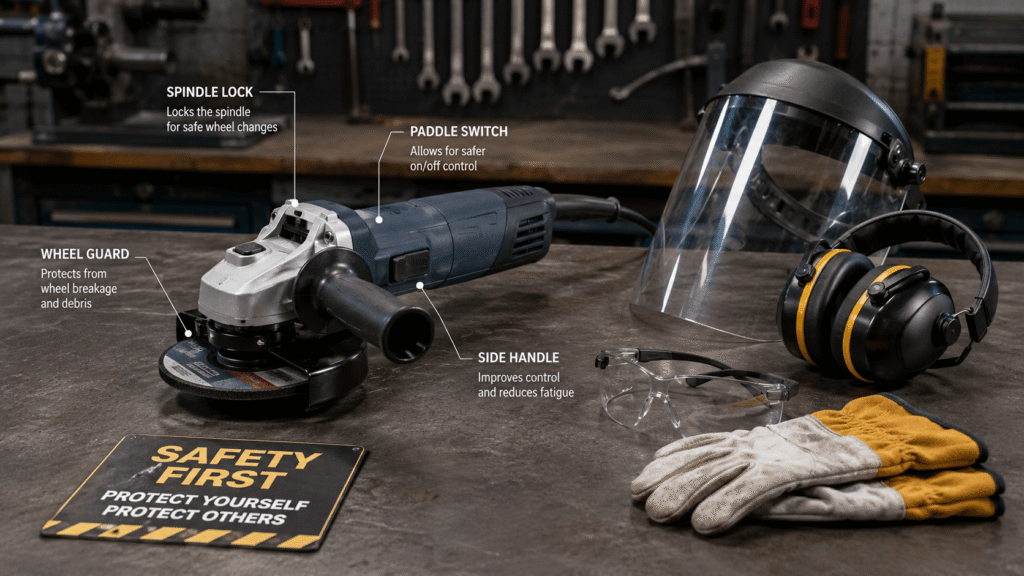
The most valuable angle grinder safety features are a properly adjustable wheel guard, paddle switch or dead-man switch, anti-kickback control, electronic brake, restart protection, overload protection, soft start, vibration reduction, spindle lock, and a secure side handle. These features improve control and reduce avoidable risk during high-speed cutting and grinding.
Angle grinders are useful, but they are not gentle tools. They spin abrasive wheels at high speed, throw sparks, create dust, and can kick back if the disc binds. Safety features are not decoration. They are buying criteria.
Wheel Guard
A wheel guard helps deflect sparks, debris, and fragments away from the user. It should be easy to adjust and should match the disc type.
Do not remove the guard to fit a larger disc. If the disc does not fit with the guard installed, it is the wrong setup.
Paddle Switch vs Slide Switch
A paddle switch or dead-man switch turns off when released. This is usually safer for professional use because the tool stops if you lose grip.
A slide switch can be more comfortable for long grinding sessions, but lock-on switches require extra caution.
Electronic Brake
An electronic brake stops the wheel faster after the trigger is released. This is helpful when working in busy shops, tight spaces, or on ladders where a spinning wheel creates extra risk.
Kickback Control
Kickback control detects sudden binding or rotation changes and helps shut down or reduce power. This is especially valuable when cutting metal pipe, rebar, concrete, or masonry.
Restart Protection
Restart protection prevents the grinder from turning back on unexpectedly after a power interruption. This matters for corded grinders and jobsite work.
Soft Start
Soft start reduces the sudden jerk when the grinder begins spinning. It improves control, especially on larger grinders.
Overload Protection
Overload protection helps prevent motor damage when the tool is pushed too hard. This is useful for fabrication, masonry, and continuous grinding.
Vibration Control
Vibration control reduces fatigue during long use. It matters more for professionals than occasional DIY users, but even beginners will notice the difference.
Side Handle
A side handle gives you two-hand control. Many grinders allow left, right, and top mounting positions. Use it. One-handed grinding is not a personality trait.
Spindle Lock
A spindle lock makes disc changes easier and safer. It is not a substitute for unplugging the tool or removing the battery before changing accessories.
Safety Feature Priority Table
| Safety Feature | DIY User | Professional User | Worth Paying More? |
|---|---|---|---|
| Adjustable guard | Essential | Essential | Yes |
| Side handle | Essential | Essential | Yes |
| Paddle switch | Highly recommended | Essential | Yes |
| Electronic brake | Nice to have | Highly recommended | Yes |
| Kickback control | Recommended | Essential | Yes |
| Restart protection | Recommended | Essential | Yes |
| Soft start | Nice to have | Recommended | Yes for larger grinders |
| Overload protection | Recommended | Essential | Yes |
| Vibration control | Nice to have | Important | Yes for frequent use |
| Spindle lock | Essential | Essential | Yes |
Essential PPE
Always use appropriate personal protective equipment:
- Safety glasses
- Face shield
- Hearing protection
- Gloves suitable for grinding work
- Respirator or dust mask when needed
- Non-flammable clothing
- Steel-toe footwear for jobsite use
When cutting masonry, concrete, brick, tile, or stone, dust extraction and respiratory protection are especially important.
Which Accessories Should You Buy?
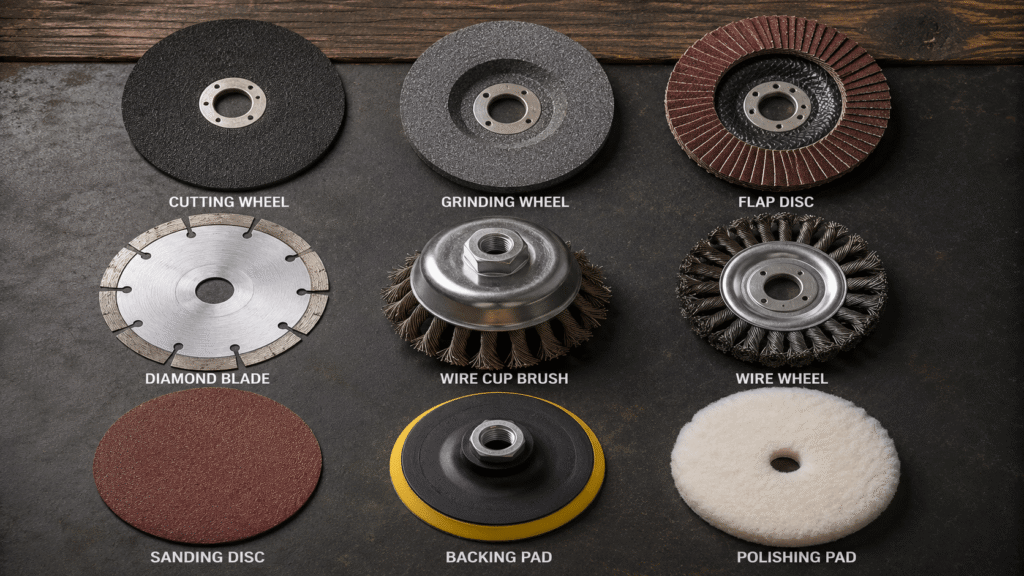
The most useful angle grinder accessories are cutting wheels, grinding wheels, flap discs, diamond blades, wire cup brushes, wire wheels, backing pads, sanding discs, and polishing pads. Buy accessories that match your grinder size, arbor, guard, material, and RPM rating. Good discs are often more important than extra tool power.
Angle grinder accessories determine what the tool can do. A grinder body without the right disc is just a loud handheld spinner with commitment issues.
Grinding Wheels
Grinding wheels are thick abrasive wheels used for removing metal, smoothing welds, shaping steel, and deburring edges. They are not designed for deep cutting.
Cutting Wheels
Cutting wheels are thin abrasive discs used for slicing metal, bolts, rebar, pipe, and sheet steel. They cut quickly but should not be used for side grinding.
Flap Discs
Flap discs combine grinding and finishing. They are excellent for weld cleanup, edge blending, rust removal, and surface smoothing.
Diamond Blades
Diamond blades are used for masonry cutting, concrete, brick, tile, stone, and pavers. Use the correct blade type for dry or wet cutting, and follow dust control guidance.
Wire Cup Brushes
Wire cup brushes remove rust, paint, scale, and corrosion from larger surfaces. They are aggressive and can throw wire strands, so PPE matters.
Wire Wheels
Wire wheels work well for edges, corners, seams, and tighter spaces. Use lower speed when recommended by the accessory.
Backing Pads and Sanding Discs
Backing pads hold sanding discs for surface preparation, paint removal, and smoothing. Variable speed is useful here.
Polishing Pads
Polishing pads require lower speed and careful control. A standard high-speed grinder without variable speed is usually not ideal for polishing.
Compatibility Table
| Accessory | Best Material | Best Use | Variable Speed Helpful? |
|---|---|---|---|
| Grinding wheel | Steel, stainless steel | Heavy stock removal | Not required |
| Cutting wheel | Steel, rebar, pipe | Metal cutting | Not usually |
| Flap disc | Steel, welds, rust | Grinding and finishing | Helpful |
| Diamond blade | Concrete, brick, tile, stone | Masonry cutting | Sometimes |
| Wire cup brush | Metal surfaces | Rust/paint removal | Yes |
| Wire wheel | Edges, seams, corners | Cleaning and stripping | Yes |
| Sanding disc | Wood, paint, metal | Surface prep | Yes |
| Polishing pad | Metal, finish work | Polishing | Essential |
Accessory Buying Rules
- Match disc diameter to grinder size.
- Match arbor size or spindle thread.
- Check maximum RPM rating.
- Use the correct guard.
- Choose the disc for the material.
- Avoid damaged, cracked, or expired abrasive wheels.
- Store discs dry and flat.
- Do not force accessories onto the grinder.
How to Match an Angle Grinder to Your Projects
The right angle grinder depends on your main material and workload. Homeowners usually need a compact 4½-inch grinder, mechanics need a metal-cutting setup, welders and fabricators benefit from 5-inch or 6-inch grinders, and concrete or construction users often need larger corded grinders with dust extraction.
Instead of asking “What is the best angle grinder?” ask “What grinder fits my real projects?”
Best Angle Grinder for DIY Homeowners
Choose:
- 4½-inch corded grinder
- 7–9 amp motor
- Adjustable guard
- Side handle
- Spindle lock
- Basic cutting wheel, grinding wheel, flap disc, and wire brush kit
Best for:
- Cutting bolts
- Sharpening mower blades
- Removing rust
- Cleaning metal
- Small tile cuts
- Occasional masonry trimming
Best Angle Grinder for Garage Mechanics
Choose:
- 4½-inch or 5-inch grinder
- Corded or brushless cordless
- Paddle switch
- Thin cutting wheels
- Flap discs
- Wire wheels
Best for:
- Exhaust work
- Rusted bolts
- Brackets
- Bodywork prep
- Brake and suspension projects
- Metal cleanup
Best Angle Grinder for Metal Fabricators
Choose:
- 5-inch or 6-inch grinder
- 10–15 amp corded or premium brushless cordless
- Constant speed electronics
- Overload protection
- Low vibration design
- Quality flap discs and grinding wheels
Best for:
- Steel fabrication
- Weld prep
- Weld grinding
- Edge cleanup
- Repeated cutting
Best Angle Grinder for Welders
Choose:
- 5-inch grinder for control
- 6-inch grinder for faster weld cleanup
- Paddle switch
- Anti-kickback
- Vibration control
- Multiple flap disc grits
Best for:
- Cleaning welds
- Removing slag
- Beveling edges
- Preparing joints
- Finishing steel
Best Angle Grinder for Construction Workers
Choose:
- Heavy-duty 5-inch or 6-inch grinder for general work
- 7-inch or 9-inch grinder for deep masonry cuts
- Cordless for mobility
- Corded for sustained cutting
- Dust extraction where needed
Best for:
- Rebar
- Concrete
- Brick
- Metal studs
- Tile
- Site repairs
Best Angle Grinder for Concrete Contractors
Choose:
- 7-inch or 9-inch corded grinder
- 13–15 amp motor
- Diamond blade or diamond cup wheel
- Dust shroud
- Vacuum-compatible dust extraction
- Soft start and anti-kickback
Best for:
- Concrete cutting
- Surface grinding
- Coating removal
- Masonry channels
- Paver trimming
Best Angle Grinder for Tile Installers
Choose:
- 4½-inch or 5-inch grinder
- Diamond tile blade
- Variable speed if possible
- Slim body
- Good visibility around the guard
Best for:
- Curved tile cuts
- Outlet notches
- Porcelain trimming
- Stone tile shaping
Best Angle Grinder for Professional Tradespeople
Choose two grinders if budget allows:
- Compact grinder: 4½-inch or 5-inch for control and quick cuts
- Large grinder: 7-inch or 9-inch for heavy masonry and deep cutting
This two-tool setup is more practical than forcing one grinder to do everything.
Common Buying Mistakes
The most common angle grinder buying mistakes are choosing the wrong size, buying too much or too little power, ignoring safety features, using cheap discs, overlooking RPM ratings, choosing a poor battery platform, ignoring ergonomics, and buying one grinder for tasks that clearly need two different tools.
A bad angle grinder purchase usually happens when buyers focus only on price, brand, or motor numbers. The real value comes from matching the grinder to the task.
15 Angle Grinder Mistakes to Avoid
- Buying a 9-inch grinder for DIY jobs
Large grinders are powerful but heavy. Most beginners are better served by a 4½-inch or 5-inch model. - Choosing the cheapest grinder available
Very cheap grinders may lack durability, smooth switches, good guards, or safety electronics. - Ignoring safety features
Guard quality, switch type, restart protection, and kickback control matter. - Using cheap or wrong discs
A quality disc cuts faster, lasts longer, and is usually safer than bargain-bin accessories. - Ignoring RPM ratings
Accessories must be rated for the grinder’s maximum speed. - Removing the guard
If the guard is in the way, change the setup. Do not remove the protection. - Using a cutting wheel for side grinding
Thin cut-off wheels are not built for lateral grinding pressure. - Buying too little power
Underpowered grinders bog down, overheat, and feel frustrating. - Buying unnecessary power
More power adds weight and cost. Not every user needs a professional grinder. - Ignoring ergonomics
Grip size, switch placement, and vibration control affect comfort and safety. - Forgetting battery cost
Cordless grinders need high-output batteries for serious work. - Choosing the wrong battery ecosystem
If you already own Milwaukee, DeWalt, Makita, Bosch, Hikoki, or Ryobi batteries, platform compatibility matters. - Not checking arbor size
Accessories must fit correctly. Adapters are not always the best answer. - Buying one grinder for every job
A compact grinder and a heavy-duty grinder often work better than one compromise tool. - Ignoring dust extraction
Masonry, concrete, brick, tile, and stone work can create harmful dust. Plan dust control before the first cut. - Not checking warranty and service support
A tool is only as good as the repair path behind it. - Skipping PPE cost
Eye, face, hearing, hand, and respiratory protection should be part of the buying budget.
Angle Grinder Buying Checklist
Before buying an angle grinder, confirm the grinder size, motor power, RPM range, switch type, safety features, accessory compatibility, weight, brand support, warranty, and intended materials. A simple checklist prevents overspending and helps you avoid buying a grinder that feels powerful on paper but wrong in your hand.
Use this printable checklist before buying.
Grinder Size
- 4½-inch for DIY and general home use
- 5-inch for better all-around cutting capacity
- 6-inch for fabrication and heavier metalwork
- 7-inch or 9-inch for concrete and masonry
Power
- 6–8 amps for light DIY
- 7–11 amps for general use
- 10–15 amps for fabrication
- 13–15 amps for masonry/concrete
- Brushless cordless if battery runtime matters
RPM
- Maximum RPM listed clearly
- Accessory RPM rating matches or exceeds tool speed
- Variable speed needed for polishing/sanding/wire brushing
- Constant speed electronics preferred for professional use
Safety
- Adjustable wheel guard
- Side handle
- Paddle switch or safe switch design
- Restart protection
- Kickback control
- Electronic brake
- Overload protection
- Soft start for larger grinders
Ergonomics
- Comfortable grip
- Manageable weight
- Low vibration design
- Easy guard adjustment
- Easy disc changes
- Good switch placement
Accessories
- Grinding wheels
- Cutting wheels
- Flap discs
- Diamond blade if cutting masonry/tile
- Wire brush or wire wheel
- Sanding backing pad if needed
- Dust shroud for concrete grinding
Brand and Warranty
- Good warranty
- Local service support
- Replacement parts available
- Compatible batteries if cordless
- Trusted accessory availability
Budget
- Grinder cost
- Disc/accessory cost
- Battery and charger cost
- PPE cost
- Dust extraction cost if needed
Frequently Asked Questions
The most important angle grinder questions involve size, power, discs, RPM, cordless performance, brushless motors, safety gear, and material compatibility. Most users should start with a 4½-inch or 5-inch grinder, then choose accessories and safety features based on whether they cut metal, grind welds, or work with masonry.
What size angle grinder is best?
A 4½-inch or 5-inch angle grinder is best for most people. It offers enough cutting depth for metal, bolts, tile trimming, rust removal, and light masonry while remaining affordable and easy to control.
Are cordless grinders powerful enough?
Yes, modern brushless cordless angle grinders can be powerful enough for metal cutting, jobsite repairs, and many professional tasks. For long grinding sessions or heavy concrete work, corded grinders still offer better continuous runtime.
Can an angle grinder cut concrete?
Yes, an angle grinder can cut concrete when fitted with the correct diamond blade. For small cuts, a 5-inch grinder may work. For deeper concrete cutting, a 7-inch or 9-inch grinder is more suitable.
Can an angle grinder cut tile?
Yes, an angle grinder can cut tile using a diamond tile blade. It is especially useful for curved cuts, notches, and small adjustments. For long straight cuts, a wet tile saw may produce cleaner results.
What RPM is best for an angle grinder?
For cutting and grinding, many small angle grinders run around 9,000–12,000 RPM. The best RPM depends on grinder size, accessory type, and material. Always make sure the disc is rated for the grinder’s maximum speed.
Are brushless grinders worth it?
Brushless grinders are worth it for cordless users, professionals, and frequent DIYers. They offer better efficiency, longer runtime, less heat, and reduced maintenance. Occasional users can still get good results from a quality brushed corded grinder.
Which disc should I use for metal cutting?
Use a thin metal cut-off wheel rated for your grinder size and RPM. For stainless steel, choose a disc marked for stainless use to reduce contamination and heat issues.
Which disc should I use for grinding welds?
Use a grinding wheel for aggressive weld removal or a flap disc for smoothing and blending. Many welders use grinding wheels first and flap discs after for a cleaner finish.
Can one angle grinder handle multiple tasks?
Yes, one grinder can handle many tasks if you use the right accessories. However, professionals often keep multiple grinders set up with different discs to save time and reduce accessory changes.
How long do angle grinders last?
A quality angle grinder can last years with proper use, cooling breaks, correct accessories, and basic maintenance. Heavy dust, overload, poor discs, and constant abuse shorten tool life.
Which brand is most reliable?
Reliable angle grinder brands often include DeWalt, Makita, Bosch, Milwaukee, Metabo, and Hikoki for professional use. Ryobi and BLACK+DECKER can suit lighter DIY work. Festool is more relevant when dust extraction and surface preparation systems are part of the workflow.
Is a 9-inch grinder too large for DIY?
For most DIY users, yes. A 9-inch grinder is heavy and powerful. It is better suited for construction, masonry, and deep cutting tasks. Beginners should usually start with a 4½-inch or 5-inch grinder.
What safety gear is essential?
Essential safety gear includes safety glasses, a face shield, hearing protection, gloves, non-flammable clothing, and respiratory protection when cutting masonry, concrete, tile, brick, or stone.
Can an angle grinder cut aluminum?
Yes, but use an accessory rated for aluminum and avoid discs that clog easily. Aluminum is softer than steel and can load abrasive wheels, so choose the correct disc and avoid overheating.
Do I need variable speed?
Variable speed is not essential for basic cutting and grinding, but it is very useful for polishing, sanding, wire brushing, paint removal, and working with heat-sensitive materials.
What is the difference between a grinding disc and a flap disc?
A grinding disc removes material aggressively. A flap disc removes material while also blending and smoothing the surface. Flap discs are often better for finishing welds and cleaning edges.
Can I use circular saw blades on an angle grinder?
No. Do not use circular saw blades on an angle grinder unless the tool and blade are specifically designed and approved for that setup. Incorrect blades can create severe kickback and injury risks.
What is the best angle grinder for home use?
The best angle grinder for home use is usually a 4½-inch corded model with a 7–9 amp motor, adjustable guard, side handle, spindle lock, and good accessory availability.
Conclusion
To choose the right angle grinder, start with your main projects, then match the grinder size, power, RPM, safety features, and accessories to those materials. Most users should buy a 4½-inch or 5-inch grinder, while professionals may need larger or multiple grinders for fabrication, concrete, and construction.
An angle grinder is one of the most versatile tools you can own, but it rewards smart buying. Do not choose only by price, brand, or power rating. Choose by real use.
For most DIY users, the best choice is a compact 4½-inch or 5-inch grinder with a good guard, side handle, spindle lock, and basic safety features. For metalworkers and welders, step up to more power, better ergonomics, and quality flap discs. For concrete and masonry, choose a larger grinder with diamond accessories and dust extraction.
If you work daily, invest in better safety electronics, vibration control, brushless motor technology, and professional-grade accessories. The tool costs more upfront, but the long-term value is usually better.
Most importantly, treat accessories and safety gear as part of the purchase. A great grinder with the wrong disc is still the wrong setup.
Explore related buying guides such as Best Angle Grinders, Best Grinding Wheels, Best Cutting Discs, Corded vs Cordless Power Tools, and Angle Grinder Safety Tips before making your final decision.
