Harmonic Balancer Stuck: Removal and Repair Guide
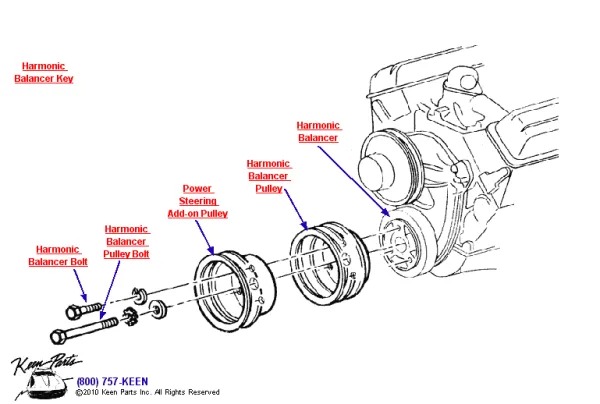
When your harmonic balancer gets stuck, the hub has seized to the crankshaft snout from corrosion, over-torque, or years of heat cycling.
Harmonic balancers are press-fit onto the crankshaft snout using an interference fit typically measured in thousandths of an inch. As of 2026, most engines still rely on that press-fit design. That means the wrong removal method can bend or fracture the crank snout.
The choice of force matters more than raw strength.
harmonic balancer stuck
A stuck harmonic balancer is when corrosion, over-torque, or heat cycling welds the hub to the crankshaft snout. Penetrating oil can break that bond, but controlled mechanical force is still required. Hammering the outer ring can ruin both the damper and the crankshaft.
The correct approach protects one of the engine's most expensive rotating parts.
Why a Stuck Harmonic Balancer Is Critical (Not Just Annoying)
You're not just removing a pulley. You're protecting the crankshaft itself.
The harmonic balancer is press-fit onto the crankshaft snout with only thousandths of an inch of interference. In our research, most seizures form between the hub bore and the crank snout after years of rust build up. Heat cycling only tightens that bond over time.
Forcing it off without support puts the crank snout at risk of bending or fracture. Manufacturer specifications confirm many engines depend on that exact press-fit for front-end timing alignment. Once the crank nose is damaged, the cost can quickly exceed a simple front seal job.
Recognizing the Symptoms Before It Becomes Catastrophic
Catching this early can prevent major repairs.
Image source: Web (Bing) / nissankaengine.com (Web image (fair-use with source credit))
A ticking, chattering, or squeal at the front of the engine is often the first sign. You may also see rust bleeding from the seam between the hub and the crank snout. If the outer ring appears loose or shifts on its own, the bonded rubber inside the damper has likely failed.
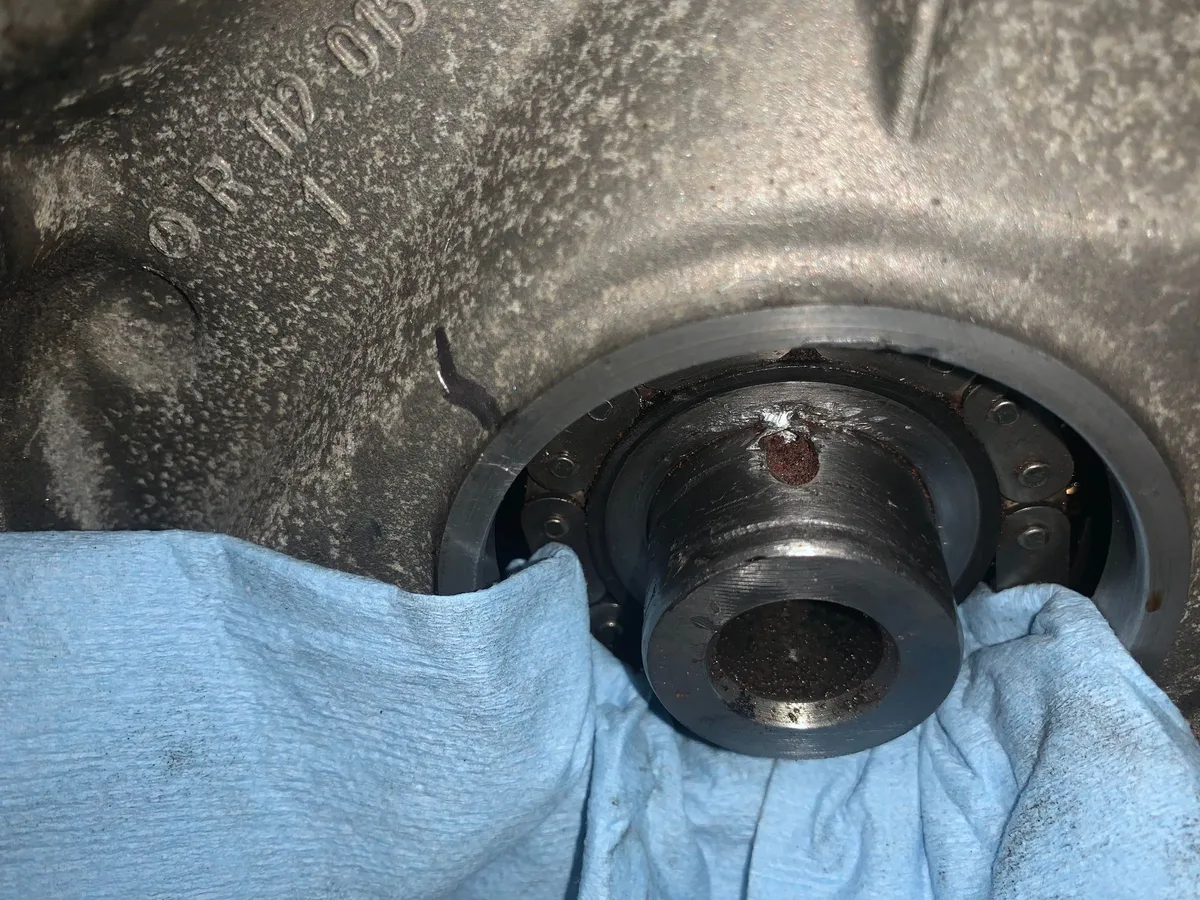
Image source: Bing (Web (fair-use with source credit))
Pay close attention to fresh oil or coolant near the timing cover. Check for play by gently trying to see movement between the center hub and the outer ring. Damage to the Woodruff keyway is also a red flag.
Each of these points to a higher risk of seizure before removal.
The Right Way vs The Wrong Way (Why Generic AI Advice Fails)
Not every pulling method is safe for a press-fit harmonic balancer.
| Method | Outcome | Risk Level |
|---|---|---|
| Dedicated harmonic balancer puller with proper support | Controlled, even removal | Low |
| Penetrant dwell plus controlled pulling | Breaks corrosion bond safely | Low to Moderate |
| Universal 3-jaw puller against an unsupported crank snout | Bent or fractured crank nose | Extreme |
| Hammering the outer ring | Scored snout or ruined damper | Extreme |
| Center-screw puller on an aluminum crank | Stripped front crank threads | Extreme |
Dedicated pullers grip the hub evenly and push axially against the crankshaft bolt hole. That spreads force across the correct points. Makeshift tools apply force off center, which is what bends slender crank snouts.
Never assume bolt thread direction. Some engines use left-hand threads. Forcing the wrong way only tightens a seized center bolt.
Axial force, not sideways force, is the only safe type here.
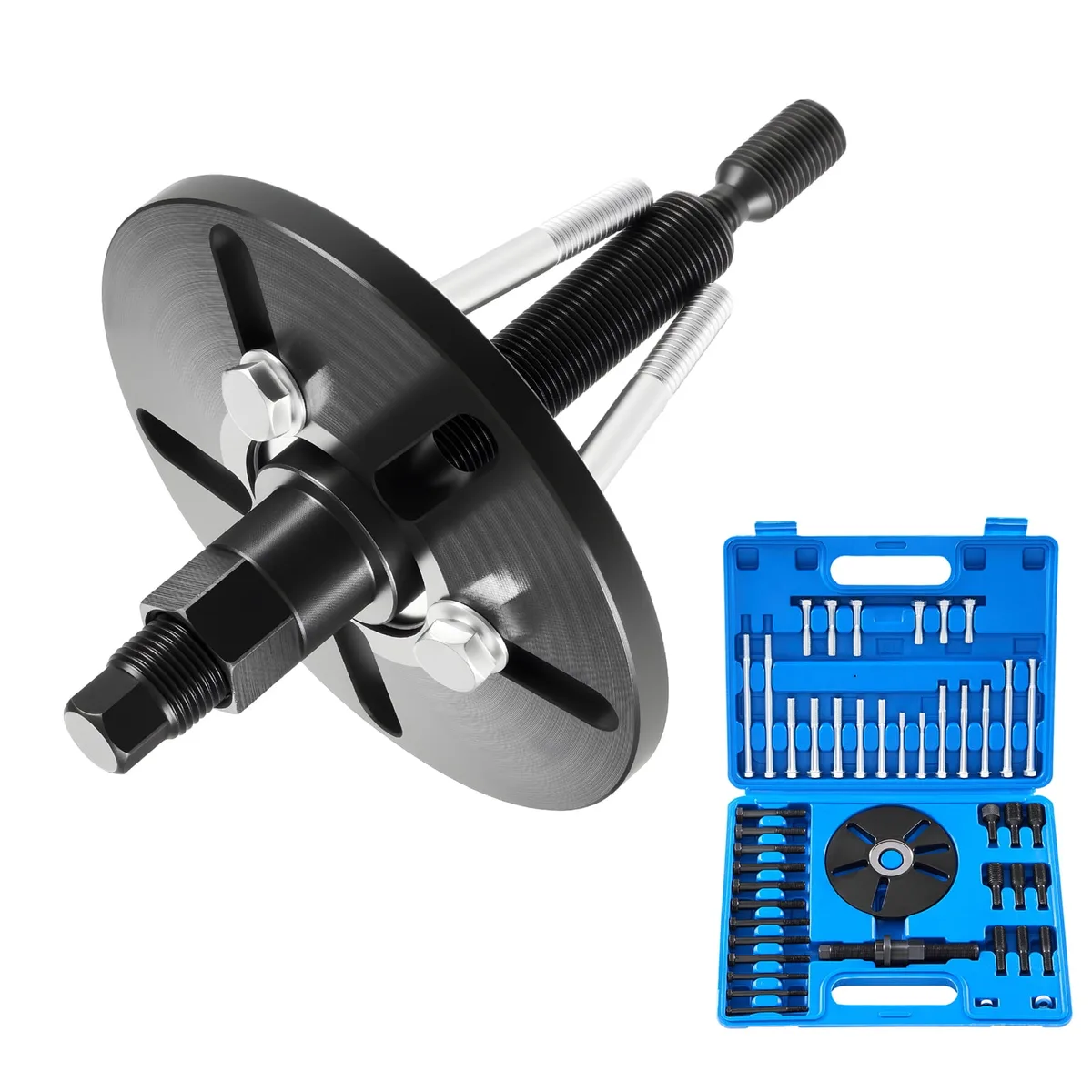
Image source: Web (Bing) / walmart.com (Web image (fair-use with source credit))
Removing a Stuck Balancer: Safe Step-by-Step Workflow
Stick to this order to limit stress on the crankshaft.
Image source: Bing (Web (fair-use with source credit))
- Lock the crankshaft. Secure the flywheel or flexplate to stop rotation while breaking loose the center bolt.
- Check the bolt. Confirm thread pitch and direction. Check for a torque-to-yield (TTY) bolt that must be replaced on reassembly.
- Soak the joint. Apply penetrating oil to the hub to crank snout interface. Give it 15 to 60 minutes of dwell time. Reapply if rust is heavy.
- Set up the puller. Use a dedicated harmonic balancer puller. Keep jaws fully seated on the hub with no overhang.
- Pull with control. Turn the forcing screw in small increments. Watch for any movement between pulls. Never jerk or shock load it.
- Inspect on removal. Check the crank snout, Woodruff keyway, front threads, and balancer bore for scoring or galling before going any further.
Always wear ANSI-approved eye protection. Keep fuel lines clear if any localized heat is considered. Support the engine securely.
Stop at the first sign of binding, slip, or twisting.
Choosing and Using Tools That Won’t Break Your Crankshaft
The right tool does more to protect the crank snout than any trick ever will.
A dedicated harmonic balancer puller is built for the interference fit on press-fit hubs. Quality sets run between $100 and $300. Most cover a wide range, but not every kit fits every engine.
Always cross check against your engine before buying.
A crankshaft holding tool is needed to keep the crank from turning when breaking the center bolt loose. A calibrated torque wrench is needed for correct reinstallation. For TTY bolts, an angle gauge or the OEM angle spec is required.
Avoid using only a generic 3-jaw puller with no hub support. Without the correct contact points, jaw slip is almost guaranteed. Crankshaft snout protectors can help limit contact damage on tight pulls, but they don't replace correct alignment.
When to Walk Away and Call a Pro
Knowing when to stop is part of doing this safely.
Stop if the puller jaws start to bend or deform under load. Stop if the forcing screw binds hard with little to no movement after proper dwell. Stop if you see the crank snout visibly flex or twist while pulling.
Stop if you can't positively confirm left or right hand thread before forcing.
A crankshaft replacement can run $1,500 to $3,000 with labor. By comparison, a skilled shop with the correct puller and holding tools is often the cheaper route at that point. If slip happens once despite correct setup, don't try a second puller or makeshift fix.
Escalate to a qualified shop.
Harmonic Balancer Removal Tools and Materials Checklist
Use this to keep only what you need on hand.
| Tool or Material | Purpose | Typical Range (as of 2026) |
|---|---|---|
| Dedicated harmonic balancer puller | Even axial pull with hub contact | $120 to $280 |
| Crankshaft holding tool | Prevents crank rotation on bolt removal | $30 to $80 |
| Calibrated torque wrench | Accurate bolt torque and angle control | $50 to $150 |
| Penetrating oil | Breaks corrosion at hub to snout joint | $10 to $20 |
| Thread cleaner or remover | Clears old thread residue | $5 to $15 |
| Torque-to-yield replacement bolts | Required by many OEM specs | $15 to $50 each |
| Front seal kit (if disturbed) | Often needed at this service point | $25 to $70 |
Only buy parts that match the exact engine. Universal does not always mean correct for your crank snout diameter.
Maintenance and Long-Term Optimization
A few small steps cut the chance of this happening again.
Inspect the balancer at every front-end service. Look for rubber separation, cracks in the ring, or rust at the hub to snout seam. Any visible runout or wobble is reason to plan for replacement.
On reassembly, clean both mating surfaces to bare metal. Remove old oil, rust film, and gasket residue from the crank snout. Follow the exact OEM torque plus angle for TTY bolts.
Never reuse a TTY balancer bolt.
In road salt heavy regions, front-end inspection should be more frequent. Keeping the area free of packed mud and road grime slows corrosion at that tight press-fit joint. Aged dampers lose a large amount of their torsional control over time.
Replacing one at the right interval is far cheaper than fixing a damaged crank snout.
Cost Considerations and Financial Impact
Know the numbers before you commit.
| Item | Range (as of 2026) | Notes |
|---|---|---|
| DIY tool purchase | $100 to $300 | Only worth it if used again or for a known fit |
| DIY parts and consumables | $40 to $120 | Includes penetrating oil, seal, and TTY bolts |
| Shop labor (removal only) | $175 to $325 | Varies by engine bay access |
| Full front service (timing cover related) | $275 to $550 | Common when seals or water pump share access |
| Crankshaft repair or replacement | $1,500 to $3,000 | Avoidable with correct removal |
Hidden costs usually come from seized bolts or damaged seals once opened up. Bundling related jobs can cut labor overlap, but only if access matches. In tight transverse engines, labor often sits at the higher end.
Professional Repair Standards and Specifications
There is a reason this falls under higher risk work.
Competent shops follow engine-specific service data, not generic puller charts. Many reference rotating assembly guidance aligned with SAE International standards for front-end components. Exact crank snout tolerances, keyway fit, and bolt specs are taken straight from OEM manuals.
For torque-to-yield fasteners, angle tightening is measured with calibrated gauges. Holding the crank correctly is mandatory to avoid twisting the timing set or stressing the flexplate. Post removal, the crank snout, threads, and keyway are checked before any new balancer is fitted.
If any of those fall out of spec, fitting a new balancer can lead to poor seating and premature failure. That level of inspection is what separates safe removal from a costly mistake.
Frequently Asked Questions
How long does penetrating oil need to soak on a stuck balancer?
Allow at least 15 minutes for light rust. For heavier corrosion, plan for 45 to 60 minutes with one reapplication. Dwell time alone won't free a true press-fit, but it cuts required puller force.
Can I use a steering wheel puller or gear puller instead?
No. Most steering or gear pullers aren't shaped to grip a harmonic balancer hub safely. Without full hub contact, jaws slip under tension and apply side load to the crank snout.
Do I have to replace the harmonic balancer every time I remove it?
Not always. If the rubber is intact, there are no cracks, and there's no visible wobble, some units can be reused. Check for hub distortion, separated elastomer, or a sheared keyway first.
Many shops replace them as a precaution on high mileage engines.
Should I apply heat to free a stuck harmonic balancer?
Only with extreme caution. Localized heat can help on rare cases, but it risks damaging the rubber element, front seal, or nearby hoses. Never apply open flame near fuel lines.
If heat is even considered, controlled and minimal is the rule. Most safe removals skip it entirely.
When is it safer to let a pro do it?
Let a pro handle it if the bolt won't budge, thread direction is unclear, the engine is transverse with little clearance, or the puller starts to slip. Also walk away if you don't have a way to lock the crankshaft. On many modern engines, those two points alone justify shop work.