


You pull out the torque wrench, set it to what feels right, and hope for the best. That's how most DIYers handle common torque specifications for cars, and it's exactly why stripped threads, warped brake rotors, and even wheel separations happen. Getting fastener torque wrong isn't just frustrating.
It's genuinely dangerous. The difference between a safe joint and a failed one can be as little as 10 foot-pounds.
Here's what most people don't realize: a dry torque spec and a lubricated one can differ by 20 to 30 percent on the same bolt. That means if you oil a thread and torque it to a dry spec, you're overstressing the fastener by hundreds of pounds of clamping force. Per ISO 6789, the international standard for torque tool accuracy, even a calibrated wrench is only certified within plus or minus 4 percent.
Stack those variables together, and you start to see why guessing doesn't work. Let's walk through what actually matters.
Quick Answer
Common torque specifications for cars vary by fastener and application. Wheel lug nuts typically range from 80 to 100 foot-pounds on compact cars and up to 180 on trucks. Oil drain plugs fall between 18 and 35 foot-pounds.
Spark plugs need 15 to 30 foot-pounds in aluminum heads. Brake caliper bracket bolts run 70 to 110 foot-pounds. Always use the factory service manual for your exact vehicle.
Never trust a generic online chart for safety-critical bolts.
Why Torque Specs Actually Matter and Why Guessing Is Dangerous
Think about what happens inside a bolted joint. The bolt stretches slightly when you tighten it, acting like a stiff spring that clamps two parts together. That clamping force, not the torque number itself, is what keeps everything in place.
Torque is just a convenient way to estimate that stretch.
Here's where it gets tricky. The same amount of torque can produce wildly different clamping forces depending on thread condition, lubrication, and bolt grade. Say you torque a dry bolt to 80 foot-pounds.
Now oil those same threads and hit the same 80 foot-pounds. The lubricated bolt will stretch further because there's less friction fighting you. You just added roughly 30 percent more clamping load without turning the wrench any further.
That's how threads strip and bolts snap.
The stakes are higher on certain fasteners. Wheel lug nuts that are too loose can let the wheel wobble, eventually shearing the studs. Too tight, and you warp the brake rotor or stretch the stud past its yield point, making it weaker for the next time.
Head bolts that get uneven torque can let the head gasket fail, dumping coolant into the oil pan. None of these are cheap fixes.
Manufacturer specifications exist because engineers calculated exactly how much stretch a given bolt needs in that specific joint. They accounted for the material, the gasket type, the operating temperature, and the vibration environment. When you deviate from that spec, you're undoing their math.
The Three Numbers That Confuse Everyone: ft-lbs, Nm, and Inch-Pounds
You open a service manual and see three different units staring back at you. Foot-pounds, newton-meters, and inch-pounds. It's easy to grab the wrong one and be off by a factor of 12 or more.
Foot-pounds (ft-lbs) is the most common unit for automotive work in the US. It measures the torque from a one-foot lever with one pound of force at the end. Think lug nuts, suspension bolts, and engine mounts.
Newton-meters (Nm) is the metric equivalent used by most manufacturers outside the US and increasingly in modern domestic cars too. European and Asian service manuals almost exclusively use Nm. One foot-pound equals roughly 1.36 newton-meters.
If you're working on a BMW, Toyota, or Volkswagen, expect Nm.
Inch-pounds (in-lbs) is for small fasteners. An inch-pound is exactly one-twelfth of a foot-pound. Use these for valve cover bolts, intake manifold bolts, and any fastener that threads into aluminum.
Most DIYers don't own a torque wrench that reads inch-pounds.
The confusion usually hits when someone sees 89 Nm on a spec sheet, thinks it looks like 89 ft-lbs, and tightens to about 66 ft-lbs instead. That's a 33 percent error in the wrong direction. Keep a conversion chart on the wall or use a digital torque wrench that switches between units.
| Unit | Typical Use | Conversion |
|---|---|---|
| Foot-pounds (ft-lbs) | Lug nuts, suspension, engine bolts | 1 ft-lb = 12 in-lbs |
| Newton-meters (Nm) | Most modern OEM specs | 1 Nm = 0.7376 ft-lb |
| Inch-pounds (in-lbs) | Small fasteners, valve covers | 1 in-lb = 0.0833 ft-lb |
What Wet vs Dry Torque Means for Your Bolts
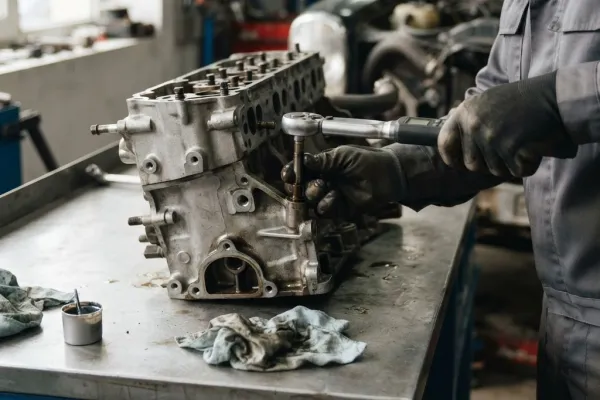
One of the most overlooked variables is whether the spec calls for dry or lubricated threads. Get this backwards, and you're effectively aiming blind.
Dry torque means the threads are clean, free of oil, anti-seize, thread locker, or any other lubricant. The friction between clean threads is higher, so you need more torque to achieve the same bolt stretch. Most factory service manuals assume dry threads unless stated otherwise.
Wet torque means the threads are lubricated with oil, anti-seize compound, or thread locker. Because lubrication reduces friction, the bolt stretches more with less applied torque. A wet spec is always lower than the dry spec for the same bolt.
Here's the problem. Anti-seize is common on spark plugs and oxygen sensor threads. If the manual says 20 ft-lbs dry and you add anti-seize without reducing the torque, you could be applying the equivalent of 26 to 28 ft-lbs of effective clamping force.
That's plenty to crack a spark plug insulator in an aluminum head.
The reverse happens with thread locker. Medium-strength thread locker like Loctite 242 typically acts as a mild lubricant during installation. Reduce your torque by about 10 percent from the dry spec.
Permanent compounds like Loctite 271 increase friction, so you might need to stay at dry spec or go slightly higher.
If the manual doesn't specify wet or dry, assume dry. If you must add lubrication because the threads are corroded or you're reusing an old bolt, reduce your target torque by 15 to 20 percent and mark the bolt for replacement next time.
The Most Common Torque Specs Every DIYer Needs
You don't need to memorize a thousand numbers. You need the five or six that keep your car safe and leak-free.
Lug Nuts
Lug nut torque varies more than people expect. A compact car like a Honda Civic typically takes 80 ft-lbs. A full-size pickup like a Ford F-150 needs 140 to 160 ft-lbs.
Heavy-duty trucks with 1-inch studs can go up to 180 or even 200 ft-lbs.
The real issue isn't the number. It's consistency. Lug nuts should always be tightened in a star pattern, alternating across the wheel, never in a circle.
That prevents the rotor from warping and ensures even clamping. After 50 miles of driving, every single lug nut should be rechecked.
Never use an impact gun for final tightening. Impact guns are not torque-controlled. Use the impact gun to run the nut down to snug, then finish with a torque wrench.
Oil Drain Plug
The oil drain plug is the most commonly overtightened fastener on any car. People crank it down because they're terrified of leaks. But the oil pan is typically stamped steel or cast aluminum.
Aluminum pans strip easily. Steel pans can crack around the weld nut.
Most drain plugs spec between 18 and 35 ft-lbs. That's not very tight. A typical drain plug uses a crush washer that deforms to create the seal.
Overtightening crushes the washer flat, then starts stressing the pan threads. Replace the crush washer every time.
Spark Plugs
Spark plugs are deceptively fragile. The ceramic insulator can crack from slight overtightening, and you won't notice until the plug misfires under load. Aluminum cylinder heads compound the problem because they expand more than the steel plug when hot.
Specs vary by plug design and head material. Typical range is 15 to 30 ft-lbs for aluminum heads and 20 to 40 for cast iron. Tapered seat plugs generally need less torque than gasketed plugs.
If you're using anti-seize, reduce the torque by about 10 percent. Never torque a spark plug into a hot engine.
Brake Caliper Brackets
Most DIYers remember to torque the lug nuts. Many forget that caliper bracket bolts are just as safety-critical. These bolts hold the entire braking assembly to the steering knuckle, and they see intense heat cycling and vibration.
Caliper bracket bolts typically range from 70 to 110 ft-lbs. Some German cars use torque-to-yield bolts that must be replaced, not reused. If the bolt has a stretch section visible near the head, replace it.
Wire brush the threads clean before installing. Dirt or rust on the threads can give a false torque reading.
Torque-to-Yield Bolts: Why You Can't Just Reuse Them
Some bolts are designed to stretch permanently during installation. These are called torque-to-yield or TTY bolts. They're common on cylinder heads, main bearing caps, and some brake caliper brackets.
A standard bolt works in its elastic range. You tighten it, it stretches, and when you loosen it, it springs back. A TTY bolt is tightened past its elastic limit into the plastic deformation zone.
It stretches and stays stretched. That permanent stretch creates a more consistent clamping force across the joint.
The problem is you can only stretch a TTY bolt once. After removal, it's shorter and weaker than spec. Reusing it risks the bolt snapping under load or failing to maintain clamping force as the engine heats and cools.
You can identify TTY bolts by appearance. They often have a narrow unthreaded section near the head, a flanged head design, or a hex key socket instead of a standard hex head. But the only reliable way is the service manual.
If the procedure says "torque to XX ft-lbs plus XX degrees," you're dealing with TTY bolts. Replace them.
A set of head bolts for a four-cylinder engine costs 30 to 60 dollars. Skipping that replacement runs the risk of a blown head gasket. That repair costs 1,000 to 2,500 dollars.
The math is straightforward.
Bolt Grades Decoded
Not all bolts are the same. A Grade 5 bolt and a Grade 8 bolt of the exact same size have wildly different torque capacities. Use the wrong one, and you risk failure.
Bolt grades are stamped on the head. For imperial bolts, look for radial lines. A Grade 5 bolt has three lines.
A Grade 8 bolt has six lines. No lines usually means Grade 2, which is the lowest strength and should never be used for automotive structural fasteners.
Metric bolts use a different system. A class 10.9 bolt has the number 10.9 stamped on the head. Class 12.9 is stronger.
Class 8.8 is roughly equivalent to Grade 5. Class 10.9 is roughly equivalent to Grade 8.
Never substitute a lower grade bolt in a safety-critical location. If the factory used Grade 8, you use Grade 8 or higher. Going up one grade is usually safe.
Going down is asking for trouble. The only exception is when the bolt is designed as a weak point. Some suspension components use a specific bolt meant to shear under extreme load.
Replacing those with stronger bolts transfers the failure point somewhere worse.
How to Use a Torque Wrench Correctly
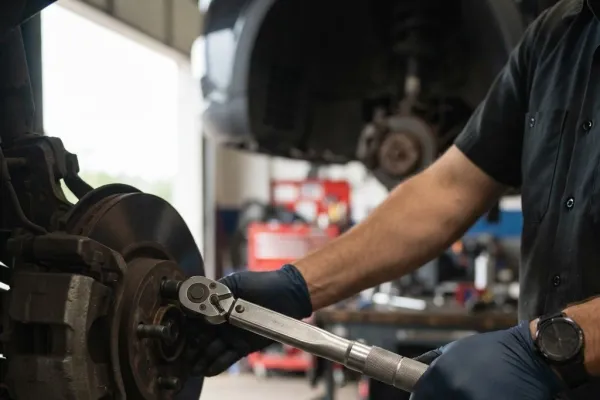
A torque wrench is only as good as the person using it. Incorrect technique is the leading cause of torque errors among DIY mechanics.
Setting a Click-Type Wrench
Click-type wrenches are the most common and the most commonly misused. Always set the wrench to the lowest value on its range before storing it. Leaving it set at 80 foot-pounds compresses the internal spring and causes calibration drift over time.
When setting a click wrench, turn the handle until the desired number lines up with the zero line on the shaft. Never force the handle past its stop. If you overshoot, back it down and come up again.
Pull the wrench smoothly. Never jerk it. A fast, hard pull can overshoot the click by several foot-pounds.
A steady motion that takes about one second per turn is ideal. When the click comes, stop immediately.
Using Extensions and Universal Joints
A crow's foot at a 90-degree angle to the wrench handle doesn't change the effective length. No adjustment is needed. If you add it inline, extending the handle, you need to recalculate.
Socket extensions have minimal effect on straight pulls. The longer the extension, the more the shaft twists before the socket turns. This stores energy like a spring.
For critical fasteners, avoid long extensions.
Torquing in Stages
Any fastener that seals a gasket or clamps a large part needs a staged process. Cylinder heads, intake manifolds, valve covers, and oil pans all fall into this category.
A simple two-stage process works for most non-critical fasteners. First pass to 50 percent of final torque. Second pass to 100 percent.
This lets the gasket compress evenly.
The tightening pattern matters. Circumference fasteners like valve covers need a crisscross pattern. Start in the middle and work outward in alternating diagonals.
Never tighten in a circle. For rectangular parts like intake manifolds, start in the center and work outward to the edges.
The Mistakes That Cost Real Money
Some mistakes are expensive because they're subtle. You don't know you made them until the part fails.
Stripped oil pan threads are the most common. A helicoil repair costs 20 to 50 dollars in parts and takes an hour. Replacing the entire oil pan costs 150 to 500 dollars plus labor.
The difference is 30 foot-pounds versus 40 foot-pounds on a drain plug that only needed 22.
Warped brake rotors happen when lug nuts are tightened unevenly. One tight lug and three loose ones pull the rotor into a slight cone shape. The first time you brake hard, you feel a pulse through the pedal.
Rotor resurfacing or replacement costs 100 to 300 dollars per axle. Using a torque wrench and a star pattern costs nothing extra.
Cracked spark plug insulators are invisible until the plug misfires. The crack causes a misfire under load, and you end up chasing fuel system issues for weeks before checking the plugs. A set of spark plugs is cheap.
The diagnostic time is not.
Blown head gaskets from reused TTY bolts are the king of expensive mistakes. The bolts seem fine. They're not fine.
They've already stretched to their plastic limit. Reusing them guarantees the gasket fails eventually. The repair bill is 1,500 to 3,000 dollars depending on the engine.
Stripped caliper bracket threads are a safety nightmare. The bolt feels tight but isn't gripping properly. Weeks later it backs out under vibration.
You lose braking on that corner. If you suspect thread damage during installation, install a helicoil immediately.
What to Do When You Don't Have the Factory Spec
You're at a friend's driveway with a borrowed wrench and no service manual. What do you do?
First, check the online database. Most manufacturers publish torque specs through their service information websites. This is safer than any generic chart.
If you can't find the exact spec, use a generic torque chart based on bolt grade and diameter as a last resort. These charts are approximations. They assume clean, dry threads and average materials.
They do not account for aluminum threads, gasket types, or torque-to-yield requirements.
Here's a rough reference for common fasteners without specs:
| Fastener Type | Typical Range (ft-lbs) | Notes |
|---|---|---|
| M8 bolt, Grade 8 | 18-22 | Small brackets, sensors |
| M10 bolt, Grade 8 | 35-45 | Medium brackets, engine covers |
| M12 bolt, Grade 8 | 60-75 | Suspension arms, control links |
| M14 bolt, Grade 8 | 85-100 | Strut tops, large brackets |
For fasteners into aluminum, reduce these numbers by 20 percent. For fasteners with Loctite, reduce by 10 percent. For torque-to-yield joints, do not guess.
Find the spec.
Another trick: look for torque stickers. Many cars have them on the sun visor, inside the fuel door, or under the hood for common specs like lug nuts.
When to Recheck Torque
Torque settles. It's not a set-it-and-forget-it measurement. The clamping force from a torqued fastener gradually relaxes as the joint components compress and seat.
Wheel lug nuts are the most important recheck. Drive 50 to 100 miles after installation, then retorque every lug nut. You will find one or two that lost 5 to 10 foot-pounds.
This is normal.
Suspension bolts should be retorqued after the first alignment or after 500 miles. The bushings settle and the control arm position shifts slightly. Tightening with the suspension loaded gives a more accurate reading.
Engine component bolts like valve covers and manifolds should be retorqued after one heat cycle. The gasket compresses and the aluminum expands. Let the engine cool completely, then hit the bolts again.
For TTY bolts, do not retorque. They are designed for a single stretch cycle. If a TTY joint leaks or loosens, the bolt must be replaced.
The Complete Torque Spec Cheat Sheet

You need quick numbers. This covers the fasteners you'll touch most often.
| Application | Typical Range (ft-lbs) | Notes |
|---|---|---|
| Wheel lug nuts (compact) | 80-100 | Recheck after 50 miles |
| Wheel lug nuts (SUV/truck) | 140-180 | Verify with vehicle-specific spec |
| Oil drain plug | 18-35 | Replace crush washer each time |
| Spark plugs (aluminum head) | 15-30 | Reduce 10% if using anti-seize |
| Brake caliper bracket bolts | 70-110 | Common on most passenger vehicles |
| Valve cover bolts | 5-10 in-lbs or very light | Use inch-pound wrench |
| Transmission pan bolts | 8-12 | Small bolts into aluminum |
| Strut top nut | 35-55 | Check thread diameter |
For bolts not listed here, use the grade and diameter chart above. And when in doubt, spend the five minutes finding the factory spec.
Tools That Actually Help
You don't need a full toolbox of specialty tools. But a few make the difference between a job done once and a job done twice.
A click-type torque wrench in 1/2-inch drive handles 90 percent of automotive work. A 1/4-inch drive for inch-pounds covers the small stuff. If you only buy one, make it a name brand with a calibration certificate per ISO 6789.
An angle gauge is necessary for torque-to-yield bolts. It clips onto the wrench and measures degrees of rotation after the initial torque. Costs about 20 dollars.
Thread chasers clean rust and dirt from threads without cutting new material. They restore accurate torque readings. Never use a tap as a chaser on an existing thread.
Taps cut material. Chasers just clean.
A torque stick for your impact gun is not a substitute for a torque wrench. It's a limiter that prevents gross overtightening during initial assembly. You still need to finish with a hand wrench.
Final Take
The most dangerous phrase in any garage is "that feels about right." Common torque specifications for cars are not trade secrets. They are published in every factory service manual and many aftermarket databases. The discipline is in looking them up before you pick up the wrench.
Build a habit. Before you touch a bolt, find the spec. Keep a phone with internet access or a printed chart in your toolbox.
It takes ten seconds and it prevents a four-hour repair.
The real skill isn't remembering that a Honda Civic lug nut is 80 foot-pounds. It's knowing that the previous person might have cross-threaded it, that the stud could be rusty, and that you should chase the threads and back the spec off 10 percent because you used anti-seize. That's the difference between a mechanic and someone who owns a torque wrench.
Frequently Asked Questions
Can I use an impact gun to torque lug nuts?
No. Impact guns are not torque controlled. Use one to run the nut down to snug, then finish with a hand torque wrench.
Impact guns routinely overtighten by 20 to 40 percent.
Do I really need to replace torque-to-yield bolts?
Yes. TTY bolts stretch permanently during installation. Reusing them means they cannot generate the required clamping force.
This leads to head gasket failure, main bearing cap loosening, or caliper bracket failure.
What happens if I overtighten an oil drain plug?
You strip the threads in the oil pan. The fix is a helicoil insert or a replacement pan. On many modern cars, the pan is aluminum and cannot be repaired easily.
Prevention costs nothing.
Is a torque wrench accurate forever?
No. Drop it once and the calibration can shift. Per ISO 6789, wrenches should be recalibrated annually or every 5,000 cycles.
If your wrench sat in a toolbox for two years, get it checked.
Why does my torque spec chart say something different from the manual?
Generic charts use averages. Your factory manual was written for that specific engine, that specific gasket, and that specific bolt material. Always trust the manual over a general chart, especially for safety-critical or gasket-sealing fasteners.
