


Most people don't realize their torque wrench has been lying to them for years.
You've probably heard that annoying little click, felt confident, and moved on. That click might have been off by 10, 15, even 20 percent. Torque Wrench Accuracy Explained starts with a hard truth: accuracy isn't about what brand you bought or how much you spent.
It's about understanding how these tools actually work and where they go wrong. A $150 click wrench can drift far past its rated ±4 percent tolerance after a single drop or a year of bad storage habits.
Per ASME B107.300 testing standards, a wrench that passes factory calibration can fail field verification within months. Let's dig into why that happens and what you can actually do about it.
Quick Answer

Torque wrench accuracy means how close the tool's reading matches true applied torque. It's stated as a percentage, usually ±4 percent for consumer wrenches and ±2 percent for professional models. Accuracy degrades with drops, misuse, and improper storage.
Calibration checks every 12 months catch drift. Your technique matters more than the tool's spec.
Why Torque Wrench Accuracy Actually Matters (More Than You Think)
A fastener's job is to clamp two parts together with a specific amount of force. Too little force and the joint loosens under vibration. Too much force and you stretch the bolt past its yield point, strip threads, or crack the component.
Both outcomes can be expensive and dangerous.
Think about your car's lug nuts. Under-torqued, they work loose and you lose a wheel at highway speed. Over-torqued, you warp the brake rotor or snap a stud.
Engine cylinder heads are even pickier. A head gasket needs uniform clamping across a dozen or more fasteners. If one bolt is 10 percent low and another is 10 percent high, the gasket fails under heat and pressure.
ASME B107.300 is the standard most US-made torque wrenches follow. It sets the accuracy tolerance and testing procedure. Wrenches that pass are stamped or certified.
But that certification reflects the moment it left the factory. What happens in your garage over the next year is entirely on you.
Aviation mechanics follow FAA-regulated torque procedures with calibrated tools every time. Industrial maintenance crews do the same for pressure vessels and structural joints. Home mechanics tend to treat their torque wrench as a permanent tool that never needs attention.
That assumption is the problem.
What "±4% Accuracy" Really Means
A ±4 percent accuracy rating means the wrench can be off by up to 4 percent in either direction across its usable range. If you set it to 50 foot-pounds, the actual torque could be anywhere from 48 to 52 foot-pounds. That's an 8 foot-pound window.
Now watch what happens at the low end of the scale. Most wrenches are only accurate between 20 and 100 percent of their maximum rating. A 250 foot-pound wrench at 20 foot-pounds?
You're operating in the dead zone. Accuracy can be off by 10, 15, even 20 percent in that bottom range.
Check the numbers on your wrench handle. If it says 10 to 150 foot-pounds, don't trust it below 30. That's the real usable range.
For smaller fasteners, you need a smaller wrench.
Here's what different accuracy specs look like in practice:
| Accuracy Spec | At 100 ft-lb Target | At 50 ft-lb Target | At 20 ft-lb Target |
|---|---|---|---|
| ±4% (consumer click) | 96–104 ft-lb | 48–52 ft-lb | Likely ±8% or worse |
| ±2% (pro click/beam) | 98–102 ft-lb | 49–51 ft-lb | ±3% if in usable range |
| ±1% (digital/precision) | 99–101 ft-lb | 49.5–50.5 ft-lb | ±1% if calibrated at that point |
The Three Types of Torque Wrench and How Accurate They Actually Are
Not all torque wrenches use the same mechanism. The design determines how accuracy holds up over time.
Click Wrenches (Micrometer Type)
This is what most people own. You twist the handle to set the value, then pull until you hear a click. Inside is a spring that compresses to a preset tension.
When the force matches that tension, the mechanism releases and the head clicks.
The weakness is the spring. Springs fatigue over time. They weaken through use, especially if you leave the wrench set at a high value for storage.
A fatigued spring clicks earlier than it should. You get less torque than you think.
Click wrenches are also vulnerable to internal contamination. Dust, grit, or moisture inside the mechanism changes the friction point. One drop onto concrete can knock internal components out of alignment.
Accuracy range: ±4 percent for consumer models, ±2 percent for professional models.
Best for: General automotive work where ±4 percent is acceptable.
Beam Wrenches
The simplest design. A long beam flexes as you apply force. A smaller pointer beam stays straight.
The gap between them shows your torque value on a scale.
No springs. No internal parts to contaminate. A beam wrench is accurate until you physically bend it.
The tradeoff is readability. You have to look at the scale while pulling, which is awkward in tight engine bays.
Accuracy range: ±2 to ±3 percent, and it stays there consistently.
Best for: Someone who wants reliability over convenience. Good for infrequent use.
Digital Torque Wrenches
A strain gauge measures the actual bending force and displays the reading on a screen. No springs involved. Digital wrenches offer features like peak hold, angle measurement, and multiple unit settings.
The catch is electronics. Batteries die. Sensors can drift with temperature extremes.
A low battery can give false readings without warning.
Accuracy range: ±1 to ±2 percent.
Best for: Professional work where ±1 percent matters and you're willing to replace batteries regularly.
Click Wrenches: The Most Popular, The Most Misunderstood
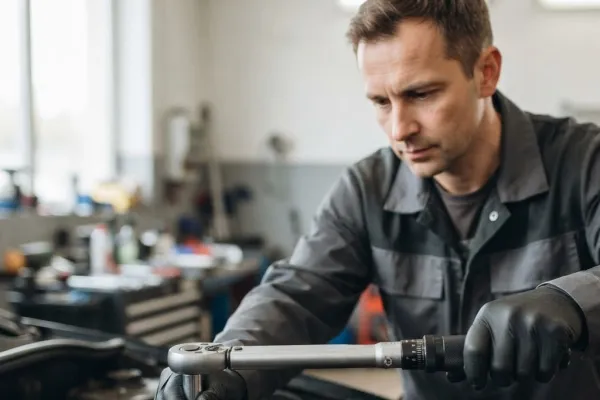
The biggest misunderstanding is how the click mechanism works. You're not supposed to crank the handle down to 150 foot-pounds and leave it there for months. That constant spring compression accelerates fatigue.
Manufacturer documentation from Proto and Snap-on both recommend storing click wrenches at the lowest setting. For micrometer-style wrenches, that means winding the handle all the way down until the spring is relaxed. Split-beam designs can be stored at any setting because the mechanism works differently.
Here are the common click wrench problems:
- Storage at high setting: Spring stays compressed, loses tension, wrench clicks early.
- Using the wrench as a breaker bar: Using one to loosen rusted bolts shocks the internal mechanism.
- Dropping the wrench: Even a single drop can shift internal components.
- Clicking multiple times: That extra 5 degrees can over-torque by 15 to 20 percent.
The split-beam design avoids the spring fatigue issue entirely. It uses a flexing beam that doesn't stay under tension at any setting. That's why aviation mechanics favor them.
Beam Wrenches: Old School, Unkillable, and Surprisingly Reliable
Beam wrenches don't get much love in the modern garage. They look primitive compared to digital screens. But they have one killer feature: they don't drift.
A beam wrench works on pure mechanical deflection. You pull, the beam bends, the pointer stays straight, and you read the gap. There's no spring to fatigue, no gear to slip, no battery to die.
If it was accurate when you bought it, it's still accurate ten years later.
That durability makes beam wrenches the go-to for people who use a torque wrench twice a year. You can toss it in a drawer and pull it out for a brake job confident it's still right.
The downsides are real though. Reading the scale requires looking at the tool while applying force. That's easy on an open bench.
It's nearly impossible when your face is against a fender liner.
Accuracy on a beam wrench typically runs ±2 to ±3 percent across the full scale. That's because there's no spring creating a nonlinear response at low settings.
Best application? Anything where access allows you to see the scale and you want a tool that stays accurate without annual calibration.
Digital Torque Wrenches: Fancy Screens Don't Fix Bad Technique
Digital torque wrenches look like the future. They beep, they flash, they store data. It's easy to assume a $200 digital wrench with a calibration certificate is perfect forever.
It's not.
Digital wrenches use a strain gauge that changes electrical resistance when stretched. Strain gauges are accurate, but they're sensitive to a few things that mechanical wrenches handle better.
Temperature is the biggest enemy. Extreme heat or cold can shift the zero point. A digital wrench that reads perfect in a 70 degree shop might be off by 2 percent in a 40 degree garage.
Battery level matters more than you'd think. As voltage drops, the electronics compensate in ways that affect measurement accuracy. Always replace batteries before a critical job.
Drop sensitivity is worse than click wrenches. A strain gauge can be damaged by a hard impact without showing any visible damage. The only way to know is to test it.
Here's when a digital wrench makes sense:
- Angle-critical fasteners: Digital with angle measurement saves you from buying a separate gauge.
- Data logging: Some shops need recorded torque values for quality assurance.
- Multiple unit needs: Switching between foot-pounds, inch-pounds, and newton-meters is easy.
For the average home mechanic, a digital wrench is a luxury. A quality beam or split-click wrench will serve you better for less money.
The #1 Thing Destroying Your Torque Wrench Accuracy
Age alone doesn't ruin a torque wrench. A quality tool from the 1980s that's been stored correctly can still be within spec today. The thing that destroys accuracy fastest is how you store it.
If you own a click-type micrometer wrench and leave it set at 100 foot-pounds between uses, you're actively degrading the spring. That constant compression creates metal fatigue. Over six months of storage at high setting, a typical spring can drift by 2 to 3 percent.
The fix is trivial. Wind the handle all the way down to the lowest setting before you put it away. For most micrometer wrenches, that means turning the handle counterclockwise until it stops.
Split-beam wrenches don't have this problem. Their adjustment mechanism doesn't tension the main spring. That's why aviation mechanics use them.
Other storage mistakes:
- Tossing it in a toolbox with heavy tools: Impact wrenches and hammers bouncing against a torque wrench can knock internal components out of alignment.
- Leaving it in a hot car: Heat accelerates spring fatigue and can warp plastic components on digital models.
- Humid environments without protection: Rust inside a beam or click mechanism introduces friction that changes the release point.
Your Technique Is Screwing Up Your Readings More Than the Tool
According to calibration service data, roughly 70 percent of torque wrenches that fail a verification check are actually fine. The operator's technique caused the error.
How you pull matters more than the wrench's spec. A smooth, steady pull at a consistent speed gives repeatable readings. A jerky motion or a fast yank can overshoot the target by 10 percent or more.
The most common bad habit is "click seeking." You pull slowly, hear the click, then pull just a tiny bit more to confirm. That extra quarter turn can add 15 to 20 percent more force.
Here are the four technique rules that matter most:
- Pull smooth and steady. No jerky starts or abrupt stops.
- Pull at the same speed every time. Consistent speed equals consistent results.
- Stop at the first click. Do not reset and pull again.
- Use both hands on high-torque settings. This keeps the wrench square to the fastener.
Side loading is a silent killer. If you pull at an angle, the wrench reads the force component along its axis. You end up at the right number on the scale but the fastener gets less torque.
Always pull perpendicular to the wrench handle.
How Often Should You Actually Calibrate?
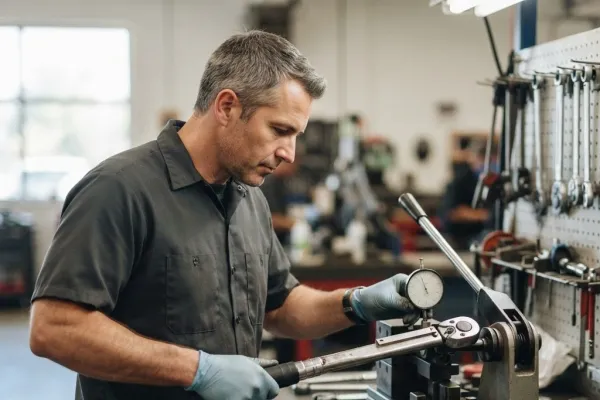
Manufacturers say every 12 months or every 5,000 cycles. That's the conservative answer. The real answer depends on how you use the tool.
If you're a home mechanic who uses a torque wrench twice a year for lug nuts, annual calibration is overkill. A beam wrench might never need calibration. A click wrench that's stored properly might hold its spec for years.
But here's the painful part. You don't know if it's still accurate unless you check it.
The smart approach is a condition-based schedule:
- Every 12 months: Professional shops, aviation mechanics, anyone with safety-critical fasteners.
- Every 24 months: Dedicated home mechanics who use the tool several times a month.
- After any drop: Get a verification check.
- Never, unless damaged: Beam wrenches. Just check that the pointer returns to zero.
Field verification costs less than full recalibration. You can buy a simple torque tester for under $100. Check your wrench at 20, 50, and 80 percent of its range.
If it's within spec at all three, you're good.
Recalibration typically costs $25 to $75 for a single wrench. Compare that to the cost of a blown head gasket or a lost wheel.
The $30 Wrench vs. The $300 Wrench
You don't always need professional-grade accuracy. Here's the honest breakdown.
A $30 beam wrench from a hardware store is often surprisingly accurate. The mechanism is simple. Verified buyer feedback shows they consistently hit within ±3 percent of spec.
That's enough for 90 percent of automotive work.
A $30 click wrench is a different story. The internal spring is cheap. Aggregate reviews show these wrenches can be off by 10 percent or more straight out of the box.
Here's when cheap works:
- Lug nuts on a daily driver: ±5 percent is fine.
- Non-critical suspension bolts: Control arms, sway bar links.
- Lawn equipment and small engines: Low torque values on accessible fasteners.
Here's when you need the good stuff:
- Cylinder head bolts: ±2 percent or better required.
- Aviation or marine fasteners: Safety always.
- Carbon fiber components on bicycles: Over-torque by 10 percent and crack a $500 frame.
- Precision assembly work: Anything below 20 foot-pounds on a large-range wrench.
The sweet spot for most home mechanics is a quality beam or split-beam click wrench in the $80 to $150 range. That buys ±2 to ±3 percent accuracy that holds for years.
The Fastener Factor: Why Threads, Lube, and Surface Rust Change Everything
Your torque wrench measures rotational force. What you actually care about is clamping force. Those two things are not the same number.
Friction eats up a huge percentage of the torque you apply. A typical threaded fastener converts only 10 to 20 percent of applied torque into actual clamping force. The rest is lost to friction under the head and in the threads.
This is why lubricant matters so much. A dry thread and a lubricated thread at the same torque setting produce wildly different clamp loads. Oil reduces friction, so more of your torque goes into stretching the bolt.
A fastener torqued to 80 foot-pounds dry might clamp at 4,000 pounds. The same bolt with oil at the same 80 foot-pounds could clamp at 6,000 pounds.
Manufacturer torque specs assume a specific condition. Some assume dry threads. Some assume lightly oiled.
Always check the service manual for the exact requirement.
Surface rust adds another variable. Rust increases friction dramatically. A rusty bolt at 80 foot-pounds might clamp less than a clean bolt at 60 foot-pounds.
Clean and chase threads before torquing to spec.
The rule from SAE International standards is simple. Follow the manufacturer's specification for thread condition. If they say dry, clean the threads and torque dry.
If they say oiled, apply a light machine oil. If they say torque-to-yield, follow the angle procedure exactly.
How to Field-Check Your Torque Wrench Without Spending a Dime
You can verify a torque wrench with nothing more than a known weight and a ruler. This won't give certified calibration, but it will catch major drift.
The method is leverage. One foot of handle length with one pound of force equals one foot-pound of torque.
Here's the process:
- Clamp the torque wrench drive in a vise. The handle should be horizontal.
- Measure the exact distance from the center of the drive square to where you'll hang the weight. Write this in inches.
- Convert your target torque to inch-pounds. Multiply foot-pounds by 12.
- Divide the inch-pounds by the handle length in inches. That's the weight in pounds you need to hang.
- Hang that weight from the measured point. Slowly lower it. Listen for the click.
If the click happens right when the weight is fully applied, the wrench is close. If it clicks early, the wrench is reading low. If it doesn't click at all, it's reading high.
Say you want to check 50 foot-pounds on a wrench with an 18-inch handle. That's 600 inch-pounds divided by 18 inches. You need 33.3 pounds.
A 35-pound dumbbell plate works.
This method is accurate to about ±3 percent if you measure carefully. Do this test annually or after any drop.
If you find a consistent error, note the offset. Adjust your target setting by that offset until you can get the wrench recalibrated. Write the correction on the handle with a paint marker.
The Proper Way to Store and Handle a Torque Wrench
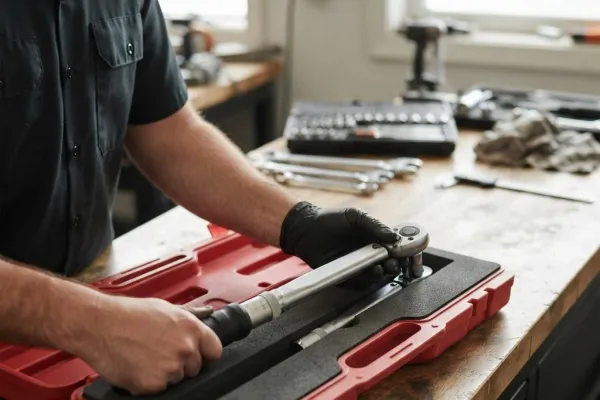
Keep your torque wrench in its own padded case or a dedicated tool drawer slot. Never let it rattle against other tools. The internal mechanism is precise enough that repeated impacts from loose sockets can shift calibration.
Temperature matters too. Avoid leaving a torque wrench in a vehicle during summer or freezing winter conditions. Rapid temperature swings can cause internal condensation, especially in digital models.
For digital wrenches, remove the battery if you won't use the tool for several months. Leaked battery acid destroys the electronics. Keep the storage area dry to prevent corrosion on exposed metal parts.
Common Mistakes That Make a Perfectly Good Wrench Give Bad Readings
The most common mistake is using a torque wrench to loosen fasteners. A breaker bar costs $20. A torque wrench costs more and takes permanent damage every time you use it for breaking rust.
Another frequent error is leaving the wrench set to a value after use. A click wrench stored at 100 foot-pounds for a month has already started drifting. Always reset to the minimum setting before putting it away.
Mixing unit systems without converting correctly causes problems too. A 50 newton-meter spec is not the same as 50 foot-pounds. The difference is about 37 percent.
Always confirm which unit your service manual uses.
Using an extension or adapter changes the effective length and can affect accuracy. A crowfoot wrench adapter adds length that changes the torque value at the fastener. Keep adapters at 90 degrees to minimize error.
Quick Reference: Accuracy Rules for Common Jobs
Lug nuts on passenger vehicles. Set to manufacturer spec, usually 80 to 100 foot-pounds. Pull smooth to the first click.
A ±4 percent wrench works fine.
Spark plugs. Torque spec is often 15 to 25 foot-pounds. Use a smaller wrench rated for that range.
A 250 foot-pound wrench at 20 foot-pounds is in its dead zone.
Cylinder head bolts. Use a ±2 percent or better wrench. Follow the torque sequence and angle procedure exactly.
Oil drain plugs. Typically 20 to 30 foot-pounds. Hand tighten with a regular ratchet and give it a quarter turn past snug.
Brake caliper bolts. Usually 25 to 40 foot-pounds. A ±4 percent wrench in the right size range works fine.
Suspension bolts. Torque spec ranges from 50 to 150 foot-pounds. Use the correct range wrench and tighten with the vehicle's weight on the ground.
When to Send It Out vs. When to Buy New
If your wrench costs under $50, replacement is cheaper than professional recalibration. A new budget wrench runs $30 to $40. Calibration service costs $25 to $75 plus shipping.
For wrenches over $100, calibration is worth it. Most calibration shops will clean, adjust, and certify the tool for $50 to $100.
If you drop any wrench regardless of price, get it checked. A drop can knock internal components out of alignment without visible damage. The field check method will tell you if it survived.
For digital wrenches, check the manufacturer's recalibration policy first. Some require return to the factory. Others accept third-party calibration.
Frequently Asked Questions
Can I calibrate my torque wrench at home?
You can field-check it using the weight and lever method. This verifies accuracy within about ±3 percent. True calibration requires specialized equipment.
Home verification catches major drift. Professional calibration is required for certification.
How long does a torque wrench stay accurate?
A beam wrench can stay accurate indefinitely if not physically bent. A quality click wrench stored correctly holds spec for 3 to 5 years. Cheap click wrenches may drift within the first year.
Annual checks catch problems early.
What is the difference between verification and calibration?
Verification checks whether the wrench reads correctly at specific test points. Calibration measures the error across the full range and adjusts the mechanism to bring it within spec. Verification tells you if there's a problem.
Calibration fixes it.
Should I buy a beam or click torque wrench?
Buy a beam wrench for infrequent use where reliability matters more than convenience. Buy a quality click wrench for regular automotive work where you need quick settings. Buy a digital wrench only if you need angle measurement or data recording.
Does using an extension affect torque accuracy?
A standard extension at 90 degrees to the wrench handle has minimal effect. A crowfoot adapter or any extension that changes the lever arm length introduces error. Apply a correction factor from the manufacturer or keep adapters perpendicular to the handle.
