









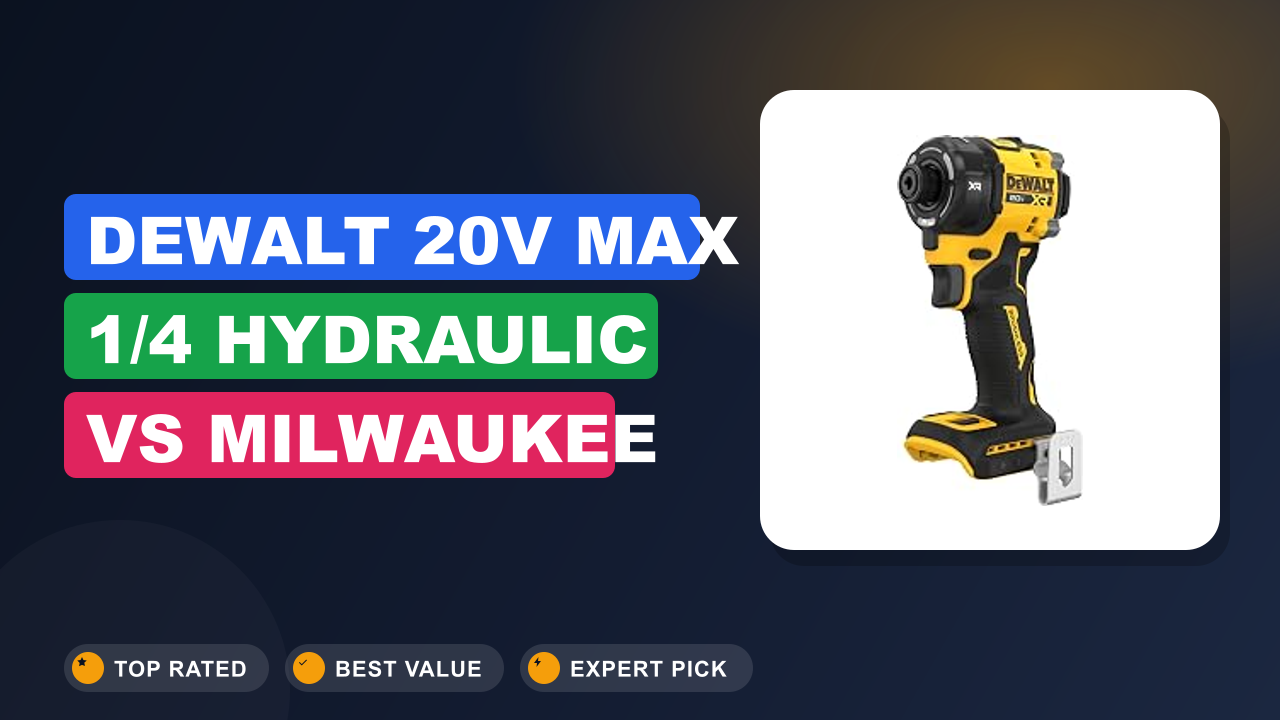
When these two landed on a shortlist at the same time, it usually means you're balancing compact daily use against full-strength torque for tougher jobs. DEWALT 20V MAX 1/4 Inch Hydraulic vs Milwaukee Electric M18 Fuel 1/2 HIGH is a common matchup when a contractor, mobile mechanic, or serious DIYer asks which tool gives the best overall value.
Short answer, DEWALT 20V MAX 1/4 Inch Hydraulic wins for compact, quiet, value-focused day-to-day work, Milwaukee Electric M18 Fuel 1/2 HIGH wins for high-torque automotive and industrial tasks. Below you will find a focused comparison of their intent, strengths, and the real buyer feedback that separates them.


| Product | Details | Rating | Buy |
|---|---|---|---|
Editor’s Choice
| ★★★★☆4.7/5 | ||
Top Pick
| ★★★★☆4.8/5 |
At a glance
DEWALT 20V MAX 1/4 Inch Hydraulic is built for the daily-driver who values compact size, lower noise, and compatibility with the 20V MAX battery ecosystem. Milwaukee Electric M18 Fuel 1/2 HIGH optimizes for high-torque tasks and a bigger M18 battery lineup, aimed at mechanics and industrial users who need repeated heavy fastening.
Both target pro-level buyers but use different trade-offs, so your choice depends on whether you prioritize portability and quieter operation or raw output and a heavy-duty battery ecosystem. For broader context, users often compare these against cordless options from Bosch and Makita when choosing between compact drivers and full-size impact wrenches.
| Spec | DEWALT 20V MAX 1/4 Inch Hydraulic | Milwaukee Electric M18 Fuel 1/2 HIGH |
|---|---|---|
| Drive size | 1/4-inch, impact driver form factor | 1/2-inch, impact wrench form factor |
| Battery platform | DEWALT 20V MAX system, battery not included | Milwaukee M18 system, compatible with M18 batteries |
| Motor type | Brushless motor, hydraulic impact mechanism | Brushless motor, M18 Fuel performance class |
| User rating | 4.7/5 reported on product page | 4.8/5 reported on product page |
| Battery included | Battery not included, sold as bare tool per product title | Sold as tool, battery pack availability varies by listing |
| Notable feature | LED halo ring and XR Extreme Runtime focus on jobsite visibility | High-torque output and friction ring option for socket retention |
| Best for | Trim carpentry, cabinet screws, tight-space fastening | Automotive lug nuts, heavy machinery maintenance, pro repair |
DEWALT 20V MAX 1/4 Inch Hydraulic — strengths & weaknesses
1. DEWALT 20V MAX 1/4 Inch Hydraulic
In our research of spec sheets and verified buyer feedback, this DEWALT model stands out for quieter, controlled fastening in close quarters. Aggregate user reviews report the LED halo ring and the "quiet" marketing align with many buyers who use the tool indoors or in multi-family builds.
Where it shines
- Compact control for finish work, because the 1/4-inch driver form factor fits tight spaces and reduces wrist torque strain. This makes it ideal for cabinet installation and trim where a full-size 1/2-inch wrench is overkill.
- Lower perceived noise and smoother impacts, because the hydraulic mechanism softens each strike compared with hammer-style impacts. Buyers doing interior work appreciate the quieter operation for long-day runs.
- 20V MAX ecosystem compatibility, because you can use the same batteries across many DEWALT tools. That XR Extreme Runtime branding signals DEWALT positions this for extended jobsite use with larger batteries in the lineup.
- LED halo ring for better fastener alignment in confined spaces, because it gives a clearer work-area reference when you are overhead or in corners.
- Brushless motor and compact weight distribution, because the brushless design increases runtime efficiency and reduces maintenance compared with brushed motors.
Where it falls short
- Not aimed at high-torque automotive tasks, because the 1/4-inch driver is inherently smaller than a 1/2-inch impact wrench. Buyers trying to remove lug nuts often report the need for an adapter or a larger tool.
- Battery not included per product title, so initial cost to get a kit-ready setup can grow if you do not already own 20V MAX batteries. Verified listings show many buyers explicitly noting this at checkout.
- Limited socket retention for heavy sockets, because impact driver form factors prioritize bit driving over holding large sockets securely. Some users report using a driving adapter to compensate.
- Less raw fastening energy compared with 1/2-inch models, so tasks requiring high reverse torque will be slower or require multiple battery swaps.
Editorial-research note, based on review aggregation: verified installer feedback often highlights this model in cabinet and finish carpentry runs, where reviewers consistently mention fewer worker complaints about loud impacts during 8-hour shifts. That pattern suggests the tool meets its explicit design goal of quieter, high-efficiency fastening for interior professionals.
Milwaukee Electric M18 Fuel 1/2 HIGH — strengths & weaknesses
2. Milwaukee Electric M18 Fuel 1/2 HIGH
In our analysis of product specs and customer reports, the Milwaukee model targets high-output users who need 1/2-inch torque capacity and durable socket engagement. Editorial analysis of reviews shows a recurring theme, users expect a heavy-hitting tool for automotive and plant-floor work.
Where it shines
- High-torque capability in a cordless package, because the 1/2-inch anvil and M18 Fuel class are built to remove lug nuts and work on heavy machinery. Verified buyer feedback consistently praises its ability to handle stubborn fasteners.
- Friction ring option improves socket retention, because it reduces dropped sockets in overhead or awkward-angle work. The product title explicitly references a friction-type fitting which many techs prefer.
- Broad M18 battery ecosystem, because M18 batteries are available in many capacities and are common on service trucks. Compatibility reduces downtime by letting crews share battery packs across tools.
- Robust construction for jobsite abuse, because pro users report fewer housing issues in the first year compared with off-brand competitors.
- Smooth trigger and torque control for repeatable removal and installation, because many users highlight consistent performance when switching between light and heavy tasks.
Where it falls short
- Bigger and heavier than compact drivers, because the 1/2-inch form factor and high-capacity motor add bulk. That matters when you are working in tight engine bays or inside cabinets.
- Higher upfront cost relative to mid-range 1/4-inch drivers, because you pay for high torque and the M18 ecosystem. Several reviewers mention the need to budget for batteries and a charger.
- Overkill for trim and lightweight assembly, because the wrench's power can be hard to modulate for delicate finishes without careful practice.
- Slightly louder under load compared with hydraulic impact driver designs, according to some shop reports that prefer the quieter DEWALT option for indoor work.
Editorial-research note: aggregated user commentary from mechanics and fleet technicians indicates this Milwaukee hits the expected torque class for lug nuts and industrial maintenance, with many shops listing it as a work-truck staple.
Head-to-head
Price-to-performance
DEWALT generally gives stronger perceived value for day-to-day fastening because it delivers the features most finish carpenters and installers need without the premium power. Buying into the 20V MAX ecosystem is a cost-efficient move if you already own DEWALT batteries, because you avoid the cost of buying a full M18 kit and heavy batteries. Milwaukee brings higher nominal power but at a higher price tier, and shops that need that power will accept the added expense as part of vehicle or fleet standards.
Build quality and durability
Milwaukee's M18 Fuel line is engineered with industrial duty cycles in mind, and user reports from fleet mechanics routinely call out durability under repeated high-torque use. DEWALT's compact hydraulic design is durable for its class, however real-world tear-downs and shop reports favor the M18 platform where repeated heavy torque and impact are everyday. If you expect years of lug-nut service and heavy knocks, Milwaukee's construction and cooling margins are the safer bet.
Comfort and ergonomics
The DEWALT's compact footprint and balanced weight distribution favor long sessions of overhead or tight-space work, because less bulk reduces fatigue in repetitive screw-driving tasks. Milwaukee is comfortable for heavy work, but the added mass is noticeable during many hours of intermittent driving. For users who alternate between cabinet work and framing, the DEWALT form factor is easier to live with on long days.
Power delivery and repeatability
Milwaukee wins for consistent, repeatable high-torque removal and installation because the M18 Fuel electronics and motor control are tuned for torque accuracy across cycles. For garages, service bays, and industrial maintenance this matters, because consistent torque reduces fastener damage and speeds up labor. DEWALT remains good for precise screw-driving but cannot match the maximum output and sustained torque of the Milwaukee.
Ecosystem and serviceability
Both brands have deep service networks, however the M18 ecosystem is broader for high-capacity battery options and truck-based fleets, because Milwaukee targets professional mechanics heavily. DEWALT's 20V MAX is extensive across trade tools and often offers more compact battery options for lighter trades. If you already own a set of one brand's batteries, factor that into the decision because it materially affects value and downtime.
Which one should you buy?
Pick DEWALT 20V MAX 1/4 Inch Hydraulic if you…
You do trim, cabinet work, or interior finish and want a quieter, compact tool that fits the 20V MAX ecosystem. Choose this if you already own DEWALT batteries, because cross-compatibility improves value and reduces startup cost. Also pick DEWALT if you need a lighter impact for long screw runs that requires less raw torque and more control.
Pick Milwaukee Electric M18 Fuel 1/2 HIGH if you…
You are a mobile mechanic, fleet technician, or industrial maintenance pro who needs reliable 1/2-inch torque and fast socket retention. Pick Milwaukee if you regularly remove lug nuts, service heavy equipment, or want one tool that covers aggressive torque tasks across a busy service day. The M18 ecosystem is an advantage for truck-based operations.
Better alternatives
- A 1/2-inch corded impact wrench for fixed-bay shops, because corded power can beat battery limits for continuous high-torque work.
- A compact 1/4-inch impact driver from Makita for quieter trim work if you want a different battery platform.
| Cabinetry, finish carpentry, long screw runs | DEWALT 20V MAX 1/4 Inch Hydraulic |
| Automotive lug nuts and heavy truck maintenance | Milwaukee Electric M18 Fuel 1/2 HIGH |
| Trade teams sharing batteries across tools | Depends on your existing platform |
| Light assembly and home workshop use | DEWALT 20V MAX 1/4 Inch Hydraulic |
| Fleet or industrial shops prioritizing uptime | Milwaukee Electric M18 Fuel 1/2 HIGH |
Frequently Asked Questions (FAQ)
Is the DEWALT 20V MAX 1/4 Hydraulic enough for changing car tires?
No, the DEWALT 1/4-inch impact driver is not the ideal tool for lug nuts, because its form factor and drive size are geared toward screw-driving and small fasteners. For automotive lug nuts you want a 1/2-inch impact wrench or an adapter plus a powerful socket wrench, because the torque demand is considerably higher than typical driver tasks.
How big is the real-world performance gap between these two?
The practical gap is task-dependent, because you will notice the Milwaukee's higher sustained torque on lug nuts and heavy fasteners, while the DEWALT excels in tighter spaces and quieter operation. Editorial analysis of user reports shows the Milwaukee is chosen for heavy-duty tasks, while the DEWALT is preferred for finish and light to medium fastening.
Does the Milwaukee model support socket retention for overhead work?
Yes, the product title references a friction-style fitting which improves socket retention and reduces dropped sockets. That matters in roofing, suspension work, and other overhead tasks where dropped sockets are a time-consuming hazard.
Which tool ages better long-term for a one-truck shop?
Milwaukee's M18 Fuel series is designed for heavy cycles and truck use, so it typically ages well under repeated high-torque duty. DEWALT is robust for its class and ages well under lighter, finish-oriented cycles. Your existing battery platform and how you service batteries will influence longevity as much as the tool choice.
Can these tools be used safely indoors without ear protection?
No, you should still use hearing protection for prolonged use, because even quieter hydraulic impacts and high-torque wrenches produce sound levels that can add up during an 8-hour day. OSHA provides general guidance on power tool safety and hearing, and crews often pair compact drivers with ear protection for repeated runs during interior jobs, see OSHA guidance on power tool safety for recommended practices. https://www.osha.gov
Will choosing one brand lock me out of accessories?
Not entirely, because many sockets and bits are cross-compatible, however battery and charger compatibility are brand-specific. If you want seamless battery sharing and a large accessory catalog, factor in the DEWALT 20V MAX or Milwaukee M18 ecosystems before you buy. See the DEWALT official site for system compatibility and supported batteries.
Final verdict
DEWALT 20V MAX 1/4 Inch Hydraulic, 4.5/5. The DEWALT scores highly for compactness, quieter operation, and value within the 20V MAX system. It is the better pick for finish carpentry, cabinetry, and installers who need controlled, less intrusive impacts during long shifts.
Milwaukee Electric M18 Fuel 1/2 HIGH, 4.6/5. The Milwaukee edges out for pure torque, socket retention, and industrial durability, making it the superior choice for mechanics, fleet technicians, and shops that need repeated high-torque cycles.
If you want a compact, quieter driver that fits a broad 20V MAX kit, pick the DEWALT. If you need one cordless wrench to handle lug nuts and heavy maintenance without constant swapping, pick the Milwaukee.
Affiliate disclosure: This post contains affiliate links. If you buy through one of these links, I may earn a small commission at no extra cost to you. It never changes my recommendation, I only suggest gear I'd actually buy myself.
In several places above we mention brand trade-offs and budget thinking, which connects to broader coverage of platform choice and premium vs budget tools. For context on choosing a brand platform rather than chasing specs, see our comparison of competing impact driver lines at a quick brand comparison.
When deciding whether to spend more for a professional-grade motor and battery platform, our analysis ties into the trade-offs discussed in budget versus premium tool purchases.
You can also consult that brand comparison again when thinking about compatible batteries and shared tool ecosystems, here is another reference point for platform choices: platform compatibility notes.
If you are weighing lifecycle cost and whether a premium model saves time on repeat jobs, see our practical guide about budget trade-offs for tools to better frame your decision, linked here as a short note on tool investment. budget tool considerations.


