


Picking the wrong disc for your angle grinder isn't just about wasting a few bucks on a wheel that burns up in thirty seconds. It's about turning a $60 tool into a projectile launcher. That's why this guide starts with a hard truth.
Every disc has a maximum speed rating, a specific material it's designed for, and a right and wrong way to mount it. Mixing those up can send ceramic shrapnel through a pair of jeans like it's tissue paper.
Manufacturer specifications and ANSI B7.1 safety standards confirm that running a 7-inch disc on a 4.5-inch grinder can spin that abrasive wheel a thousand RPM over its rated limit. That mismatch causes catastrophic fragmentation. So before we talk about which disc removes rust fastest or which gives the smoothest weld prep, let's make sure you know the difference between a grinding disc and a cut-off wheel.
That distinction alone prevents most of the accidents that land people in urgent care.
Quick Answer
There are seven main angle grinder disc types. Grinding discs remove material fast. Cut-off wheels slice through metal and tile.
Flap discs blend and finish in one step. Diamond blades handle masonry and stone. Wire brushes strip rust and paint.
Sanding discs smooth surfaces. Specialty discs carve wood or polish metal. Match the disc to the material first.
Then check the RPM rating on the disc against your grinder's no-load speed. Never use a disc rated lower than your grinder runs.
Why Getting the Wrong Disc Can Be Dangerous
Here's a scenario that plays out more often than it should. Someone grabs a cut-off wheel, mounts it on a grinder, and starts using the face of the wheel to grind down a weld. The disc was never designed for lateral pressure.
It fractures. A piece hits their forearm.
Grinding discs and cut-off wheels look similar but behave completely differently. A grinding disc, technically called a Type 27 depressed center wheel, is built with reinforced layers that handle side-loading. You can lean into it.
A cut-off wheel, Type 1, is thin and brittle by design. It cuts straight through material. It does not scrape along the surface.
The most common disc-related injuries come from three mistakes:
- Using the wrong disc type for the task
- Exceeding the disc's maximum RPM rating
- Removing the wheel guard for convenience
Each of those is preventable with about thirty seconds of attention before you pull the trigger.
The 7 Angle Grinder Disc Types You'll Actually Use
You can walk into any hardware store and see fifty different discs on the rack. Most of them fall into seven categories. Once you know what each one does and when to reach for it, you stop guessing.
Grinding Discs (Type 27): For Heavy Stock Removal
This is the workhorse. Grinding discs are thick, reinforced wheels with a depressed center that lets the arbor nut sit flush inside the disc. They're designed for aggressive material removal.
Knocking down weld beads. Beveling plate edges. Removing heavy burrs from cut steel.
They come in grit ranges from coarse (16 to 24 grit) for fast removal to finer (60 grit) for lighter cleaning. The abrasive material matters. Standard aluminum oxide discs are cheap and work fine on mild steel.
Zirconia discs cost more but last two to three times longer under pressure, especially on stainless steel or hard alloys. Ceramic discs are the premium option. They self-sharpen as they wear, which means consistent cut speed throughout the disc's life.
A quality zirconia grinding disc removes about 30 percent more material per disc than a standard aluminum oxide disc at roughly double the cost. That's a good trade if you do production work. For a quick home job on a rusty hitch receiver, the cheap disc is fine.
Cut-Off Wheels (Type 1): For Clean, Fast Cutting
Thin, flat, and brittle. Cut-off wheels are designed to slice through material with minimal kerf and heat buildup. They come in thicknesses from a paper-thin 0.045 inches up to 0.125 inches for heavier work.
The thin wheels cut faster and leave a cleaner edge, but they're fragile. If you twist them in the cut or apply side pressure, they can bind and shatter. Thicker wheels are more forgiving but generate more friction and heat.
Here's the key difference. Cut-off wheels cut. They do not grind.
Do not use the side of a cut-off wheel to smooth a surface. Do not push it sideways into a weld. That's asking for a fracture.
If you need to cut a bolt flush and then flatten the remaining nub, switch discs between steps.
Flap Discs: The Best Balance of Speed and Finish
Flap discs are probably the most versatile option on this list. They consist of overlapping abrasive flaps bonded to a backing plate. As the outer layer wears down, fresh abrasive is exposed.
This gives them a much longer working life than a grinding disc for many applications.
The angle of the flaps matters. Flat flap discs (Type 27) are good for surface blending and finishing on flat areas. Conical flap discs (Type 29) have a shallower angle that lets you work on edges and contours more aggressively.
Flap discs range from 40 grit (aggressive stock removal) up to 120 grit (smooth finishing). A common trick in fabrication shops is to rough with a 40-grit flap disc, then switch to an 80-grit for the final blend, skipping the grinding disc entirely. It saves time and leaves a more consistent surface, especially on stainless steel where heat discoloration is a concern.
Diamond Blades: For Masonry, Tile, and Stone
Diamond blades don't really cut. They grind away material at a microscopic level using industrial diamond particles embedded in a metal bond. The exposed diamonds do the work while the metal matrix wears away to expose fresh diamonds.
There are three main rim styles:
- Segmented rim: Deep slots between segments allow cooling and debris removal. Best for general masonry, brick, and concrete blocks. Cuts fast but leaves a rougher edge.
- Turbo rim: Continuous rim with a serrated edge. Cuts fast like a segmented blade but leaves a cleaner finish. Good for concrete pavers and hard stone.
- Continuous rim: Smooth, solid rim with no segments. Cuts slower but produces a chip-free edge. Essential for ceramic tile, porcelain, and glass.
For tile work, a continuous rim diamond blade run wet (with water cooling) is the standard. Dry cutting is possible on some blades but shortens their life significantly.
Wire Brushes: For Rust and Paint Removal
Wire brushes come in two main configurations. Crimped wire brushes have wavy strands that flex more and provide a gentler cleaning action. Knotted wire brushes have straight strands twisted together, making them much more aggressive for heavy rust and scale removal.
The cup shape is best for flat surfaces like a steel deck or a truck bed. The wheel shape works better in corners, along weld seams, and inside channels.
One thing most people don't realize is that wire brushes have a lower maximum RPM than abrasive discs. Running a wire wheel at full grinder speed can cause wires to break loose and embed in your skin. Manufacturer specs typically recommend running wire brushes 2,000 to 3,000 RPM below the grinder's max speed.
If you don't have a variable speed grinder, consider one with speed control for this work.
Sanding Discs and Backing Pads: For Surface Prep
Sanding discs attach to a rubber or plastic backing pad, usually with a hook-and-loop system. They're not as aggressive as flap discs, but they provide a much finer finish for paint prep, wood sanding, or final blending on body filler.
The common sizes are 5-inch and 6-inch discs that match the backing pad diameter. Grits range from 36 (very coarse) up to 400 (fine). For angle grinders, you rarely need anything finer than 120 grit because the tool's speed and weight make fine sanding easy to overdo.
The biggest mistake here is using a backing pad rated for a lower RPM than your grinder. Check the arbor nut compatibility too. Some backing pads use a threaded mount, while others use a standard 5/8-11 arbor nut with a washer.
Specialty Discs: Stripping, Carving, and Polishing
This category covers everything that doesn't fit neatly into the others. Stripping discs made of polyurethane or rubberized abrasive are popular for removing paint and adhesive without gouging the underlying metal. Wood carving discs, sometimes called Lancelot discs, have chainsaw-style teeth that let you shape wood aggressively.
Polishing pads use wool or foam to buff metals to a mirror finish.
These discs are situational. You wouldn't buy a wood carving disc unless you do sculptural work. But for specific jobs, they save enormous time compared to doing the same work by hand.
Grinding vs. Cutting: The Critical Difference
This is the single most important distinction in this entire article, and it's the one most casual users get wrong.
Grinding applies lateral pressure to the face of the disc. Cutting applies forward pressure through the edge. The disc geometry, reinforcement, and bond type are completely different for each.
A grinding disc has a thick cross-section with fiberglass reinforcement layers embedded throughout. This reinforcement lets the disc handle the sideways forces of grinding a weld or flattening a surface. The depressed center design (Type 27) also provides a deeper recess for the arbor nut, which reduces stress concentration at the center hole.
A cut-off wheel has minimal reinforcement. It's designed to be thin so it cuts fast with minimal material loss. The lack of reinforcement means it cannot handle side loads.
If you try to grind with a cut-off wheel, the lateral force exceeds the disc's structural limits. The disc can crack, shed fragments, or explode entirely.
ANSI B7.1, the standard for abrasive wheel safety in the United States, explicitly states that abrasive wheels must be used only for their intended operation. That isn't a suggestion. It's a compliance requirement that OSHA 1910.215 enforces in workplace settings.
For home users, it's the difference between a safe day in the shop and a bad afternoon in the ER.
If you ever wonder whether a disc is a grinding or cutting wheel, look at the shape. A depressed center with a thick profile is a grinding disc. A flat, thin profile with straight sides is a cut-off wheel.
When in doubt, read the label printed on the disc itself.
What All Those Numbers on the Disc Actually Mean
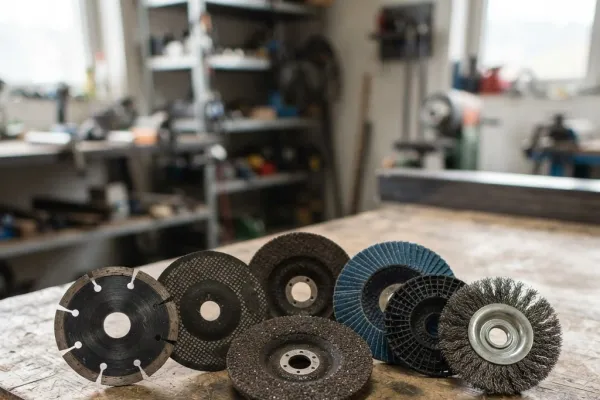
Every disc has a set of markings printed on it. Most people ignore them. Those markings are the disc's identity card and its safety certificate.
Disc Diameter and Your Grinder Size
The most obvious number is the diameter. Common sizes are 4.5 inches, 5 inches, 6 inches, 7 inches, and 9 inches. Your grinder is designed for one specific disc diameter.
A 4.5-inch grinder runs 4.5-inch discs. Period.
Putting a 7-inch disc on a 4.5-inch grinder requires removing the guard and running the disc at a higher linear speed than it was designed for. The disc's maximum RPM is printed on it. The grinder's no-load speed is printed on the tool.
If the disc's max RPM is lower than the grinder's no-load speed, you cannot safely use that disc.
Arbor Size: Why That Hole Matters
The hole in the center of the disc is the arbor hole. In North America, the standard is 5/8 of an inch. Most discs sold in the US come with either a 5/8-inch pre-punched hole or a removable bushing that reduces a larger hole down to 5/8-inch.
European discs often use a 22.23mm bore, which is slightly larger than 7/8-inch. Always check that the arbor hole matches your grinder's arbor nut size before mounting. A loose fit causes vibration that can crack the disc.
Maximum RPM: The One Number You Never Exceed
This number is printed on every disc, usually near the center. It might say "Max RPM 13,300" or "Max RPM 6,600." Compare that number to your grinder's no-load speed, which is printed on the tool's nameplate.
Most 4.5-inch grinders run at 11,000 RPM. Most 9-inch grinders run at 6,600 RPM. If your 4.5-inch grinder runs at 11,000 RPM, you need a disc rated at 11,000 RPM or higher.
A disc rated at 8,600 RPM on that grinder is a disc that will fail.
Grit, Bond, and Abrasive Material
Grit refers to the size of the abrasive particles. Lower numbers mean coarser grit. Coarse grit removes material fast.
Fine grit leaves a smooth finish.
Bond refers to what holds the abrasive grains together. Resin bond is the most common for grinding and cut-off discs. Vitrified bond is used for some precision wheels.
Metal bond is used for diamond blades.
Abrasive material determines how well the disc performs on different substrates. Aluminum oxide is the baseline for steel. Zirconia alumina runs cooler and lasts longer on stainless steel and high-nickel alloys.
Ceramic alumina self-sharpens and maintains cut speed as it wears. Silicon carbide is used for non-ferrous metals, stone, and glass.
How to Match the Disc to the Material
This is where most people overthink it. The rule is simple. Soft materials need hard bonds.
Hard materials need soft bonds. That sounds backwards, but here's why it works.
A soft bond wears away faster, exposing fresh abrasive grains. On a hard material like tool steel or ceramic tile, you need that constant fresh grit to keep cutting. A hard bond holds onto the abrasive too long, and the grains go dull before they release.
The disc glazes over and stops cutting.
On soft materials like aluminum or brass, the opposite happens. A soft bond releases abrasive too fast. The disc wears down before it finishes the job.
You want a harder bond that holds the grains in place longer.
Here's the practical guide for common materials:
- Mild steel and structural steel: Aluminum oxide grinding disc or zirconia flap disc. Standard cut-off wheel for slicing.
- Stainless steel: Zirconia or ceramic abrasive. Avoid aluminum oxide. It generates too much heat and causes work hardening. Use a dedicated stainless cut-off wheel.
- Aluminum: Silicon carbide grinding wheel or a non-loading flap disc with stearate coating. Standard aluminum oxide discs load up and clog.
- Cast iron: Silicon carbide or aluminum oxide. Cut-off wheels work fine, but expect more dust and grit.
- Concrete and brick: Diamond blade, segmented rim for speed. A silicon carbide grinding disc works but wears fast.
- Tile and porcelain: Continuous rim diamond blade, run wet if possible. Never use an abrasive cut-off wheel on tile. It chips and overheats.
- Wood: Carving discs or sanding discs only. Never use a grinding disc or cut-off wheel on wood. They clog, grab, and can kick the grinder back at you.
- Paint and rust: Wire brush or stripping disc. For heavy rust, start with a knotted wire cup. For thin surface rust, a crimped wire wheel is gentler.
The #1 Mistake People Make
The most common error isn't using the wrong disc for the material. It's using the right disc in the wrong orientation.
With a grinding disc, work at a 15 to 30 degree angle relative to the surface. Flat against the work causes the disc to load up and overheat. Too steep an angle digs in and gouges the material.
With a flap disc, use a shallower angle, around 5 to 10 degrees. Flat against the work burns the flaps and shortens its life dramatically. You can tell someone is using a flap disc wrong when the outer edge is worn down to the backing plate while the inner flaps look new.
With a cut-off wheel, keep the wheel perfectly perpendicular to the cut. Any twisting or wobbling produces binding. Binding causes kickback, and kickback from a cut-off wheel is violent.
With a wire brush, let the brush do the work. Pushing too hard bends the wires and reduces cleaning effectiveness. Light pressure keeps the wire tips sharp and aggressive.
The second most common mistake is not matching the arbor adapter. Many discs come with a reducing bushing that lets a larger arbor hole fit a smaller grinder spindle. People throw that bushing away thinking it's packaging.
That bushing centers the disc on the spindle. Without it, the disc runs eccentric, vibrates, and can crack around the center hole.
Safe Practices for Every Disc Change and Use
Before you mount any disc, unplug the grinder. Not the trigger lock. Not the switch.
Unplug it. Spindle locks are mechanical and can fail. A grinder starting unexpectedly with a disc in your hand is not something you want to experience.
Spin the disc by hand after mounting it. Listen for rubbing. Watch for wobble.
If the disc doesn't spin true, reposition it or swap it out. A disc that wobbles at rest will wobble dangerously at speed.
Check the disc for cracks. Hold it up to light or tap it gently with a metal tool. A solid disc rings like a bell.
A cracked disc thuds. If it thuds, throw it away.
Follow the three-second rule when starting a cut or grind. Let the disc come to full speed. Touch the material lightly.
If the grinder jerks or the disc chatters, release the trigger and reassess. That initial contact tells you everything about whether the setup is correct.
Wear the right protection. Safety glasses are non-negotiable. A face shield adds protection against wire brush fragments and disc shrapnel.
Hearing protection matters more than most people realize. An angle grinder at full speed hits 100 to 110 decibels, well above the threshold for permanent hearing damage with prolonged exposure.
Gloves should be tight fitting. Loose gloves can get caught in the spindle or between the disc and the work piece. Cut-resistant gloves are ideal.
Normal work gloves can melt or catch fire from sparks.
Keep the work area clear of flammable materials. Grinding sparks can travel 15 to 20 feet and ignite sawdust, gasoline fumes, or dry grass. A fire extinguisher within reach is cheap insurance.
When to Spend More on a Disc
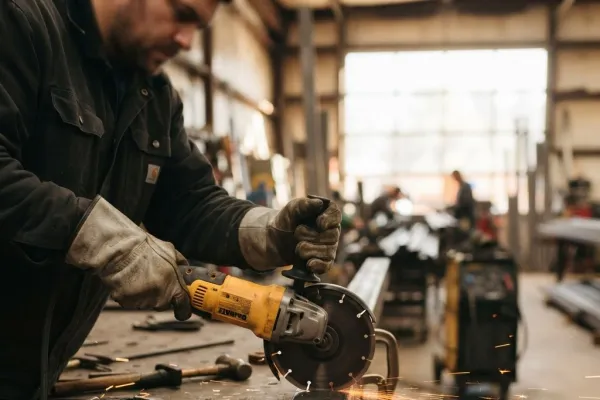
Not every disc needs to be premium. Here's the honest breakdown.
Spend more on flap discs for stainless steel. Cheap flap discs burn up fast on stainless because the abrasive dulls quickly and the resin bond breaks down from heat. A quality zirconia or ceramic flap disc on stainless can outlast a cheap disc by four to five times.
The cost per cut favors the premium disc.
Spend more on diamond blades for tile work. Cheap diamond blades have uneven segment bonding that causes chipping and chatter. A good continuous rim blade from a reputable manufacturer gives you clean cuts and consistent performance across dozens of jobs.
Spend more on grinding discs for production work. If you're grinding welds for eight hours a day, the difference between a cheap disc and a premium disc is measurable in time and fatigue. For a single weld on a gate repair, the cheap disc works fine.
Save money on cut-off wheels for mild steel. The difference between a $2 cut-off wheel and a $6 cut-off wheel is lifespan, not safety, as long as both are rated for your grinder's RPM. A cheap wheel might wear out faster, but it won't fail if you use it correctly.
Save money on wire brushes for light rust removal. A $5 knotted wire cup cleans surface rust as well as a $15 one for occasional use. The expensive version lasts longer, but if you're using it twice a year, you won't notice.
Avoid the absolute cheapest no-name discs sold in bulk. Off-brand discs are frequently cited in safety reports for inconsistent bond quality, missing RPM ratings, and eccentric mounting holes. Stick with recognizable brands from established manufacturers.
Norton, 3M, DeWalt, Makita, and Bosch all produce discs that meet ANSI standards.
How to Tell When a Disc Needs Replacing
Grinding discs wear down. When a 4.5-inch grinding disc reaches about 2 inches in diameter, replace it. Running a disc that small increases the surface speed beyond safe limits and reduces control.
Cut-off wheels wear thin. If the wheel diameter has reduced by more than half, swap it. A cut-off wheel that's too small cannot reach the work surface, and the arbor nut can contact the material.
Flap discs wear unevenly. When the abrasive flaps are worn down to the backing material, the disc stops cutting effectively and starts burning the workpiece. Replace it when the backing plate becomes visible in any area.
Diamond blades lose segments. If a segment cracks, chips, or falls off, the blade is unbalanced and dangerous. Replace it immediately.
A blade with uneven segment wear will vibrate and cut poorly.
Wire brushes lose wires. When a wire cup or wheel has lost about a third of its bristles, it's time to replace it. A wire brush with missing wires becomes unbalanced and less effective.
Stripping discs and sanding discs load up. If the disc is loaded with paint or adhesive residue and won't clean off with a rubber cleaning stick, replace it. Loaded discs generate friction instead of cutting.
Quick Selection Guide
| Job | Disc to Grab | Grit or Type |
|---|---|---|
| Knock down a weld bead on steel | Grinding disc (Type 27) | 24 to 36 grit |
| Cut a bolt or rebar | Cut-off wheel (Type 1) | 0.045 inch |
| Blend a weld to match the parent metal | Flap disc | 60 to 80 grit |
| Remove rust from a steel gate | Knotted wire cup brush | N/A |
| Cut a porcelain tile | Continuous rim diamond blade | N/A |
| Clean paint from a wood surface | Stripping disc | N/A |
| Polish stainless steel | Wool buffing pad | Compound as needed |
| Shape a piece of wood | Carving disc | N/A |
Common Mistakes to Avoid
The first mistake is not cleaning the work surface before you start. Grease, oil, or wet paint on the metal loads up the disc instantly. A loaded disc stops cutting and starts burning.
It overheats the material and glazes the abrasive. You then push harder, which only makes it worse.
The second mistake is using a disc past its prime. A grinding disc worn down to a nub loses its structural reinforcement. The fiberglass layers near the center are gone.
The remaining disc is brittle and prone to cracking. Replace discs when they reach about half their original diameter.
The third mistake is cutting without a clear line. Freehand cutting with a cut-off wheel is fine for quick snips, but for straight cuts on sheet metal or tile, use a straightedge guide clamped to the work piece. The wheel follows the path of least resistance.
Give it a path.
The fourth mistake is forgetting about heat. Grinding generates heat. On thin metal, that heat warps the material.
On stainless steel, it causes heat tint and can compromise corrosion resistance. On hardened steel, it can draw the temper and soften the metal. Keep the disc moving.
Don't dwell in one spot.
The fifth mistake is stacking disc types on the same arbor. Never stack a grinding disc with a cut-off wheel on the same spindle. Each disc has different torque characteristics and reinforcement.
Stacking them creates unpredictable loading and can cause one disc to fracture the other.
How to Store Discs So They Last
Discs are more fragile than they look. Grinding discs and cut-off wheels absorb moisture from the air. That moisture degrades the resin bond and reduces the disc's structural strength.
Store them in a dry area below 80 degrees Fahrenheit per ANSI B7.1 guidelines.
Keep discs flat or hanging on a pegboard. Storing them on edge in a drawer can cause the disc to warp over time. Warped discs vibrate badly and don't run true.
Keep cut-off wheels in their original packaging until you're ready to use them. The cardboard sleeve prevents edge damage. A chipped edge on a cut-off wheel creates a stress concentration point that can propagate into a full crack during use.
Do not stack heavy objects on top of discs. The weight can cause micro fractures in the bond that weaken the disc's integrity. A disc that looks fine but has internal fractures can fail catastrophically under load.
For diamond blades, store them dry and clean. Resin bonds in the metal matrix can degrade if the blade sits in water or high humidity long term. A dry blade that's wiped clean after use lasts for years.
When to Upgrade Your Grinder
The discs matter, but the grinder you put them on matters too. A standard single-speed grinder works for most jobs. It runs at around 11,000 RPM, which is fine for grinding discs, cut-off wheels, and flap discs on metal.
For wire brushes and polishing pads, variable speed is almost essential. Running a wire brush at full speed throws wires aggressively and wears the brush out fast. Running a polishing pad at full speed burns the compound and leaves swirl marks.
A variable speed grinder lets you dial down to 3,000 to 5,000 RPM for these tasks.
For heavy grinding on thick steel, a more powerful grinder with 10 to 13 amps handles the load without bogging down. A standard 6-amp grinder stalls under heavy pressure on a grinding disc. The motor slows, the disc stops cutting, and you compensate by pushing harder.
That's exactly when things go wrong.
For more details on matching the grinder to your work, our full buying guide covers everything from power requirements and arbor sizes to guard setup. It's worth a read if you're still deciding between models.
Final Safety Checklist
Before you pull the trigger on any disc, run through this list. It takes fifteen seconds.
The grinder is unplugged while you mount the disc. The disc matches the tool's arbor size. The disc's maximum RPM rating meets or exceeds the grinder's no-load speed.
The guard is installed and positioned to deflect sparks away from your body. The disc spins freely without rubbing the guard. The arbor nut is tight but not overtightened.
The spindle lock is fully disengaged before startup. Your work piece is clamped down, not held by hand. You're wearing safety glasses, hearing protection, and gloves.
The area behind the grinder is clear of people and flammable materials.
Your safety checklist is where you stop and think before every job. It's the most important part of this guide.
1. Unplug the grinder before changing discs
Always. Every time. The spindle lock can fail.
The trigger can jam. A grinder that starts unexpectedly with your hands near the disc causes horrific injuries. This takes two seconds and removes all risk.
2. Inspect the disc before mounting
Run your fingers around the edge. Feel for cracks, chips, or uneven wear. Hold the disc up to a light source and look for hairline fractures.
Tap the disc gently with a metal tool. A solid disc rings. A cracked disc thuds.
3. Verify the RPM rating matches your grinder
The disc's maximum RPM must equal or exceed your grinder's no-load speed. This number is printed on both items. If the disc says 8,600 RPM and your grinder runs at 11,000 RPM, do not mount that disc.
4. Install the guard correctly
The guard must cover at least 120 degrees of the disc on the operator side. Position it so sparks deflect away from your body. Never remove the guard for convenience.
A guard that annoys you is still better than a disc fragment in your thigh.
5. Clamp the work piece
Never hold the material with one hand while grinding with the other. A clamped work piece stays put. A hand-held work piece can slip, pivot, or kick the grinder back at you.
Use clamps, a vise, or a dedicated work holding setup.
6. Wear full personal protective equipment
Safety glasses are required. A face shield adds protection against wire brush fragments and flying sparks. Hearing protection is non-negotiable for prolonged use.
Tight-fitting gloves protect your hands without getting caught in the spindle. Cotton or leather clothing covers exposed skin. Remove loose jewelry and tuck in drawstrings.
7. Clear the work area
Grinding sparks travel 15 to 20 feet. Remove flammable materials, fuel containers, solvents, and dry vegetation from the area. Keep a fire extinguisher within reach.
Check for bystanders behind you and ask them to move clear.
This checklist covers every common factor in angle grinder accidents. Follow it before every use. Discard shortcuts that save five seconds at the cost of your safety.
Frequently Asked Questions
Can I use a wood blade on an angle grinder?
Wood carving discs exist, but they're specialty items designed specifically for shaping wood. Do not use standard grinding discs or cut-off wheels on wood. They clog with resin, overheat, and can kick back violently.
Use only discs clearly labeled for wood applications.
What happens if I use a grinding disc for cutting?
A grinding disc cuts poorly because it's thick and generates excessive friction. More importantly, the depressed center geometry creates stress risers along the inner radius when used for plunge cuts. This increases the risk of disc failure.
Use a cut-off wheel for cutting.
How do I know if a disc is rated for my grinder's speed?
Look for the maximum RPM printed on the disc. Compare it to the no-load speed printed on your grinder's nameplate. If the disc's max RPM is equal to or higher than the grinder's speed, it's safe.
If it's lower, do not mount that disc.
Can I sharpen a dull diamond blade?
Some diamond blades can be sharpened by making a few cuts in a soft abrasive material like a concrete block or an abrasive dressing stone. This exposes fresh diamond particles. If the blade has no visible diamond remaining on the segments, it's worn out and cannot be restored.
Why does my disc vibrate when I turn on the grinder?
Vibration usually means the disc isn't centered on the arbor, the arbor nut is loose, or the disc has a manufacturing defect. Unplug the grinder, remove the disc, and check the mounting. If the disc spins true off the tool but vibrates when mounted, replace the disc.
How long should an angle grinder disc last?
Lifespan depends entirely on material and usage. A grinding disc on mild steel might last 15 to 30 minutes of continuous use. A flap disc on the same material can last 45 minutes to an hour.
A diamond blade on concrete can last through hundreds of linear feet of cut. Disc life shortens dramatically on hard or abrasive materials.
