


You’ve probably stood in the tool aisle or scrolled through drill specs wondering, “How much torque do I need in a cordless drill?” It’s a fair question, but the real answer isn’t a single number you can look up on a box. Torque needs change with every job, every material, and every screw size.
Manufacturer specifications confirm that most consumer drills fall between 250 and 750 in‑lbs of torque. As of 2026, the sweet spot for a typical homeowner sits around 500 in‑lbs. But that’s only useful once you understand how torque actually behaves in your hand.
What You’re Really Asking (And Why the Answer Isn’t a Single Number)
You’re not asking for a physics lesson. You want to drive screws without stripping them, drill holes without stalling, and buy a drill that fits your actual projects. That’s a condition‑based question, not a spec‑sheet number.
Torque is simply the rotational force the drill can apply. More torque lets you muscle through tougher materials or larger fasteners. But too much torque strips screw heads or snaps bits.
Too little leaves you stuck with a half‑driven lag bolt.
The trick is matching torque to the job. A drill with 350 in‑lbs might be perfect for hanging shelves but hopeless for sinking 3‑inch deck screws into oak. Conversely, a 700 in‑lb beast will shred drywall screws if you don’t use the clutch.
So before you pick a number, ask yourself what you’ll actually be drilling or driving most often. That’s the variable that decides everything.
Quick Answer
For universal home use, aim for 400 to 600 in‑lbs. This range covers 90% of typical jobs: drywall, furniture assembly, decking, and ⅜‑inch holes in wood.
Light tasks like small screws and particle board need under 300 in‑lbs. Heavy work like lag bolts and hole saws requires 600 in‑lbs or more.
Set your clutch correctly for the material. Match the torque to the fastener size. That prevents stripping and prolongs battery life.
How Cordless Drill Torque Actually Works (Clutch, Gears, and Motor)
Torque doesn’t just come from the motor. It’s a combination of three interacting systems.
The Clutch Adjusts the Torque Limit
The numbered ring behind the chuck is the torque clutch. It disengages the drive train when resistance exceeds a set level. A lower number (say 5) clicks out with light force, perfect for small screws.
Higher numbers (15, 20) let you drive deeper before slipping. The drill symbol bypasses the clutch entirely for maximum torque.
You’ll find a full explanation of how these numbers work in our guide on the numbered clutch settings. It’s one of the most misunderstood features of a cordless drill.
The Gearbox Multiplies Force
Most cordless drills have two speed ranges. Low gear (usually 0, 450 RPM) provides high torque for tough jobs. High gear (up to 1,800 RPM) trades torque for speed.
The gear ratio is what lets a compact motor spin a ½‑inch bit through hardwood.
The Motor Type Determines Efficiency
Brushless motors deliver more torque per watt than brushed motors. They also hold torque better under load because they don’t lose energy to friction from brushes. Aggregate reviews indicate brushless models consistently outperform their brushed counterparts when driving large screws.
Understanding these parts helps you read torque ratings correctly. A drill rated at 500 in‑lbs in low gear will feel substantially stronger than the same drill in high gear. Always check torque specs at the lower gear.
The Two Big Variables That Change Everything: Material and Fastener Size
Torque isn’t a fixed number you pick once. It depends on two factors that vary with every project.
Material Hardness
Soft materials like pine, drywall, and plastic require very little torque. Drive a #8 screw into pine with 150 in‑lbs and you’re fine. Try the same setting in hardwood like oak or ipe and the screw will either stall or strip.
Hardness scales exponentially. A 2‑inch screw in oak can need twice the torque of the same screw in pine. For metal, the torque requirement jumps even higher, especially when using self‑tapping screws or drilling steel.
Fastener Size and Type
Screw diameter and length directly affect the torque needed. A #6 screw (3.5 mm) needs about 100 in‑lbs to seat. A #12 screw (5.5 mm) needs 350 in‑lbs for the same depth.
Lag bolts and structural screws require 600 in‑lbs or more, especially when driven into dense wood without a pilot hole.
Pilot holes reduce torque demand by roughly 30 to 50%. If you’re working with hardwoods or large fasteners, drill a pilot hole first. It saves your battery and your wrist.
Your Decision Tree: Light, Medium, or Heavy Torque?
Instead of chasing a single number, categorize your projects. Then pick the torque range that matches your most common workload.
Light Duty (Under 300 in‑lbs): Furniture, Drywall, Small Screws
This range is for assembly work and lightweight drilling. You’ll use it for flat‑pack furniture, small cabinet hinges, and drywall anchors.
Drills in this class are compact and lightweight. They’re easy to maneuver into tight corners. A 12V drill is often enough here.
If you never plan to drive anything larger than a #10 screw into softwood, you don’t need more.
Medium Duty (300–600 in‑lbs): Deck Screws, Hardwood, ⅜‑inch Holes
This is the sweet spot for most homeowners. You can drive 2½‑inch deck screws into pressure‑treated lumber, bore ⅜‑inch holes in plywood, and handle general construction.
A 600 in‑lb drill in low gear feels confident without being unwieldy. It also leaves headroom for occasional heavier tasks if you use the right technique. Many brushless 18V/20V drills fall into this band.
Heavy Duty (600+ in‑lbs): Lag Bolts, Hole Saws, Metal Framing
If you’re building a deck, framing a wall, or drilling through steel studs, you need serious torque. Lag bolts ¼ inch and larger demand this level. So do hole saws over 1½ inches in diameter.
Drills in this class are heavier and bulkier. They can twist your wrist if you’re not ready for the kickback. That’s where using both hands and keeping the drill perpendicular matters most.
A model like the DEWALT 20V MAX XR hammer drill is a solid choice for this range, offering strong torque and brushless efficiency.
Our complete guide on how to choose a cordless drill in 2026 breaks down these categories further, including weight tradeoffs and battery recommendations.
A Practical Rule of Thumb
If you’re unsure, buy a drill rated at 500, 600 in‑lbs in low gear. It covers medium duty and can handle light heavy work with the right bit and pilot holes. For professional use, go 700+ in‑lbs and get a brushless model with a high‑capacity battery.
Matching Clutch Settings to Your Job (So You Stop Stripping Screws)
The clutch is your torque limiter. It’s the most underused feature on most cordless drills. Set it right and you’ll never strip another screw head.
Low numbers (1, 5) are for small fasteners in soft materials. Think #6 screws into drywall or plastic anchors. The clutch clicks out with very little resistance.
That protects the screw head and the material.
Medium numbers (6, 12) work for general driving. #8 and #10 screws into pine or plywood. The screw seats flush but the clutch stops before the bit cams out.
High numbers (13, 20) are for large screws in hardwood or dense materials. You want the screw fully seated but not so deep it splits the wood. The clutch engages later and lets you control the final depth.
The drill symbol bypasses the clutch entirely. Use this only for drilling holes, not driving screws. In this mode, the drill delivers full torque until you release the trigger.
How to Find Your Perfect Setting
Start low. Drive a test screw into scrap material. If the clutch clicks out before the screw is seated, dial up one number.
Repeat until the screw sits flush without the bit slipping.
That’s your setting for that screw size in that material. Write it down. A #8 screw in pine might be 8.
The same screw in oak might be 14.
Common Mistakes That Wreck Screws, Bits, or Your Wrist

Even with the right torque, bad habits cause damage. Here are the most frequent mistakes we see.
Mismatching Bit and Screw Head
A Phillips bit that’s too small or too large causes cam-out. Always match the bit size to the screw. Use a #2 Phillips for most deck screws.
Use a #1 for smaller cabinet screws.
Driving Without a Pilot Hole
This is the biggest mistake in hardwood. Driving a 3-inch screw into oak without a pilot hole requires massive torque. A pilot hole reduces torque demand by 30 to 50% and prevents splitting.
Using the Wrong Speed
Low gear gives you torque. High gear gives you speed. Using high gear for large screws means the motor bogs down.
Switch to low gear for driving.
Ignoring the Battery
A weak battery delivers less torque. As the battery discharges, the drill’s maximum torque drops. Charge your battery fully before heavy jobs.
Use a high-capacity battery (4Ah or 5Ah) for sustained torque.
Not Using Both Hands
High torque creates kickback. If you’re driving a large lag bolt one-handed, the drill can twist your wrist. Use a side handle if your drill includes one.
Hold the drill with both hands.
When a Compact Drill Beats a High-Torque Beast (And Vice Versa)
Bigger isn’t always better. Compact drills have real advantages for certain jobs.
Compact Drills (Under 350 in‑lbs)
Best for: overhead work, tight spaces, furniture assembly, light drilling. These drills are lightweight and easy to handle. A 12V compact drill weighs about half of a full-size 18V model.
If you’re an electrician, a cabinet installer, or a DIYer who mostly builds furniture, a compact drill is ideal. Just don’t expect it to drive 4-inch lag bolts.
High-Torque Drills (Over 600 in‑lbs)
Best for: framing, decking, hole saws, metal drilling, heavy construction. These drills are heavier and bulkier. They have more torque reserve, which means they don’t stall easily.
The tradeoff is fatigue. A 700 in‑lb drill weighs around 4 to 5 pounds with a battery. Use it overhead for an hour and your arm will feel it.
The Middle Ground
Most homeowners don’t need two drills. A 500 in‑lb brushless drill with a 4Ah battery covers 90% of jobs. It’s light enough for casual use and strong enough for occasional heavy work.
If you find yourself needing more torque regularly, add a compact drill for light duty. Keep the high-torque drill for the tough stuff.
Real-World Examples: Three Jobs, Three Torque Choices
Example 1: Assembling a Flat-Pack Bookshelf
Fasteners: #6 cam screws and small dowels. Material: particle board with a thin veneer. Torque needed: under 150 in‑lbs.
Clutch setting: 3 to 5. A compact drill or even a screwdriver works here.
Example 2: Building a Pine Deck
Fasteners: 2½-inch deck screws (#10). Material: pressure-treated pine. Torque needed: 400 to 500 in‑lbs.
Clutch setting: 10 to 14. A medium-duty drill in low gear handles this well.
Example 3: Installing a Door Frame with Lag Bolts
Fasteners: ¼-inch lag bolts, 3 inches long. Material: oak. Torque needed: 650 to 750 in‑lbs.
Drill a pilot hole first. Drive the lag bolt in low gear. Use both hands.
The Battery Factor: Why Voltage and Amp-Hours Affect Your Torque
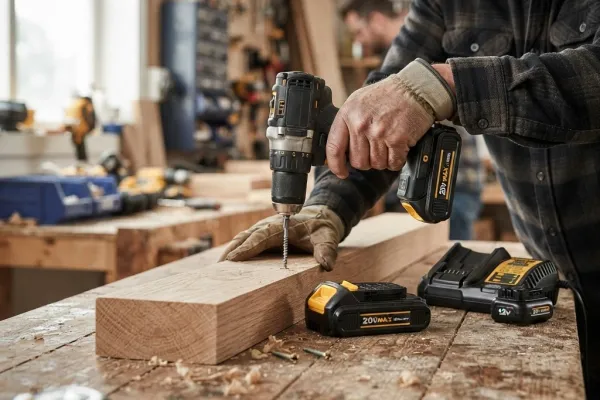
The battery is your torque source. Voltage and amp-hours play different roles.
Voltage Determines Maximum Torque
Higher voltage motors can produce more torque. A 20V max drill delivers more torque than a 12V drill in the same size class. But motor design, gear ratio, and battery chemistry all matter.
Amp-Hours Determine Sustained Torque
A 5Ah battery holds more charge than a 2Ah battery. That means it can deliver high torque for longer without voltage sag. For heavy torque jobs, use a 4Ah or 5Ah battery.
Cold Weather Affects Torque
Lithium-ion batteries lose capacity in cold temperatures. Below 40°F, the battery can’t deliver full current. Store your batteries at room temperature before use.
Keep a spare battery in your pocket when working in cold weather.
Pro Tips for Getting the Most Out of Your Drill’s Torque
Use sharp bits. A dull bit requires more torque to cut. Keep the chuck tight.
A loose chuck slips under load. Switch to low gear for drilling holes over ¼ inch and for all screw driving. Lubricate screws in hardwood with a bar of soap to reduce friction.
Clean the battery contacts with a dry cloth periodically.
Final Decision Guide: A Two-Minute Flowchart for Your Next Project
Step 1: Identify the material. Soft (pine, drywall, plastic) or hard (oak, maple, metal).
Step 2: Check the fastener. Under #10 or bigger?
Step 3: Decide the torque range. Soft + small: under 300 in‑lbs, clutch 3, 6. Soft + large: 300, 500 in‑lbs, clutch 8, 14.
Hard + small: 300, 500 in‑lbs, clutch 10, 16. Hard + large: 600+ in‑lbs, drill mode.
Step 4: Drill a pilot hole for hardwoods.
Step 5: Test on scrap. Dial in the clutch setting.
Step 6: Use low gear for driving.
OSHA guidelines for power tool safety recommend using both hands and keeping proper stance when operating high-torque tools. Follow these practices to avoid injury.
Frequently Asked Questions
What torque do I need for driving deck screws?
For 2½-inch deck screws in pressure-treated pine, aim for 400 to 500 in‑lbs. Use a clutch setting around 10 to 14. Drill a pilot hole if the wood is dense.
Can I use a 12V drill for heavy work?
Not reliably. A 12V drill typically delivers under 300 in‑lbs. That’s fine for furniture and drywall.
For deck screws, lag bolts, or hole saws, you need an 18V or 20V max drill.
Does higher torque mean faster drilling?
Not directly. Higher torque lets you maintain speed under load. A high-torque drill stalls less when pushing through tough material.
How do I know if my drill has enough torque?
If the drill stalls before the screw is fully seated, you need more torque. Switch to low gear first. If it still stalls, you need a drill with a higher torque rating.
What’s the difference between in‑lbs and Nm?
In‑lbs (inch-pounds) and Nm (Newton-meters) are both torque units. 1 Nm equals about 8.85 in‑lbs. A 500 in‑lb drill is roughly 56 Nm.
Should I always use the drill symbol for maximum torque?
Only for drilling holes. For driving screws, use the numbered clutch settings. The drill symbol bypasses the clutch and delivers full torque.
That’s correct for drilling but risky for screw driving.
