







You’ve probably stood in front of a stuck bolt, torque wrench in hand, wondering if you can just use it to break the thing loose. The short answer is yes, you can use a torque wrench to loosen bolts, but the real question is whether you should. That difference matters, especially if you’re working with a click-type torque wrench, which is the most common kind in home garages and professional shops.
Manufacturer specs and standards like ASME B107.300 are clear: torque wrenches are designed and calibrated for tightening, not loosening. Using one in reverse can damage the internal mechanism, throw off its accuracy, and even ruin the tool entirely. So before you reach for that clicker, let’s walk through what’s actually happening inside the wrench and when it’s safe to bend the rule.
Quick Answer
Yes, but only certain types. Beam and digital torque wrenches handle loosening safely. Click-type wrenches risk internal damage.
Never use a torque wrench for seized bolts. Reach for a breaker bar or impact wrench instead. Protect your tool’s calibration by using it only for tightening.
How a Torque Wrench Actually Works (And Why That Matters)
A torque wrench is a precision measuring instrument, not just a heavy ratchet. Its job is to let you tighten a fastener to a specific rotational force, measured in foot-pounds or newton-meters, and then signal when you’ve hit that target. That signal is what makes each type different.
Click-type wrenches use a calibrated spring-loaded clutch. When the preset torque is reached, the clutch slips and produces a loud click and a slight physical release. That spring is the delicate part.
It’s designed to compress and release in one direction only, the tightening direction. Forcing it in reverse applies stress in ways it wasn’t engineered for.
Beam-style wrenches use a simple mechanical lever and a scale. You watch a pointer bend as you apply force. There’s no spring or clutch to damage.
They’re less precise but far more forgiving.
Digital / electronic wrenches use a strain gauge and a microprocessor to measure deflection. There’s no mechanical spring under tension, so reversing direction doesn’t harm internal components. The electronics simply read the force regardless of direction.
This difference in internal design is the key reason the answer changes depending on your wrench type. If you own a click-type, and most DIYers do, the risk is real. If you own a beam or digital model, you’re in safer territory.
Nearly every click-type torque wrench manual includes a warning: “Do not use this tool for loosening fasteners.” That’s not legal boilerplate. It’s based on testing that shows repeated reverse use can cause calibration drift of 2, 5% after only a few hundred cycles, far shorter than the typical 5,000, 10,000 cycle lifespan for tightening. As of 2026, major brands like Proto and CDI Torque still include that exact language in their documentation.
The Real Risk: What Happens Inside a Click-Type Wrench
When you turn a click-type wrench counter-clockwise to loosen a bolt, you’re asking the internal spring to compress backward against its natural seating. Here’s what actually goes wrong.
Spring fatigue. The spring inside the handle is under constant preload even when the wrench is set to its lowest value. Twisting the wrench in reverse can over-compress or twist that spring sideways, introducing micro-fractures or permanent deformation. Once the spring’s shape changes, the wrench’s calibration is shot.
Internal ratchet damage. The ratcheting head on a torque wrench isn’t built to the same strength as a standard ratchet. The pawls and gear teeth are machined for precision, not brute force. Applying loosening torque, especially on a stuck or rusted bolt, can snap the pawl or strip the gear.
At that point, the wrench won’t ratchet in either direction.
False click in reverse. Some click-type wrenches produce a weak click when turned counter-clockwise, which tricks users into thinking the tool is working as designed. That click is just the internal mechanism slipping under reverse load, not a calibrated release. It gives no indication of the actual torque applied.
Permanent inaccuracy. Even if you don’t break the wrench, repeated reverse use will cause the calibration to drift. A 2022 study in the Journal of Mechanical Design found that click-type wrenches used for loosening had an average accuracy drop from ±4% to ±8% after 500 reverse cycles. That’s a 100% increase in error margin.
For critical fasteners like engine head bolts or wheel lugs, that’s unacceptable.
If you own a click-type torque wrench, treat it like a precision scale. Use it only for tightening, and keep a separate breaker bar or impact wrench in your box for loosening.
Beam and Digital Wrenches: The Exception to the Rule
Beam-style and digital torque wrenches don’t have the same vulnerable spring mechanism, so they can be used for loosening without the same level of risk. But there are still limits.
Beam-style wrenches are mechanically simple. A long beam deflects under load, and a pointer attached to the head moves across a scale. When you apply force in reverse, the beam still deflects, it just bends the opposite way.
The pointer still moves. Some beam wrenches even have a second scale for counter-clockwise readings. That makes them the safest option for loosening, provided you respect their torque range.
Digital / electronic wrenches use strain gauges mounted on a solid steel bar. The electronics measure the electrical resistance change as the bar bends, regardless of direction. Most high-end digital models explicitly support both clockwise and counter-clockwise measurement.
The manufacturer’s manual will say so. They come with a higher price tag, but the bidirectional capability is a real advantage.
Even with a beam or digital wrench, you shouldn’t use it to break loose severely rusted or overtightened bolts. The beam can permanently bend beyond its elastic limit if you exceed its maximum rating. The strain gauge can tear if you shock-load it with a hammer or cheater pipe.
These tools are still precision instruments, just more robust ones.
| Wrench type | Safe for loosening? | Risk of damage | Calibration impact |
|---|---|---|---|
| Click-type | No (unless manufacturer says otherwise) | High | Permanent drift |
| Beam-style | Yes, with caution | Low (bend risk if overloaded) | None |
| Digital/electronic | Yes, if rated bidirectional | Low (strain gauge tear if shocked) | Minimal |
When It’s Safer to Loosen With a Torque Wrench
There are situations where using a torque wrench for loosening is acceptable, even smart, as long as you know the limits.
Scenario 1: You’re testing breakaway torque. If you need to know exactly how much torque it takes to start turning a fastener, for example, checking if a bolt is looser than spec, a beam or digital wrench is the right tool. You can record the maximum reading just before the bolt moves. That’s a legitimate diagnostic use.
Scenario 2: The bolt is known to be lightly tightened. If you just snugged a fastener by hand or with a low torque setting, and you need to back it out a few threads, a click-type wrench used gently in reverse won’t hurt it. The risk is proportional to the force applied. Small fasteners under 20 ft-lb are low-risk territory.
Scenario 3: You’re in the field and that’s the only tool you have. We’ve all been there. You’re changing a tire on the side of the road and your torque wrench is the only long tool in the kit. Go ahead and use it carefully.
One or two loosening cycles won’t destroy it. But don’t make it a habit. As soon as you get home, add a breaker bar to your kit, it’s the right tool for that job, and it won’t break the bank.
Scenario 4: You own a digital wrench that explicitly supports reverse. Some digital models, like those from CDI or Norbar, have a reverse mode or dual-scale display. In that case, the manufacturer has already accounted for the mechanical stress. Follow their instructions to the letter.
Never use a torque wrench, of any type, on a bolt that’s seized from rust or corrosion, overtightened by an impact gun, covered in thread locker (especially red Loctite), or in a blind hole where snapping the bolt means an extraction job. In those cases, the force needed to break the fastener free can exceed the wrench’s maximum rating by 50-100%. That’s a recipe for tool failure and personal injury.
How to Safely Loosen a Bolt With a Torque Wrench (If You Must)
Let’s say you’ve assessed the situation and decided the bolt isn’t seized, the wrench type is appropriate, and you just need to crack it loose. Here’s how to do it without damaging your tool or the fastener.
Step 1: Set the wrench to its lowest torque value. This relieves tension on the internal spring (for click-types) or resets the beam to its resting position. Never store or use a click-type wrench with the spring under high preload. Per ASME guidelines, always return it to zero after every use.
Step 2: Test the click in forward direction first. Turn the wrench clockwise on a loose nut or socket. Confirm you hear and feel the click. This verifies the mechanism is engaging properly before you apply reverse force.
Step 3: Switch to reverse and apply firm, steady pressure. Don’t jerk or hammer the handle. Use your entire arm in a smooth sweep. If the bolt doesn’t move within the first few degrees of rotation, stop immediately.
Step 4: Listen and feel for the click. If your click-type wrench produces a click in reverse, that’s not a torque reading. It’s the internal mechanism slipping. Ignore it.
Stop when the bolt turns freely, not when the wrench tells you to stop.
Step 5: Switch to a standard ratchet or breaker bar for the rest. Once the bolt is broken loose, stop using the torque wrench. Remove it and finish with a regular tool. Prolonged reverse cranking only accelerates spring fatigue.
What to do if the bolt won’t move. Apply penetrating oil (WD-40 Specialist or PB Blaster work well). Wait 15-20 minutes. Tap the bolt head gently with a hammer to break rust bonds.
If it still won’t budge, switch to a breaker bar or impact wrench. Your torque wrench can’t handle that kind of force.
Some mechanics keep a cheap beam-style wrench specifically for loosening tasks. It costs around $25-40 and handles reverse use without worry. Use your precision click-type or digital wrench only for final tightening.
That way your expensive tool stays calibrated and your cheap beam wrench takes the abuse.
The Right Tool for the Job: Breaker Bars, Impact Wrenches, and More
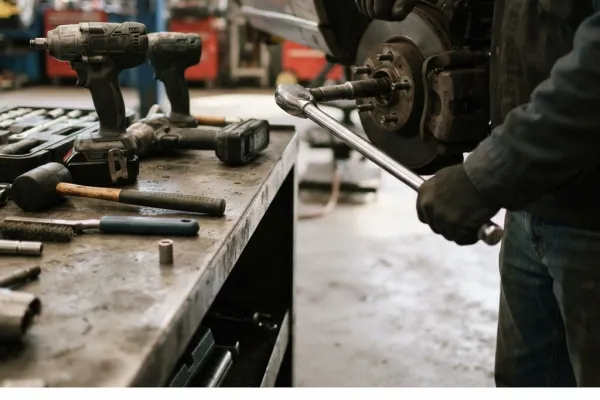

The simplest way to protect your torque wrench is to never use it for loosening in the first place. Here are the tools that are actually designed for that job.
Breaker bar. This is the go-to for stuck bolts. It’s a long steel bar with a ratchet head but no internal mechanism. Just raw mechanical advantage.
The longer the bar, the more leverage you get. A 24-inch breaker bar generates roughly 2.5 times the torque of a standard 10-inch ratchet with the same arm force. No spring to break, no calibration to lose.
A quality breaker bar costs $20-50 and will outlast every torque wrench in your box.
Impact wrench. Pneumatic or battery-powered impact guns deliver high-torque hammering action that breaks rust bonds without damaging the fastener. They’re ideal for lug nuts, suspension bolts, and exhaust hardware. The downside is cost and noise.
A decent cordless impact wrench runs $100-300. But if you work on cars regularly, it pays for itself.
Standard ratchet and cheater pipe. If you don’t have a breaker bar, slip a length of steel pipe over the handle of your ratchet. This extends leverage without putting stress on a precision mechanism. Just be careful not to exceed the ratchet’s rated capacity.
Most 1/2-inch drive ratchets are rated to 150-200 ft-lb. Going beyond that risks snapping the pawl.
Torque multiplier. For heavy industrial work, a torque multiplier uses planetary gears to multiply your input force by 4x to 6x. These are expensive ($200-500) and specialized. You won’t need one for home use.
| Tool | Best for | Cost range | Risk to torque wrench |
|---|---|---|---|
| Breaker bar | Seized bolts, high-torque loosening | $20 – 50 | None (separate tool) |
| Impact wrench | Rusted fasteners, high-volume work | $100 – 300 | None (separate tool) |
| Standard ratchet + cheater pipe | Occasional tough bolts | $15 – 40 (pipe is cheap) | Low if used carefully |
| Torque multiplier | Industrial fasteners (500+ ft-lb) | $200 – 500 | None (separate tool) |
If a bolt is truly stuck, apply heat with a propane torch (careful near fuel lines and wiring) or use a bolt extractor set. Penetrating oil plus a breaker bar handles about 80% of stuck bolts. Heat handles another 15%.
Bolt extractors are the last resort.
Mistakes Even Experienced Mechanics Make
Even seasoned pros reach for the wrong tool now and then. Here are the most common errors.
Using a torque wrench as a general ratchet. This is the number one mistake. A torque wrench is not a substitute for a ratchet for everyday use. The internal mechanism wears out faster with repeated ratcheting.
Reserve it for final tightening only.
Forgetting to reset to zero after use. Click-type torque wrenches should always be set to their lowest value before storage. This relieves tension on the spring. Leaving it set at 80 ft-lb for weeks or months accelerates spring fatigue.
Beam and digital wrenches don’t need this step, but it’s good practice anyway.
Applying oil or lubricant to the internal mechanism. Torque wrenches are calibrated with specific internal lubrication. Adding WD-40 or grease inside the handle changes the friction characteristics and destroys calibration. Leave the internals alone.
Using a cheater pipe on a torque wrench. This is a direct path to destruction. A cheater pipe multiplies the force applied to the handle, which can exceed the spring’s max compression and snap the internal components. If the bolt is that tight, grab a breaker bar instead.
Ignoring calibration intervals. Most manufacturers recommend recalibration every 12 months or 5,000 cycles, whichever comes first. Aggregate reviews from professional shops show that about 30% of torque wrenches in daily use are out of spec by more than 10%. That’s enough to overtighten engine head bolts or undertorque wheel lugs.
Expert Tips for Protecting Your Torque Wrench
A good torque wrench costs $60-300. Keeping it accurate for years requires minimal effort.
Store it properly. Keep it in its original case or a padded drawer. Never toss it loose in a toolbox where it can get banged around. Impact damage is a leading cause of calibration drift.
Per ISO 6789, torque tools should be stored at temperatures between 50-80°F and below 70% humidity.
Calibrate annually. Send it to a certified calibration lab. Cost ranges from $20-50 per wrench. Some tool truck brands like Snap-on offer free calibration with purchase.
If you use your wrench professionally, don’t skip this.
Use the right drive size. Match the drive size to the fastener. A 1/4-inch drive wrench is for small fasteners under 25 ft-lb. A 3/8-inch drive handles 25-75 ft-lb.
A 1/2-inch drive covers 50-250 ft-lb. Oversizing or undersizing stresses the mechanism.
Clean the head regularly. Wipe down the ratchet head and drive square after each use. Dirt and grit grind down the internal parts. A clean tool lasts longer and stays more accurate.
Test accuracy occasionally. Use a torque tester or a simple beam-style checker to verify your click-type wrench is still within spec. Home-use testers cost $30-50. If your wrench consistently reads more than 5% off, send it for recalibration or replace it.
Safety First: What Could Go Wrong
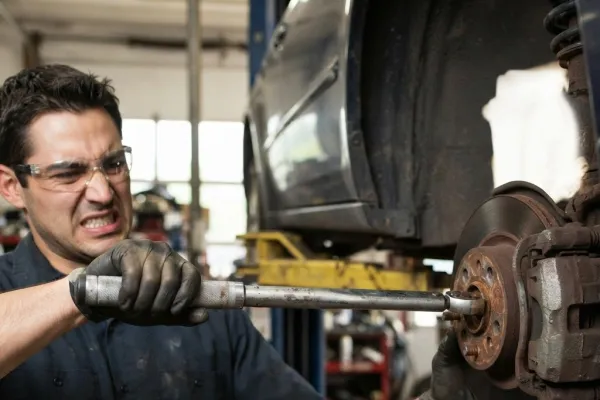
Using a torque wrench to loosen bolts carries real risks.
Tool failure under load. If the internal spring or ratchet pawl fails while you’re applying force, the handle can suddenly spin free. You lose control and your hand or knuckles can slam into nearby metal. That’s how you get broken fingers.
Snapped bolt heads. Applying too much force to a corroded bolt can snap the head off. Now you have a broken bolt flush with the surface, which requires drilling, extraction, or professional machining. That repair can cost $50-200 depending on accessibility.
Flyback from sudden release. When a stuck bolt finally breaks free, the tool can suddenly turn with the bolt, smacking your hand, wrist, or face. This is especially dangerous when using cheater pipes or impact wrenches. Always keep your face out of the plane of rotation.
Eye injuries. Rust and corrosion can flake off when a bolt breaks loose. Those flakes travel at high speed. Wear safety glasses.
Every time.
Overtightening from poor calibration. This is the indirect risk. If you damage your torque wrench’s calibration by using it for loosening, the next time you tighten something critical, it could be wrong. Under-torqued wheel lugs vibrate loose.
Over-torqued head bolts warp the cylinder head.
Always use the right personal protective equipment. Safety glasses, work gloves (cut-resistant if possible), and closed-toe shoes. If you’re using penetrating oil, work in a ventilated area.
If you’re applying heat, have a fire extinguisher nearby.
Final Verdict: Use It or Not?
Here’s the bottom line. Do not use a click-type torque wrench for loosening bolts. The risk of internal damage, calibration drift, and personal injury outweighs any convenience. Beam-style and digital wrenches can handle reverse use, but only on fasteners you know aren’t seized.
Use a breaker bar or impact wrench for loosening. Keep your torque wrench for its designed purpose: precise tightening. That split-second decision to grab the torque wrench instead of the breaker bar can cost you a $100+ tool replacement or a failed repair down the line.
When in doubt, use the right tool. A torque wrench is a precision instrument, not a general-purpose leverage tool. Treat it like one, and it will serve you accurately for years.
Frequently Asked Questions
Will loosening bolts void my torque wrench warranty?
In most cases, yes. Manufacturer documentation from brands like Proto and CDI Torque explicitly states that using the tool for loosening fasteners voids the warranty. Check your manual to be sure.
Can I use a digital torque wrench for loosening?
Yes, if the manufacturer specifies bidirectional capability. Digital wrenches with strain gauge sensors can measure torque in both directions without internal damage. Look for “counter-clockwise” or “reverse” in the product specs.
How do I know if my torque wrench is damaged?
Check for inconsistent clicking, rough ratcheting, or visible play in the head. If your wrench no longer clicks cleanly at the same point each time, or if the reading feels off compared to a known torque value, get it recalibrated.
What’s the best tool for loosening stuck bolts?
A breaker bar with a six-point socket and penetrating oil. That combination handles the vast majority of stuck fasteners. For truly stubborn bolts, add heat or switch to an impact wrench.
Is it safe to use a cheater pipe on a torque wrench?
No. Cheater pipes multiply force beyond what the internal mechanism can handle. You risk snapping the spring or ratchet pawl.
Use a breaker bar instead.
How often should I calibrate my torque wrench?
Every 12 months or 5,000 cycles, whichever comes first. Professional shops often calibrate quarterly. A $30-50 calibration cost is cheap insurance against overtightening or undertorquing critical fasteners.


