


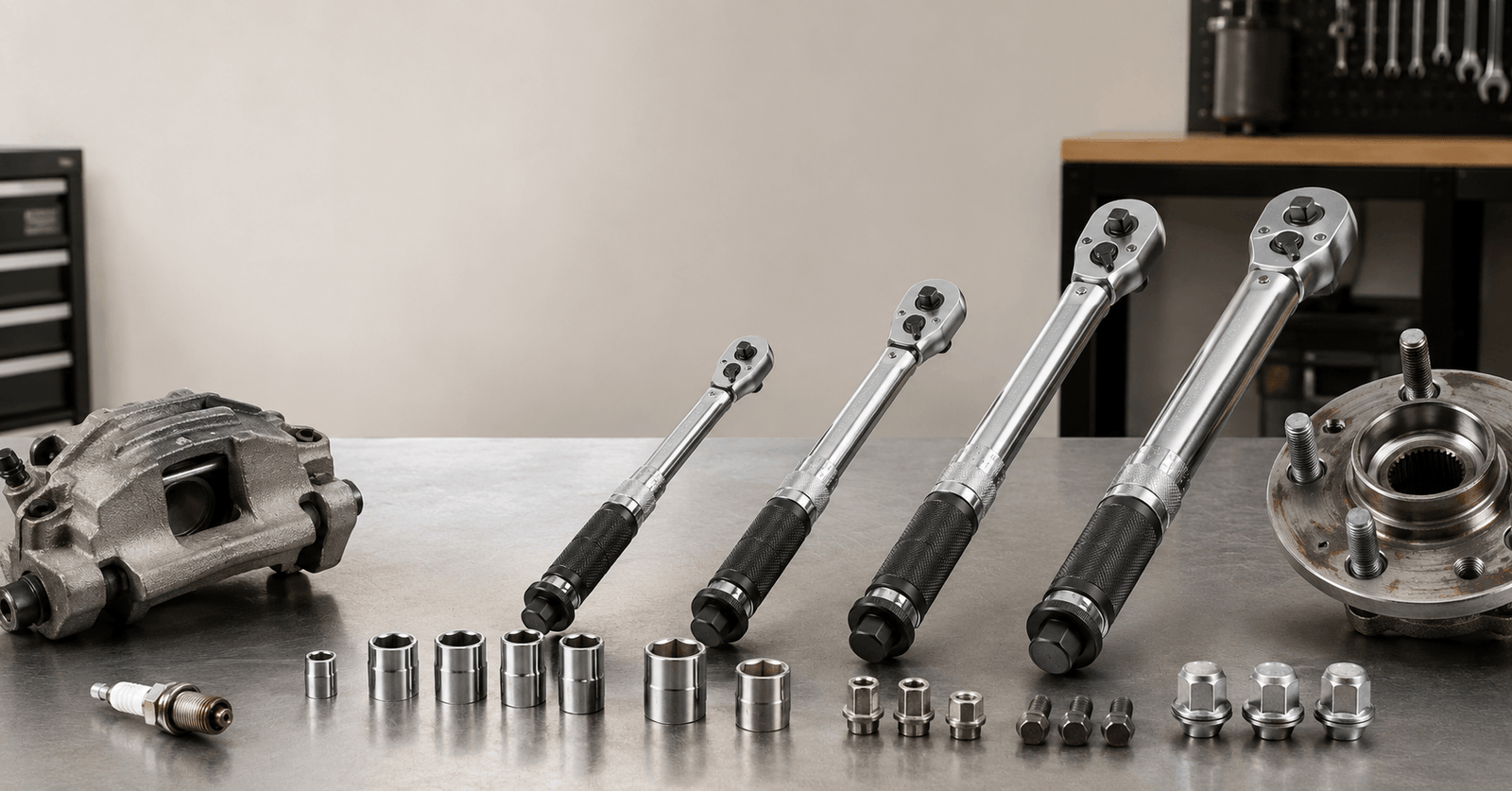
Choosing the right torque wrench size matters more than many beginners realize. A torque wrench is not just a fancy ratchet with numbers on it. It is a precision tool designed to tighten fasteners to a specific torque value, helping prevent over-tightening, under-tightening, damaged threads, warped parts, broken bolts, and unsafe assemblies.
The correct torque wrench size depends on the fastener size, torque specification, socket size, and type of work. It does not simply mean buying the biggest wrench available. A large 1/2-inch torque wrench may be perfect for lug nuts, but it can be inaccurate or awkward for spark plugs, valve covers, bicycles, electronics, or small engine sensors.
For automotive repair, motorcycle maintenance, DIY projects, and mechanical maintenance, torque accuracy directly affects safety and reliability. Lug nuts, brake calipers, suspension bolts, spark plugs, oil drain plugs, and cylinder head bolts all need the right amount of torque. Too little torque can let parts loosen. Too much torque can stretch bolts, crush gaskets, strip threads, or damage expensive components.
This guide explains torque wrench sizes, torque ranges, drive sizes, wrench types, buying advice, and real-world recommendations so you can confidently choose the best torque wrench size for your job.
What size torque wrench do you need?
Most people need a 3/8-inch or 1/2-inch torque wrench first. A 1/4-inch torque wrench is best for low-torque precision work, 3/8-inch suits general automotive and motorcycle maintenance, 1/2-inch handles lug nuts and suspension, while 3/4-inch and larger tools are for trucks and heavy equipment.
The best torque wrench size depends on what you work on most often. The drive size tells you what socket size the wrench accepts, but the torque range tells you whether the wrench can accurately tighten the fastener.
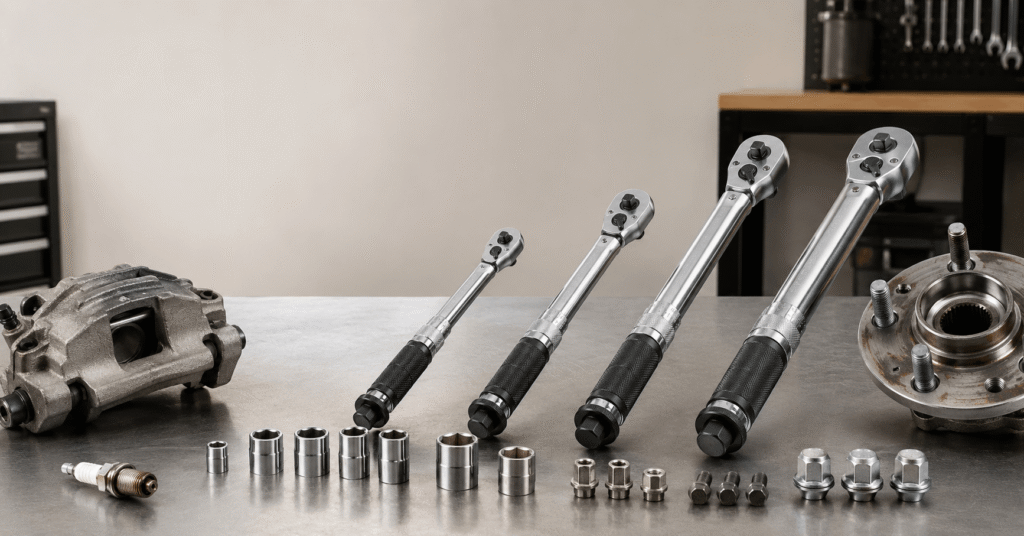
Quick recommendation table
| Main Job Type | Best Torque Wrench Size | Typical Use |
|---|---|---|
| Bicycles, small engines, electronics | 1/4-inch | Low-torque precision fasteners |
| Motorcycles, oil changes, brakes, small car repairs | 3/8-inch | General maintenance |
| Cars, SUVs, lug nuts, suspension | 1/2-inch | Medium-to-high torque jobs |
| Trucks, trailers, farm equipment | 3/4-inch | Heavy-duty torque applications |
| Industrial equipment, large machinery | 1-inch | Very high-torque work |
For most DIY mechanics, the best first purchase is usually a 1/2-inch torque wrench if they mainly work on wheels and suspension. If they do more engine, brake, motorcycle, or smaller mechanical work, a 3/8-inch torque wrench may be more useful.
The smartest long-term setup is often:
- 1/4-inch inch-pound torque wrench for small fasteners
- 3/8-inch foot-pound torque wrench for general maintenance
- 1/2-inch foot-pound torque wrench for wheels, suspension, and heavier automotive work
That three-wrench setup covers far more real-world jobs than one oversized wrench.
Understanding torque wrench drive sizes
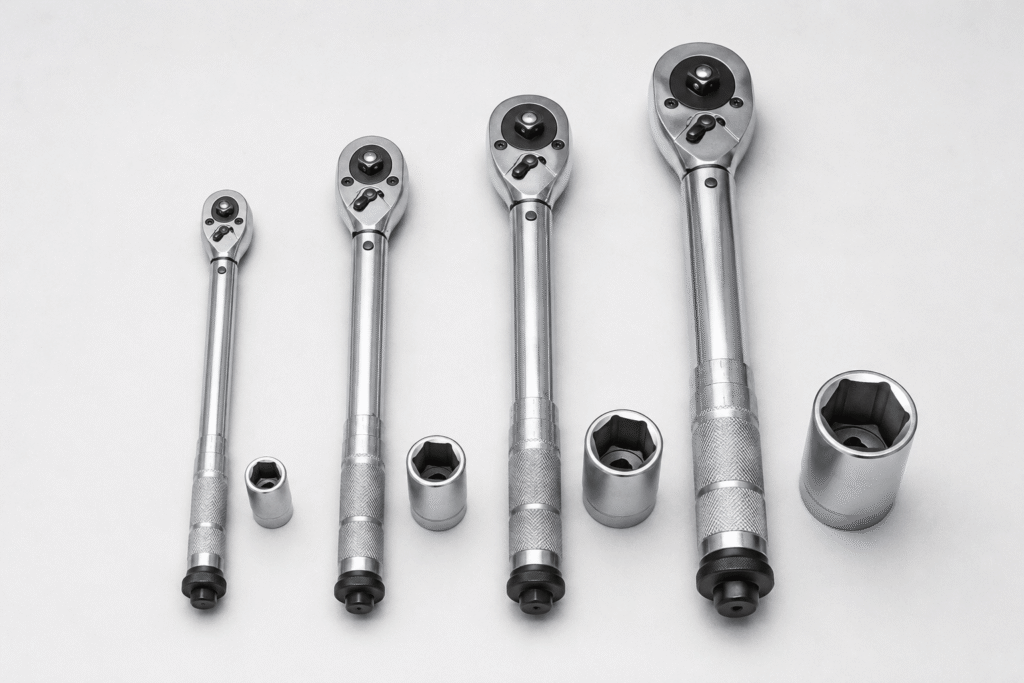
Torque wrench drive size is the square connector that holds the socket. Common drive sizes include 1/4-inch, 3/8-inch, 1/2-inch, 3/4-inch, and 1-inch. Smaller drives fit smaller sockets and lower torque ranges, while larger drives handle bigger sockets, longer handles, and higher torque loads.
A torque wrench drive size is not the same as the torque range, but the two are closely related. A 1/4-inch drive torque wrench usually measures low torque in inch-pounds. A 1/2-inch drive torque wrench usually measures higher torque in foot-pounds.
Common torque wrench drive sizes
- 1/4-inch drive: Small sockets, light torque, precision work
- 3/8-inch drive: Medium sockets, general repair, motorcycles, light automotive
- 1/2-inch drive: Larger sockets, wheels, suspension, SUVs, trucks
- 3/4-inch drive: Heavy-duty automotive, commercial vehicles, trailers
- 1-inch drive: Industrial equipment, heavy machinery, large fasteners
Drive size vs socket size
The drive size must match the socket drive size. For example, a 1/2-inch torque wrench fits 1/2-inch drive sockets. You can use adapters, but adapters add length, increase flex, and may affect accuracy or tool control if used carelessly.
Illustrated comparison description
Imagine five torque wrenches lined up from shortest to longest:
- The 1/4-inch wrench looks slim and compact, like a precision tool.
- The 3/8-inch wrench is medium-sized and easy to handle in engine bays.
- The 1/2-inch wrench is longer and stronger, made for wheel and suspension torque.
- The 3/4-inch wrench is noticeably larger and heavier.
- The 1-inch wrench looks like an industrial tool built for very large fasteners.
The larger the drive size, the more torque the tool usually handles. But bigger is not automatically better. A huge wrench on a small fastener is like using a sledgehammer to hang a picture frame. Technically possible? Maybe. Smart? Absolutely not.
Torque wrench size comparison chart
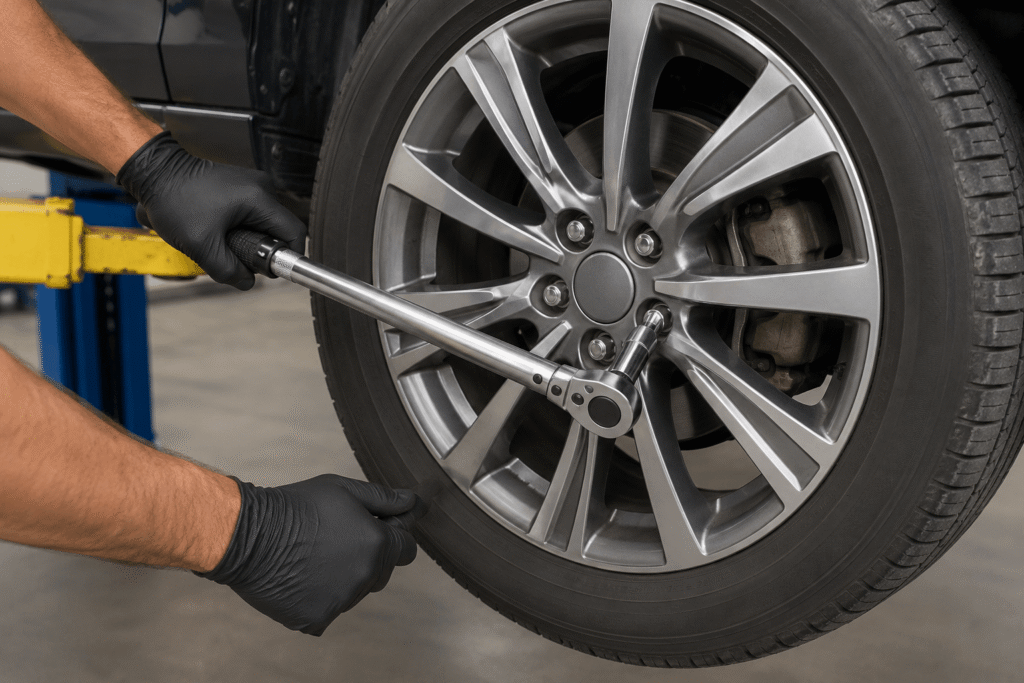
A torque wrench size comparison chart helps you match drive size, torque range, application, and user type. The most common choices are 1/4-inch, 3/8-inch, and 1/2-inch. Heavy-duty users may need 3/4-inch or 1-inch torque wrenches for trucks, machinery, and industrial fasteners.
| Drive Size | Typical Torque Range | Best Applications | Common Users | Advantages | Limitations |
| 1/4-inch | 20–200 in-lb / 2–20 ft-lb | Bicycles, small engines, sensors, valve covers, electronics | Cyclists, motorcycle owners, precision DIYers | Excellent control, accurate at low torque, compact | Too small for lug nuts or suspension |
| 3/8-inch | 10–100 ft-lb | Motorcycles, brakes, oil drain plugs, engine accessories, small automotive work | DIY mechanics, motorcycle owners, home mechanics | Versatile, manageable size, good for medium fasteners | Not ideal for high-torque lug nuts |
| 1/2-inch | 25–250 ft-lb | Lug nuts, suspension, axle parts, trucks, SUVs | Car owners, mechanics, tire shops | Strong, common, ideal for wheels | Too large for small fasteners |
| 3/4-inch | 100–600 ft-lb | Commercial vehicles, trailers, farm machinery, construction equipment | Fleet mechanics, truck shops, heavy equipment techs | Handles serious torque | Heavy, expensive, unnecessary for most DIYers |
| 1-inch | 200–1,000+ ft-lb | Industrial machinery, large trucks, heavy equipment | Industrial technicians, diesel mechanics | Maximum torque capacity | Not practical for normal automotive work |
These ranges are general buying ranges, not fixed rules. Always check the torque specification in the service manual or manufacturer repair documentation before tightening fasteners.
When should you use a 1/4-inch torque wrench?
Use a 1/4-inch torque wrench when the job requires low torque, small sockets, and high precision. It is best for bicycles, electronics, small engine parts, valve covers, spark plugs, interior trim, sensors, and delicate fasteners where a larger wrench can easily over-tighten or damage threads.
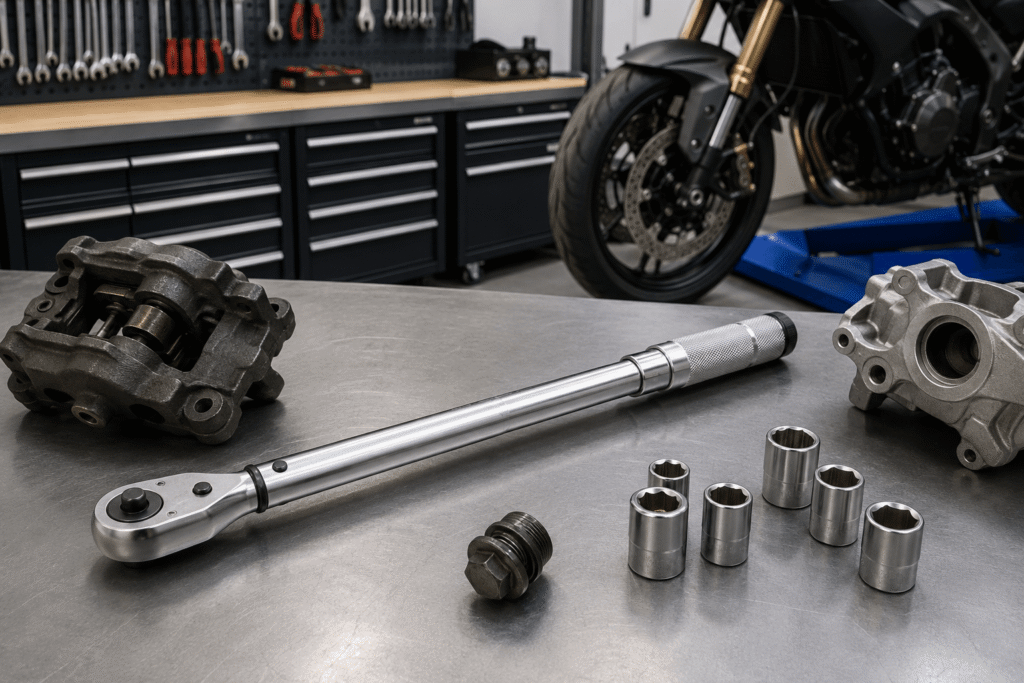
A 1/4-inch torque wrench is usually the best choice for inch-pound torque values. Many small fasteners are not measured in foot-pounds because the torque required is too low. Instead, they use inch-pounds, often written as in-lb.
Best uses for a 1/4-inch torque wrench
- Bicycle stems, handlebars, seat posts, and carbon parts
- Motorcycle covers and small engine fasteners
- Engine sensors
- Valve covers
- Spark plugs on some engines
- Interior trim fasteners
- Small electronics and machine screws
- Plastic housings
- Small aluminum components
Why precision matters here
Small fasteners often thread into aluminum, plastic, or thin metal. Over-tightening can strip threads or crack parts. Under-tightening can cause leaks, vibration, or loose components.
A 1/4-inch torque wrench gives better feel and accuracy at low torque values because it is designed for that range. If a valve cover bolt calls for 80 in-lb, a large 1/2-inch wrench is the wrong tool. It may not even read accurately that low.
Best buyer profile
Buy a 1/4-inch torque wrench if you work on:
- Bicycles
- Motorcycles
- Small engines
- Engine sensors
- Spark plugs
- Low-torque fasteners
- Lightweight mechanical assemblies
For many DIYers, this is not the first torque wrench they buy, but it often becomes one of the most useful once they start doing careful engine or motorcycle work.
When is a 3/8-inch torque wrench the best choice?
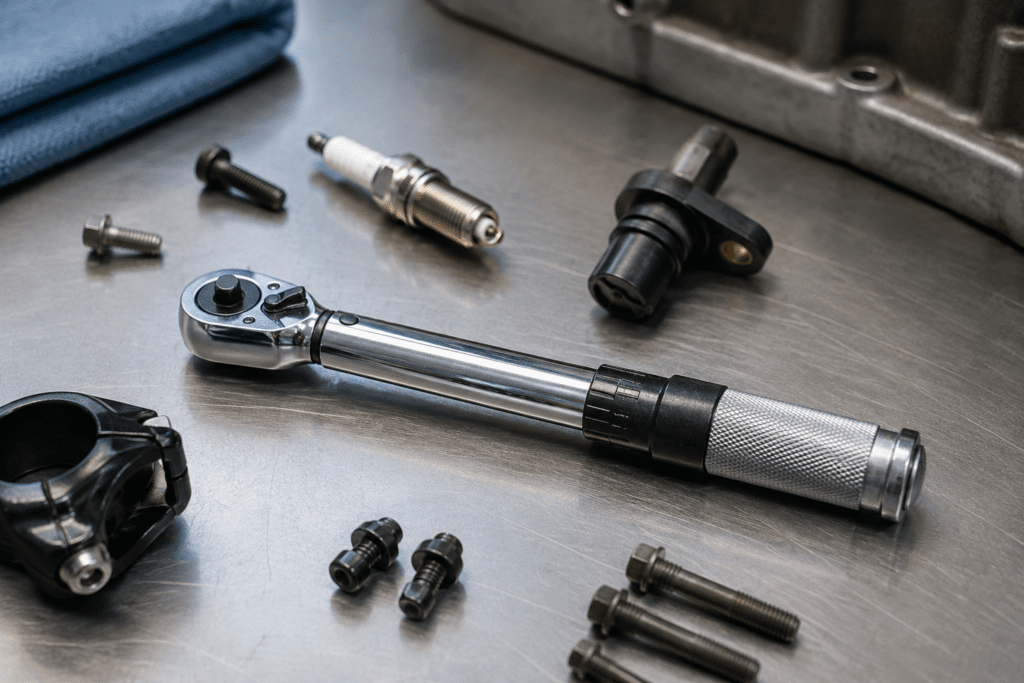
A 3/8-inch torque wrench is best for general automotive repair, motorcycle maintenance, brake work, oil drain plugs, engine accessories, and medium-size fasteners. It offers a useful balance between precision and strength, making it one of the most versatile torque wrench sizes for home mechanics and DIY users.
The 3/8-inch torque wrench sits in the sweet spot between small precision work and heavier automotive work. It is usually easier to handle than a 1/2-inch wrench, especially in tight engine bays.
Common 3/8-inch torque wrench jobs
- Oil drain plugs
- Brake caliper guide pins
- Brake brackets on smaller vehicles
- Motorcycle axle pinch bolts
- Motorcycle engine covers
- Intake manifold bolts
- Water pumps
- Alternator brackets
- Small suspension brackets
- Engine accessories
- Transmission pan bolts
Practical examples
If you change your own oil, a 3/8-inch torque wrench can help tighten the oil drain plug correctly. Too loose and it may leak. Too tight and you may strip the oil pan threads. Nobody wants to explain that repair bill over coffee.
For motorcycle owners, a 3/8-inch drive wrench is extremely useful because many motorcycle fasteners fall in a medium torque range. It is also easier to control on smaller parts.
Best buyer profile
Buy a 3/8-inch torque wrench if you:
- Work on motorcycles
- Do regular car maintenance
- Replace brake parts
- Tighten oil drain plugs
- Work inside engine bays
- Need one versatile medium-duty wrench
For many home mechanics, a 3/8-inch wrench is the best second purchase after a 1/2-inch wrench.
Why a 1/2-inch torque wrench is the most popular
A 1/2-inch torque wrench is popular because it handles common automotive jobs like lug nuts, suspension bolts, axle components, truck maintenance, and heavy car repair. It covers the torque range many DIY mechanics need most often, especially for wheel installation and medium-to-high torque fasteners.
If most people buy only one torque wrench, they often buy a 1/2-inch drive torque wrench. That makes sense because wheel lug nuts are one of the most common torque wrench applications.
Best uses for a 1/2-inch torque wrench
- Lug nuts
- Wheel installation
- Suspension bolts
- Strut bolts
- Control arm bolts
- Axle nuts on some vehicles
- Truck maintenance
- Trailer wheels
- Brake caliper brackets
- Larger engine mounts
- Higher-torque automotive fasteners
Why DIY mechanics often start here
A 1/2-inch torque wrench usually has a long handle and enough leverage for higher torque values. That makes it ideal for tightening wheels after tire rotation, brake work, or seasonal wheel changes.
Correct lug nut torque is important because uneven or incorrect torque can cause wheel vibration, warped brake rotors, damaged studs, or unsafe wheel attachment. A torque wrench helps apply consistent clamping force across all lug nuts.
When not to use it
A 1/2-inch wrench is not ideal for very small fasteners. Do not use it for delicate valve cover bolts, tiny motorcycle cover bolts, small sensors, or bicycle parts unless the specified torque falls comfortably within the wrench’s accurate range.
Most torque wrenches work best in the middle of their range, not at the extreme low or high end. That is one reason a 1/2-inch wrench is not a do-everything solution.
When do you need a 3/4-inch or larger torque wrench?
You need a 3/4-inch or larger torque wrench for high-torque fasteners on commercial vehicles, trailers, construction equipment, agricultural machinery, heavy trucks, and industrial systems. These tools are built for torque values far beyond normal passenger car maintenance and are usually unnecessary for basic DIY automotive work.
A 3/4-inch torque wrench is a heavy-duty tool. It is longer, heavier, and more expensive than standard automotive torque wrenches. It also requires larger sockets and more physical control.
Best uses for 3/4-inch torque wrenches
- Heavy truck wheels
- Commercial trailers
- Agricultural machinery
- Construction equipment
- Large suspension parts
- Fleet maintenance
- Industrial bolted joints
- Large diesel equipment
When you may need a 1-inch torque wrench
A 1-inch torque wrench is normally reserved for industrial equipment, heavy machinery, large trucks, and very large fasteners. This is not a tool most homeowners or casual DIYers need.
Buyer advice
Only buy a 3/4-inch or 1-inch torque wrench if your equipment actually requires it. These tools are not “better” for normal cars. They are simply built for larger fasteners and higher torque specifications.
If you work on passenger cars, SUVs, motorcycles, or home projects, your money is usually better spent on a quality 3/8-inch and 1/2-inch setup.
Torque wrench types explained
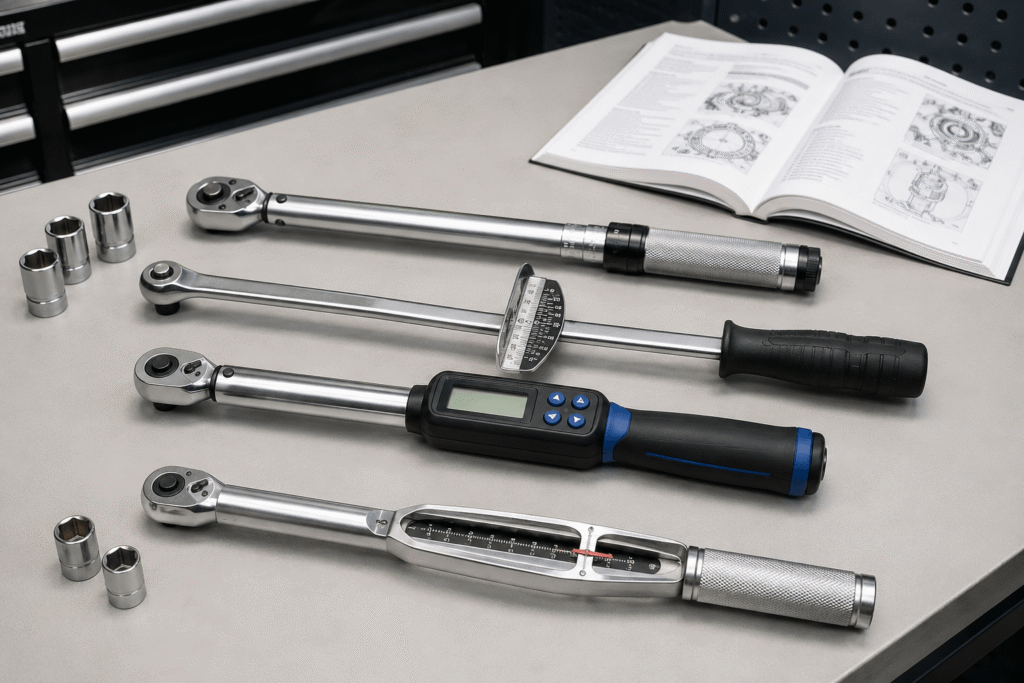
The main torque wrench types are click, beam, digital, and split beam. Click torque wrenches are the most common, beam wrenches are simple and affordable, digital models offer advanced readings, and split beam wrenches are durable and convenient for frequent automotive use.
Torque wrench type matters almost as much as drive size. Different designs suit different budgets, accuracy needs, and work environments.
Click torque wrench
A click torque wrench makes a click or release feel when the preset torque is reached.
Best for:
- Automotive repair
- Wheel installation
- DIY mechanics
- General workshop use
Advantages:
- Easy to use
- Widely available
- Good value
- Familiar design
- Works well for most users
Limitations:
- Needs proper storage
- Can be over-torqued after the click
- Requires periodic calibration
- Lower-quality models may feel vague
Beam torque wrench
A beam torque wrench uses a pointer and scale. As force is applied, the beam bends and the pointer shows torque.
Best for:
- Budget users
- Occasional work
- Simple verification
- Learning torque basics
Advantages:
- Simple design
- No spring mechanism to wind down
- Affordable
- Durable if handled carefully
Limitations:
- Harder to read
- Requires good viewing angle
- Less convenient in tight spaces
Digital torque wrench
A digital torque wrench uses an electronic sensor and display. Many models beep, vibrate, or light up near the target torque.
Best for:
- Professionals
- Precision work
- Torque-angle applications
- Users who want clear feedback
Advantages:
- Easy-to-read display
- Often supports ft-lb, in-lb, and Nm
- Audible and visual alerts
- Some models store readings
Limitations:
- More expensive
- Requires batteries
- More sensitive to damage
- May be overkill for beginners
Split beam torque wrench
A split beam torque wrench uses a beam-style internal mechanism with an adjustable setting. It is popular among technicians because it is fast and durable.
Best for:
- Frequent automotive work
- Tire shops
- Professional mechanics
- Users who dislike winding click wrenches down
Advantages:
- Easy to set
- Durable
- Good for repeated work
- Often does not need to be stored at lowest setting like traditional click models
Limitations:
- More expensive than basic click wrenches
- Usually limited to specific torque ranges
- Not ideal for very low torque
How to match torque wrench size to your project
Match torque wrench size to your project by checking the manufacturer torque specification, choosing a wrench whose range comfortably includes that value, and selecting the drive size that fits the socket and fastener. Avoid using a wrench at the very bottom or top of its rated range.
The right process is simple:
- Find the torque specification.
- Check whether it is listed in in-lb, ft-lb, or Nm.
- Choose a wrench with a suitable torque range.
- Match the drive size to your sockets.
- Use the correct socket and tightening sequence.
Home DIY
For furniture, appliances, small machines, and light mechanical work, a 1/4-inch or 3/8-inch torque wrench is usually enough.
Recommended:
- 1/4-inch for small screws and delicate fasteners
- 3/8-inch for medium bolts and general repairs
Car maintenance
For cars, most DIYers should own a 1/2-inch torque wrench first, especially if they remove wheels.
Recommended:
- 1/2-inch for lug nuts and suspension
- 3/8-inch for oil plugs, brakes, and engine accessories
Motorcycle repair
Motorcycles use many medium and low-torque fasteners. A 3/8-inch wrench is often the main tool, with a 1/4-inch wrench for smaller engine and bodywork fasteners.
Recommended:
- 3/8-inch for general motorcycle maintenance
- 1/4-inch for small covers, sensors, and delicate bolts
Bicycle maintenance
Bicycles need low torque and high care, especially carbon fiber components.
Recommended:
- 1/4-inch inch-pound or Newton-meter torque wrench
Engine rebuilding
Engine work often needs multiple torque ranges. Cylinder head bolts, main caps, rod bolts, valve covers, and sensors can require different tools.
Recommended:
- 1/4-inch for small fasteners
- 3/8-inch for medium engine fasteners
- 1/2-inch for higher-torque engine and drivetrain fasteners
Heavy equipment
Heavy equipment requires high-capacity torque tools and sometimes torque multipliers.
Recommended:
- 3/4-inch for heavy-duty fasteners
- 1-inch for industrial and large machinery applications
Common torque ranges for automotive jobs
Common automotive torque values vary by vehicle, fastener size, material, and manufacturer specifications. Lug nuts often require higher torque, while spark plugs, valve covers, and oil drain plugs need lower torque. Always follow the vehicle manufacturer’s service manual instead of guessing from a generic chart.
| Automotive Job | Common Torque Range | Common Wrench Size |
| Lug nuts | 80–140 ft-lb | 1/2-inch |
| Spark plugs | 10–25 ft-lb / sometimes in-lb | 3/8-inch or 1/4-inch |
| Oil drain plugs | 15–35 ft-lb | 3/8-inch |
| Brake caliper guide pins | 15–35 ft-lb | 3/8-inch |
| Brake caliper brackets | 70–120+ ft-lb | 1/2-inch |
| Valve cover bolts | 40–120 in-lb | 1/4-inch |
| Wheel bearings / hub bolts | 60–180+ ft-lb | 1/2-inch |
| Suspension bolts | 80–200+ ft-lb | 1/2-inch |
| Cylinder head bolts | Varies widely; may require torque-angle | 1/2-inch or digital torque-angle wrench |
These are general examples only. Manufacturer torque specifications matter because fastener material, thread pitch, lubrication, gasket type, and bolt design all affect torque.
Mistakes people make when choosing a torque wrench
The biggest torque wrench mistakes include buying only the largest size, ignoring torque range, using the tool outside its accurate range, using extensions incorrectly, skipping calibration, storing click wrenches under spring tension, and using a torque wrench as a breaker bar.
Here are the mistakes to avoid.
1. Buying only the biggest wrench
A 1/2-inch or 3/4-inch torque wrench looks strong, but it cannot replace a low-range 1/4-inch wrench. Small fasteners need precision, not brute force.
2. Ignoring torque range
Drive size is not enough. A wrench must cover the required torque value comfortably.
3. Using the bottom of the range
Many torque wrenches are most reliable in the middle of their working range. Avoid using a wrench at its extreme low setting unless the manufacturer states it is accurate there.
4. Using extensions incorrectly
Normal straight extensions usually have minimal effect when kept aligned, but crowfoot adapters and offset extensions can change effective length and torque. If the adapter changes the lever length, you may need a torque correction formula.
5. Not calibrating
A torque wrench can drift over time, especially with heavy use, drops, overloads, or poor storage.
6. Storing click wrenches under tension
Many click-type wrenches should be returned to their lowest marked setting after use. Do not wind below the minimum unless the manufacturer says it is safe.
7. Using it as a breaker bar
A torque wrench is for tightening to specification, not loosening stuck bolts. Use a breaker bar for loosening. Save the torque wrench for the final tightening step.
Tips for accurate torque wrench use
For accurate torque wrench use, choose the correct range, set the torque carefully, use the proper socket, tighten smoothly, follow the correct sequence, stop at the click or alert, avoid jerky force, and store the tool properly after use. Accuracy depends on both the tool and the user.
Step-by-step torque wrench use
- Find the torque specification
Use the service manual, manufacturer guide, or repair database. - Choose the correct wrench
Make sure the target torque falls inside the tool’s usable range. - Inspect the fastener and threads
Dirty, damaged, rusty, or lubricated threads can change clamping force. - Set the torque value
Lock the setting if the wrench has a lock ring or knob. - Use the correct socket
Use quality sockets that fit properly. Avoid damaged sockets. - Tighten by hand first
Start fasteners by hand to avoid cross-threading. - Apply smooth pressure
Pull steadily from the handle grip. Do not jerk the wrench. - Stop at the click, beep, or indicator
Once the wrench signals target torque, stop. Do not add “just a little more.” - Use the correct tightening sequence
Wheels, cylinder heads, and covers often require a star, crisscross, or staged pattern. - Store the wrench correctly
Clean it, return it to the proper setting, and keep it in its case.
Expert note
Torque is not the same as clamping force. Torque is a turning force applied to the fastener. Clamping force is the tension created in the joint. Thread condition, lubrication, washers, coatings, and fastener quality all affect the final clamping force.
Maintenance and calibration
Torque wrench maintenance includes cleaning the tool, storing it in a protective case, avoiding drops, preventing overload, checking accuracy, and recalibrating periodically. Calibration frequency depends on usage, workplace requirements, safety importance, and manufacturer guidance, but annual recalibration is a common baseline for many users.
A torque wrench is a measuring tool. Treat it more like a scale or gauge than a normal ratchet.
Basic maintenance checklist
- Wipe the wrench after use
- Keep it dry
- Store it in its case
- Avoid dropping it
- Do not exceed rated torque
- Do not use it to loosen stuck fasteners
- Keep ratchet heads clean
- Follow manufacturer storage instructions
- Check calibration after overload or impact
How often should you calibrate?
Many professional shops calibrate torque wrenches every 6 to 12 months, depending on usage and quality requirements. Heavy use, safety-critical work, or repeated high-torque work may require more frequent testing.
You should recalibrate sooner if:
- The wrench was dropped
- It was overloaded
- It was used daily in a shop
- It was exposed to dirt, water, or chemicals
- It no longer clicks consistently
- It is used for critical assemblies
- A quality-control program requires it
For casual DIY users, periodic accuracy checks and careful storage may be enough between professional calibrations. For professional technicians, documented calibration is a much bigger deal.
Expert buying advice
Buy one torque wrench if your work is narrow, two torque wrenches if you do regular automotive maintenance, and a complete torque wrench set if you handle bicycles, motorcycles, cars, engine work, and heavy-duty repairs. The best setup depends on torque range, not tool size alone.
When to buy one torque wrench
Buy one wrench if you only do one main type of job.
Best single-wrench choices:
- Wheel and tire work: 1/2-inch torque wrench
- Motorcycle maintenance: 3/8-inch torque wrench
- Bicycle repair: 1/4-inch torque wrench
- Small engine work: 1/4-inch or 3/8-inch torque wrench
When to buy two torque wrenches
Most DIY car owners benefit from two.
Best two-wrench setup:
- 3/8-inch torque wrench for oil plugs, brakes, engine accessories
- 1/2-inch torque wrench for lug nuts, suspension, wheels
This setup covers most passenger car maintenance.
When to buy a complete torque wrench set
Buy a full set if you work on multiple machines or do serious mechanical work.
Best complete setup:
- 1/4-inch inch-pound wrench
- 3/8-inch foot-pound wrench
- 1/2-inch foot-pound wrench
- Optional digital torque-angle wrench for engine assembly
- Optional 3/4-inch wrench for trucks and heavy equipment
Recommendations by user type
| User Type | Best Setup |
| Beginner DIYer | 1/2-inch click torque wrench |
| Car owner | 1/2-inch + 3/8-inch |
| Motorcycle owner | 3/8-inch + 1/4-inch |
| Bicycle owner | 1/4-inch Nm/in-lb wrench |
| Home mechanic | 1/4-inch + 3/8-inch + 1/2-inch |
| Professional technician | Full set, calibrated, with digital or split beam options |
Torque wrench size comparison table
The best torque wrench size depends on torque range, tool weight, accuracy needs, typical jobs, budget, and comfort. A 1/4-inch wrench offers precision, 3/8-inch offers versatility, 1/2-inch offers automotive strength, and 3/4-inch handles heavy-duty torque applications.
| Feature | 1/4-inch | 3/8-inch | 1/2-inch | 3/4-inch |
| Typical Torque Range | 20–200 in-lb | 10–100 ft-lb | 25–250 ft-lb | 100–600 ft-lb |
| Weight | Light | Medium | Medium-heavy | Heavy |
| Accuracy Use Case | Low torque precision | General repair | High automotive torque | Heavy equipment |
| Typical Jobs | Bicycles, sensors, valve covers | Oil plugs, brakes, motorcycles | Lug nuts, suspension, wheels | Trucks, trailers, machinery |
| Price Range | Low to medium | Low to medium | Medium | High |
| Ease of Use | Easy in tight spaces | Very versatile | Strong but larger | Requires strength and space |
| Best For | Delicate fasteners | General mechanics | Cars and SUVs | Commercial/heavy-duty work |
Decision tree: which torque wrench should I buy?
Choose a torque wrench by starting with your main project type. Bicycles usually need 1/4-inch, motorcycles usually need 3/8-inch, cars often need 3/8-inch or 1/2-inch, SUVs usually need 1/2-inch, and trucks may require 3/4-inch depending on torque specifications.
Use this simple decision guide:
- Do you mainly work on bicycles?
Buy a 1/4-inch torque wrench. - Do you mainly work on motorcycles?
Buy a 3/8-inch torque wrench, then add a 1/4-inch later. - Do you mainly work on cars?
Buy a 1/2-inch torque wrench for wheels, then add a 3/8-inch. - Do you mainly work on SUVs?
Buy a 1/2-inch torque wrench. - Do you mainly work on trucks or trailers?
Check the torque specs. You may need 1/2-inch or 3/4-inch. - Do you rebuild engines?
Buy 1/4-inch, 3/8-inch, and 1/2-inch, and consider a digital torque-angle wrench. - Do you work in industrial maintenance?
Consider 3/4-inch, 1-inch, torque multipliers, and calibrated professional tools.
Expert tips for choosing and using torque wrenches
The best torque wrench results come from matching the tool to the torque specification, using quality sockets, tightening smoothly, avoiding range extremes, storing the wrench correctly, and recalibrating when needed. Good technique protects fasteners, improves repeatability, and helps prevent expensive mechanical mistakes.
Here are 15 practical tips:
- Buy by torque range first, drive size second.
The torque value matters more than the square drive. - Keep the target torque near the middle of the range.
This usually improves accuracy and control. - Use inch-pound wrenches for small fasteners.
Do not guess low torque with a large foot-pound wrench. - Use foot-pound wrenches for automotive wheels and suspension.
Lug nuts and suspension parts usually need higher torque. - Check manufacturer specifications every time.
Generic charts are not a replacement for a service manual. - Do not use a torque wrench as a breaker bar.
Loosening stuck bolts can damage the mechanism. - Stop when the wrench clicks.
Extra movement after the click can over-tighten the fastener. - Use slow, steady pressure.
Jerky force can produce inaccurate torque. - Hold the wrench at the marked grip area.
Hand position affects leverage and consistency. - Use impact sockets with impact tools, not torque wrenches by default.
For hand torque, quality chrome sockets are usually fine unless the job requires impact-rated sockets. - Avoid cheap adapters when precision matters.
Poor adapters add play and flex. - Understand crowfoot adapter correction.
If the adapter extends the wrench length, torque changes. - Tighten wheels in stages.
Use a star pattern and final torque pass. - Store click wrenches properly.
Follow the manufacturer’s storage instructions. - Recalibrate after a drop or overload.
A damaged torque wrench can still look fine but read incorrectly.
Quick buying checklist
A good torque wrench purchase starts with the torque range, drive size, wrench type, socket quality, calibration confidence, and comfort. Before buying, confirm your common jobs, required units, fastener sizes, and whether you need low-torque precision or high-torque automotive strength.
Use this checklist before buying:
✔ Know the required torque range
✔ Match drive size to fasteners
✔ Choose the right wrench type
✔ Buy quality sockets
✔ Verify calibration
✔ Avoid overextending torque range
✔ Store correctly
✔ Follow manufacturer specifications
✔ Recalibrate periodically
✔ Select a comfortable wrench length
✔ Check whether you need in-lb, ft-lb, or Nm
✔ Choose a readable scale or digital display
✔ Confirm clockwise and counterclockwise accuracy if needed
✔ Avoid unknown bargain tools for critical work
✔ Buy a case or storage box if not included
Key takeaways
Most DIYers should start with a 1/2-inch torque wrench for lug nuts and wheel work, then add a 3/8-inch for general maintenance and a 1/4-inch for low-torque precision. The right torque wrench size depends on the fastener’s required torque, not just the vehicle or tool size.
- 1/4-inch torque wrenches are best for bicycles, sensors, valve covers, spark plugs, and small fasteners.
- 3/8-inch torque wrenches are best for motorcycles, oil drain plugs, brakes, and general automotive maintenance.
- 1/2-inch torque wrenches are best for lug nuts, wheels, suspension, and heavier car or SUV work.
- 3/4-inch torque wrenches are for commercial vehicles, trailers, machinery, and heavy equipment.
- 1-inch torque wrenches are industrial tools for very large fasteners.
- Do not buy the largest wrench and expect it to do everything.
- Always follow manufacturer torque specifications.
- Store, use, and calibrate torque wrenches like precision measuring tools.
Frequently Asked Question
What size torque wrench is best for lug nuts?
A 1/2-inch torque wrench is usually best for lug nuts because most passenger cars, SUVs, and light trucks require medium-to-high torque values. It offers enough leverage and range for wheel installation. Always confirm the exact lug nut torque in the vehicle owner’s manual or service information.
Is a 3/8 or 1/2 torque wrench better?
A 3/8-inch torque wrench is better for motorcycles, brakes, oil drain plugs, and medium fasteners. A 1/2-inch torque wrench is better for lug nuts, suspension bolts, and higher-torque automotive work. For car maintenance, owning both is ideal because they cover different torque ranges.
Can one torque wrench do everything?
One torque wrench cannot do everything accurately. A large wrench may handle lug nuts but be unsuitable for small valve cover bolts or bicycle parts. A small wrench may be precise but too weak for suspension work. Most serious DIYers eventually need at least two torque wrenches.
Do I need inch-pounds or foot-pounds?
Use inch-pounds for low-torque fasteners and foot-pounds for medium-to-high torque fasteners. Small engine parts, valve covers, sensors, and bicycles often use in-lb or Nm. Lug nuts, suspension bolts, and many automotive fasteners usually use ft-lb. Always match the unit in the service manual.
What torque wrench do mechanics use?
Mechanics commonly use 1/4-inch, 3/8-inch, and 1/2-inch torque wrenches. Many professionals also use digital torque-angle wrenches, split beam torque wrenches, and larger 3/4-inch tools for trucks or heavy equipment. Professional shops usually maintain calibration records for critical work.
How accurate are click torque wrenches?
Quality click torque wrenches are commonly rated around ±3% to ±4% clockwise accuracy within their specified working range, though this varies by brand and model. Accuracy depends on calibration, storage, tool quality, and user technique. Always check the manufacturer’s stated accuracy range.
Should beginners buy a digital torque wrench?
Beginners can buy a digital torque wrench, but it is not always necessary. A good click torque wrench is usually easier, cheaper, and durable enough for basic DIY work. Digital models are useful when you need clear readings, multiple units, torque-angle measurement, or professional-level feedback.
How often should a torque wrench be calibrated?
Many torque wrench manufacturers and calibration programs use 12 months or 5,000 cycles as a common recalibration baseline. Heavy use, drops, overloads, safety-critical work, and professional shop requirements may require more frequent calibration. Casual users should still check accuracy periodically.
Can you loosen bolts with a torque wrench?
You should not use a torque wrench to loosen stuck bolts. A torque wrench is a measuring tool designed for controlled tightening. Using it as a breaker bar can damage the internal mechanism and affect accuracy. Use a breaker bar or ratchet for loosening, then torque during final tightening.
What happens if you use the wrong torque wrench size?
Using the wrong torque wrench size can cause inaccurate torque, stripped threads, broken bolts, damaged parts, leaks, vibration, or unsafe assemblies. A wrench that is too large may over-tighten small fasteners, while a wrench that is too small may be overloaded on high-torque jobs.
Conclusion
So, what size torque wrench do you need? For most people, the answer is simple: buy based on the job, not the biggest tool on the shelf. A 1/4-inch torque wrench is best for low-torque precision, a 3/8-inch torque wrench is excellent for general maintenance, and a 1/2-inch torque wrench is the go-to choice for lug nuts, wheels, and heavier automotive work.
If you only work on cars and want one tool first, start with a quality 1/2-inch click torque wrench. If you do motorcycles, brakes, oil changes, or engine bay work, a 3/8-inch torque wrench may be more useful. If you handle bicycles, sensors, valve covers, and delicate fasteners, add a 1/4-inch inch-pound torque wrench.
The best torque wrench is not the largest one. It is the one that matches the manufacturer’s torque specification, fits the fastener, works within the right range, and helps you tighten parts safely and accurately.
