








Buying a circular saw sounds simple until you start comparing blade sizes, motor power, battery platforms, bevel capacity, cutting depth, worm drive vs sidewinder designs, and safety features. The wrong saw can leave rough cuts, stall in thick lumber, feel uncomfortable after a few minutes, or create avoidable safety risks.
This guide explains how to choose a circular saw based on your projects, skill level, budget, and long-term tool needs. Whether you are a DIY homeowner cutting plywood, a beginner building your first workbench, a furniture maker chasing clean sheet-good cuts, or a contractor framing every week, the right circular saw should feel powerful, accurate, safe, and comfortable.
You will learn which blade size to choose, when corded beats cordless, why motor power and RPM matter, what safety features are worth paying for, and which circular saws are worth considering.
Quick Answer: How Do You Choose the Right Circular Saw?
Choose a circular saw by matching the blade size, motor power, cutting depth, power source, and features to your projects. A 7-1/4 inch circular saw is best for most users, while 6-1/2 inch cordless saws suit lighter DIY work. Choose corded for continuous power, cordless for portability, and prioritize safety, ergonomics, blade quality, and budget.
Why Choosing the Right Circular Saw Matters
Choosing the right circular saw matters because blade size, power, weight, safety features, and saw design directly affect cutting accuracy, speed, fatigue, and control. A saw that fits your work helps you cut cleaner, avoid stalls, reduce kickback risk, and get better long-term value from blades, batteries, and accessories.
A circular saw is one of the most useful construction tools and DIY tools, but not every electric circular saw is built for the same job. A lightweight battery circular saw may be perfect for trimming plywood, while a heavy-duty worm drive saw is better for framing lumber and pressure-treated stock.
The wrong saw usually causes three problems: poor performance, reduced accuracy, and unnecessary fatigue. A small underpowered saw may struggle with wet framing lumber. A heavy rear-handle saw may feel awkward for a first-time buyer cutting a few boards on weekends.
Safety also matters. OSHA requires portable circular saws with blades over 2 inches to have upper and lower guards, and the lower guard must return automatically when the saw leaves the workpiece. OSHA also identifies kickback as a major hazard, especially when ripping, using poor-quality lumber, or using the wrong blade.
| Factor | Why It Matters | Buying Impact |
|---|---|---|
| Blade size | Controls cutting depth and blade availability | 7-1/4 inch is most versatile |
| Motor power | Affects speed under load | Higher power helps in thick lumber |
| Corded vs cordless | Determines runtime and portability | Corded for long cuts, cordless for mobility |
| Weight | Affects control and fatigue | Lighter saws help beginners |
| Bevel capacity | Enables angled cuts | Important for framing and finish carpentry |
| Safety features | Reduces risk and improves control | Electric brake, guard, trigger lock matter |
| Ergonomics | Affects comfort and accuracy | Handle shape and balance matter |
A good circular saw does not need every feature. It needs the right features for the cuts you actually make.
Key Factors to Consider Before Buying a Circular Saw
The most important circular saw buying factors are blade size, cutting depth, motor power, power source, weight, ergonomics, bevel capacity, and safety features. Start with your material thickness and project type, then choose a saw that has enough power, comfortable handling, reliable blade availability, and safety controls you will actually use.
Blade Size

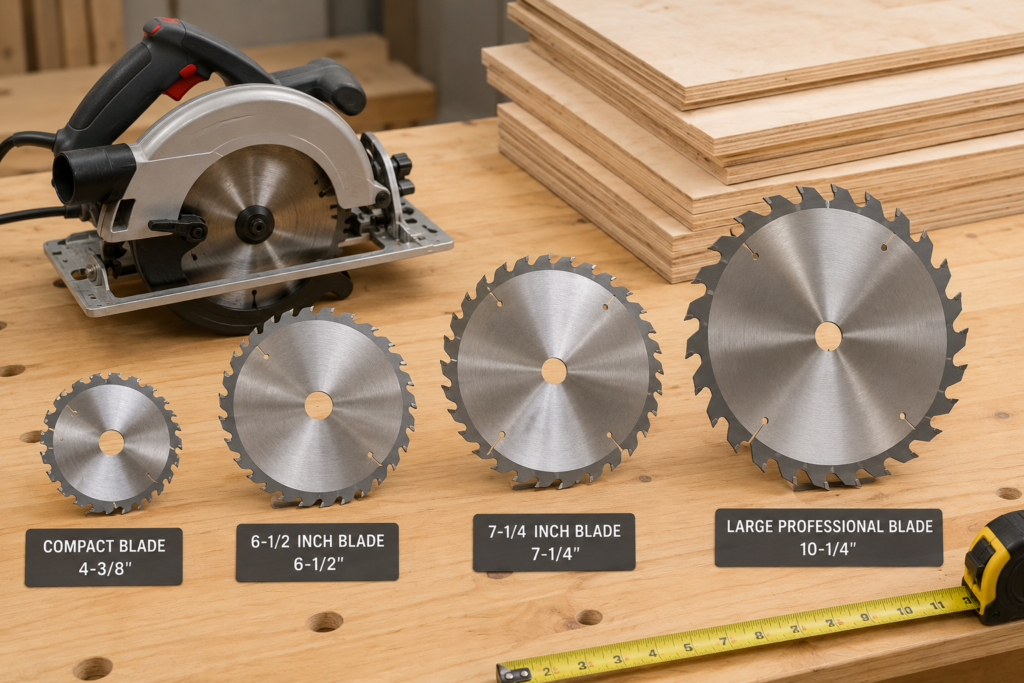
Blade size determines how deep the saw can cut, what materials it handles well, and how easy it is to find replacement blades. The most common handheld circular saw blade sizes are 6-1/2 inch and 7-1/4 inch, while compact saws often use smaller blades. Lowe’s blade guidance lists 6-1/2 inch and 7-1/4 inch as standard handheld circular saw sizes.
5-3/8 Inch Circular Saw
A 5-3/8 inch circular saw is usually a compact or older cordless saw size. It is light and easy to control, but it has limited cutting depth.
Pros
- Lightweight
- Easy to store
- Good for thin boards and panel work
- Less intimidating for light DIY tasks
Cons
- Limited depth of cut
- Not ideal for framing
- Fewer blade options than 7-1/4 inch
- Slower for thick lumber
Ideal users: occasional DIYers, hobbyists, and users cutting thin sheet goods or trim.
6-1/2 Inch Circular Saw
A 6-1/2 inch circular saw is popular in cordless models because it balances cutting capacity, battery efficiency, and weight. It can handle many plywood, OSB, deck board, and 2x lumber tasks, depending on the saw’s depth capacity.
Pros
- Lighter than most 7-1/4 inch saws
- Common in cordless platforms
- Good for plywood cutting and general DIY
- Easier to control overhead or one-handed where safe and appropriate
Cons
- Less cutting depth than 7-1/4 inch models
- May not cut all thick framing material in one pass
- Blade selection is good but not as wide as 7-1/4 inch
Ideal users: DIY homeowners, remodelers, trim carpenters, and cordless tool users who value portability.
7-1/4 Inch Circular Saw
A 7-1/4 inch circular saw is the best circular saw size for most people. It offers enough cutting depth for common construction lumber, has excellent blade availability, and works for framing, plywood cutting, cross cuts, rip cuts, decking, and general woodworking.
Pros
- Best all-around blade size
- Easy to find blades for wood, plywood, framing, laminate, and specialty materials
- Good cutting depth for 2x lumber
- Available in corded and cordless models
- Suitable for DIY and professional use
Cons
- Heavier than compact saws
- More saw than some occasional users need
- Cordless versions need strong batteries for best performance
Ideal users: most DIYers, beginners, carpenters, remodelers, contractors, and woodworkers.
Larger Professional Blades
Some professional circular saws use larger blades, including 8-1/4 inch or specialty sizes. These are less common for general DIY work and are usually chosen for specific construction, timber, beam, or production cutting tasks.
Pros
- More cutting depth
- Better for thick stock
- Useful in specialized professional work
Cons
- Heavier
- More expensive
- Less beginner-friendly
- Blades may cost more
Ideal users: contractors, timber framers, and professionals with repeated deep-cut requirements.
Cutting Depth
Cutting depth tells you how thick a material the saw can cut in one pass. For most buyers, the saw should cut standard 2x lumber at 90 degrees and offer enough depth at 45 degrees for bevel cuts.
A typical 7-1/4 inch circular saw can cut around 2-3/8 to 2-5/8 inches at 90 degrees, depending on the model. For example, the SKIL 5280 manual lists a 7-1/4 inch blade, 5/8 inch arbor, 2-7/16 inch depth at 90 degrees, and 1-15/16 inch depth at 45 degrees.
| Material | Recommended Capability |
|---|---|
| 2×4 lumber | At least 1-1/2 inch cut depth; 7-1/4 inch preferred |
| Plywood | 6-1/2 inch or 7-1/4 inch works well |
| Hardwood boards | Strong motor and sharp blade matter more than size alone |
| Decking | 6-1/2 inch works; 7-1/4 inch gives more flexibility |
| Framing lumber | 7-1/4 inch saw with strong motor is best |
| Beveled 2x cuts | Check 45-degree cutting depth before buying |
A useful rule: buy enough cutting depth for your thickest normal project, not your thinnest project.
Motor Power
Motor power affects how well the saw maintains speed through thick, wet, dense, or engineered material. For corded saws, power is usually shown in amps. For cordless saws, look at voltage, brushless motor design, battery capacity, and real-world cutting performance.
For corded saws, 15 amps is the common standard for full-size 7-1/4 inch circular saws. For cordless saws, 18V, 20V Max, 24V, 36V, and higher-voltage systems can all work well, but battery quality matters. A weak battery on a strong saw is like putting bicycle tires on a pickup truck.
Key motor terms:
- Amps: Common corded power rating. A 15-amp saw is usually best for general full-size use.
- Watts: Shows power output or input depending on manufacturer wording. Compare carefully.
- Brushless motor: More efficient, usually better runtime, less maintenance, and stronger performance under load.
- Battery voltage: Higher voltage can help, but motor design and battery capacity matter too.
- RPM: Higher RPM can cut faster, but torque and blade quality decide how well the saw performs under load.
For example, Milwaukee states that the M18 FUEL 7-1/4 inch saw uses a POWERSTATE brushless motor at 5,800 RPM and is designed for carpenters, remodelers, and general contractors.
Corded vs Cordless Circular Saw
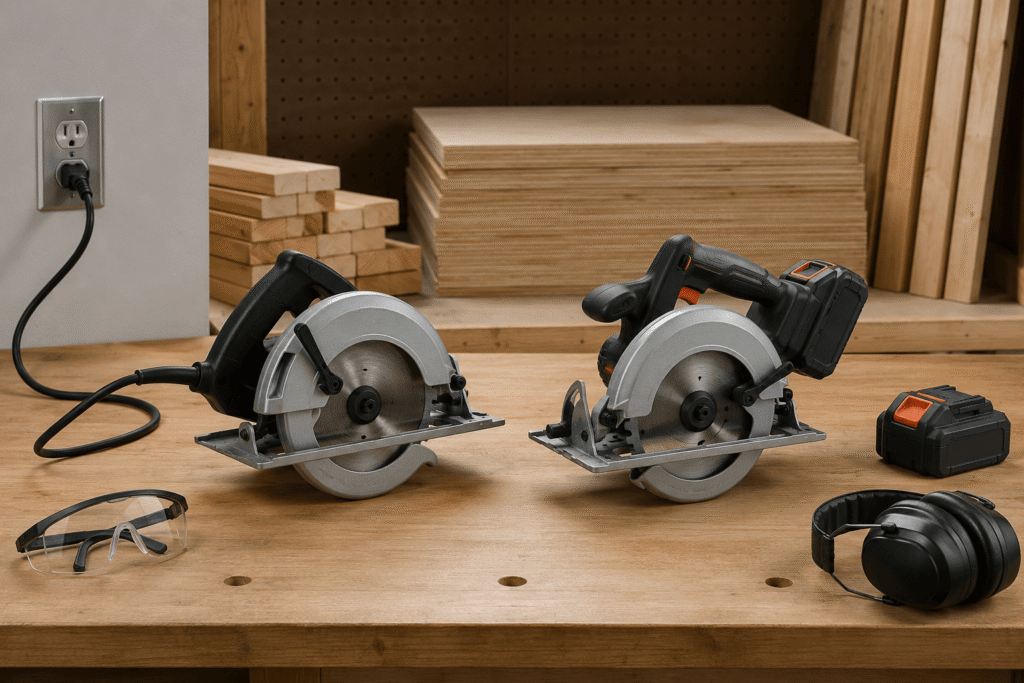
A corded circular saw is best for continuous power, heavy cutting, and lower upfront cost, while a cordless circular saw is best for portability, quick jobs, outdoor work, and jobsites without easy power access. Choose corded for long framing sessions and cordless if mobility matters more than unlimited runtime.
| Category | Corded Circular Saw | Cordless Circular Saw |
|---|---|---|
| Power | Consistent power | Strong with modern brushless models |
| Runtime | Unlimited with outlet | Limited by battery size |
| Portability | Limited by cord | Excellent |
| Maintenance | Simple; inspect cord | Battery care required |
| Cost | Usually cheaper tool-only | Higher if buying batteries/charger |
| Best use | Framing, workshop, long cuts | Remodeling, jobsite, quick cuts |
| Beginner fit | Good value | Easier movement, less cord hassle |
| Professional fit | Great for heavy repetitive work | Great if already in battery platform |
A smart buying shortcut: if you already own batteries from DeWalt, Milwaukee, Makita, Bosch, Ryobi, or FLEX, staying within that battery platform often saves money.
Weight and Ergonomics
Weight and ergonomics affect accuracy more than many buyers expect. A powerful saw that feels awkward will produce worse cuts than a slightly less powerful saw you can control smoothly.
Consider:
- Can you hold the saw comfortably with two hands?
- Does the handle fit your grip?
- Can you see the cut line clearly?
- Does the saw feel nose-heavy or balanced?
- Are the depth and bevel levers easy to reach?
- Is the blade on the side you prefer?
For beginners, lighter is usually better. For professionals, a heavier saw may be acceptable if it delivers torque, durability, and stability.
Bevel Capacity
Bevel capacity lets the saw tilt for angled cuts. This matters for rafters, trim, stair parts, framing details, furniture components, and any project where a square 90-degree cut is not enough.
Look for:
- At least 45-degree bevel capacity
- Positive stops at 22.5 degrees and 45 degrees
- Easy-to-read bevel scale
- Firm bevel lock
- Smooth adjustment
A higher bevel capacity, such as 50–57 degrees, gives more flexibility. But do not pay extra for extreme bevel range if you mostly cut plywood and basic boards.
Safety Features
Circular saw safety features are not “nice extras.” They help reduce risk and improve control, especially for beginners and high-volume users.
Important safety features include:
- Electric brake: Stops the blade faster after releasing the trigger.
- Blade guard: Covers the blade when not cutting.
- Trigger lock: Helps prevent accidental starts.
- Dust blower: Clears sawdust from the cut line.
- LED light: Improves visibility in dim spaces.
- Stable shoe/base: Helps the saw track straight.
- Sharp, correct blade: Reduces binding and kickback risk.
CCOHS recommends checking the retracting lower blade guard, using safety glasses or a face shield, wearing hearing protection in noisy areas, disconnecting power before blade changes, using two hands, standing to the side to avoid kickback, and selecting the correct blade for the stock being cut.
Types of Circular Saws
The main types of circular saws are sidewinder saws, worm drive saws, mini circular saws, and track saw systems. Sidewinders are lighter and common for DIY and general carpentry. Worm drives offer torque for framing. Mini saws handle small cuts. Track saws deliver cleaner, straighter sheet-good cuts.
Sidewinder Circular Saw
A sidewinder circular saw has the motor mounted beside the blade. It is the most common circular saw style for homeowners, DIYers, and many carpenters.
Advantages
- Lighter than most worm drive saws
- Easy to handle
- Usually more affordable
- Good for cross cuts, rip cuts, plywood, and framing
- Available in many corded and cordless models
Disadvantages
- Less torque than worm drive designs
- Shorter body may reduce reach on wide sheet goods
- Blade visibility depends on blade orientation and user preference
Best users: DIY homeowners, beginners, finish carpenters, remodelers, and general woodworkers.
Worm Drive Circular Saw
A worm drive circular saw places the motor behind the blade and uses gearing to deliver more torque. It is popular in framing, construction, and heavy-duty cutting.
Advantages
- Strong torque
- Excellent for framing saw work
- Better reach across sheet goods
- Durable for jobsite use
- Good line-of-sight on many models
Disadvantages
- Heavier
- More expensive
- More tiring for beginners
- May be overkill for occasional DIY
Best users: professional carpenters, contractors, framers, remodelers, and serious DIYers cutting thick or dense material often.
Popular Mechanics tested the Makita 5377 magnesium hypoid saw and highlighted its torque, magnesium components, 4,500 RPM speed, clear depth and bevel settings, and sealed oil-bathed gear system.
Mini Circular Saw
A mini circular saw is a compact saw designed for light cuts, small panels, trim work, flooring, and tight spaces.
Advantages
- Very lightweight
- Easy to store
- Good for small projects
- Less intimidating for beginners
- Useful in tight spaces
Disadvantages
- Limited depth
- Not ideal for framing
- Smaller blade selection
- Can be less stable for long cuts
Ideal applications
- Cutting thin plywood
- Trimming panels
- Flooring cuts
- Hobby projects
- Light repair work
A mini saw is convenient, but it should not be your only circular saw if you plan to build decks, frame walls, or cut thick hardwood.
Track Saw vs Circular Saw
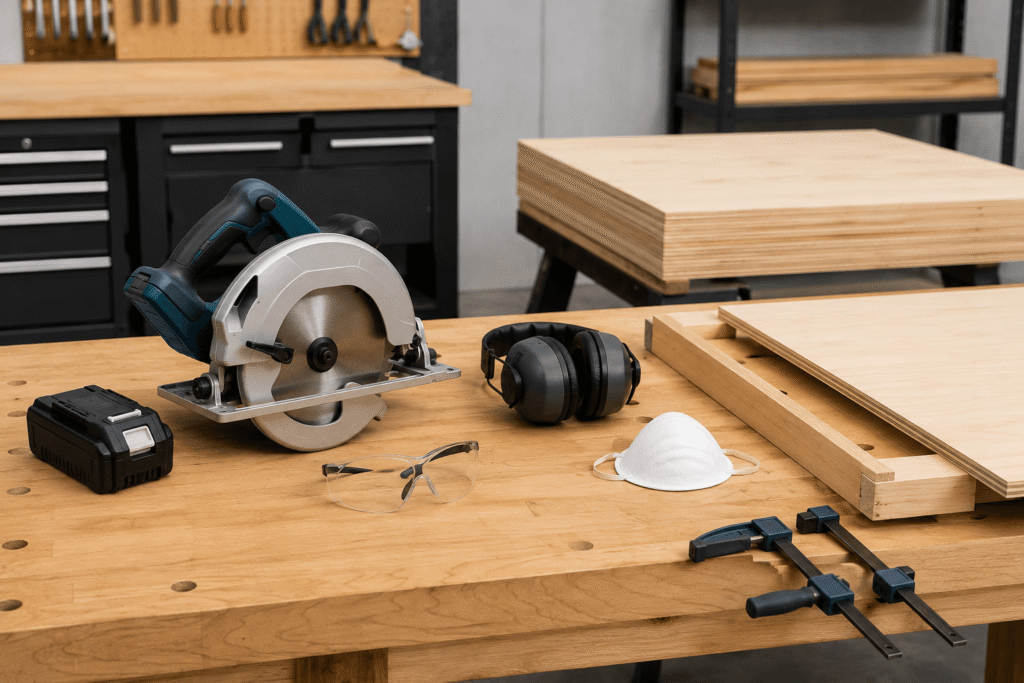
A circular saw is more versatile and affordable, while a track saw is better for clean, straight, splinter-controlled cuts in plywood, MDF, doors, panels, and furniture parts. Choose a circular saw for rough and general work. Choose a track saw when accuracy and finish quality matter most.
| Feature | Circular Saw | Track Saw |
|---|---|---|
| Best for | General cutting, framing, DIY | Sheet goods, cabinets, furniture |
| Accuracy | Good with guide | Excellent with rail |
| Portability | Very good | Good, but needs track |
| Cost | Lower | Higher |
| Finish quality | Depends on blade and guide | Cleaner edges |
| Learning curve | Beginner-friendly | Easy but more specialized |
| Dust collection | Basic to moderate | Usually better |
| Replacement for table saw? | Sometimes | Better for sheet goods |
Choose a circular saw first if you need one tool for many jobs. Choose a track saw if your work involves plywood cabinets, furniture panels, built-ins, and high-finish cuts.
Common Mistakes When Buying a Circular Saw
The most common circular saw buying mistakes are choosing by price alone, ignoring blade quality, buying the wrong blade size, overlooking battery compatibility, paying for unnecessary features, ignoring ergonomics, and failing to consider future projects. A good saw should match your work, not just look powerful on the box.
Buying Based Only on Price
Cheap saws are tempting, but price alone does not tell you whether the saw cuts straight, holds adjustments, or feels safe. A low-cost 15-amp corded saw can be excellent value, but a flimsy shoe or rough adjustment mechanism is frustrating.
Expert recommendation: Buy the best saw that meets your real cutting needs, then save money on features you do not need.
Ignoring Blade Quality
Many circular saws include a basic framing blade. It may cut lumber, but it may not produce clean plywood or finish carpentry cuts.
Expert recommendation: Budget for at least one good blade. Use a 24-tooth blade for fast framing cuts and a 40–60 tooth blade for cleaner plywood and finish cuts.
Choosing the Wrong Blade Size
Some beginners buy a small saw because it feels safer. But if the saw cannot cut common materials in one pass, it becomes frustrating and potentially less controlled.
Expert recommendation: Choose 7-1/4 inch for the most versatility. Choose 6-1/2 inch if portability matters more than maximum depth.
Overlooking the Battery Ecosystem
A cordless circular saw is only as practical as its batteries. If you buy into a weak or uncommon battery platform, future upgrades get expensive.
Expert recommendation: If you already own cordless drills or impact drivers, consider the same battery system.
Buying Unnecessary Features
Laser guides, Bluetooth tracking, premium cases, or extreme bevel capacity may sound exciting. Tiny tool-store dopamine hit. But they do not matter if the saw lacks power, control, or a stable base.
Expert recommendation: Prioritize motor power, shoe quality, guard operation, blade visibility, and ergonomics first.
Ignoring Ergonomics
A saw that feels awkward will be harder to control. This matters for beginners, older users, and anyone making repeated cuts.
Expert recommendation: If possible, hold the saw before buying. Check handle comfort, balance, line of sight, and adjustment levers.
Ignoring Future Projects
Buying only for today may lead to another purchase later. If you plan to build a deck, remodel a room, or cut lots of plywood, choose a saw with enough capacity now.
Expert recommendation: Buy for the next 2–3 years of projects, not just one weekend.
Not Considering Replacement Blade Availability
Unusual blade sizes or arbor sizes can make replacement blades harder to find.
Expert recommendation: Choose common blade and arbor sizes unless you have a specialized reason not to.
Recommended Circular Saw Specifications by User Type
The best circular saw specifications depend on how often you cut, what materials you use, and how much accuracy you need. DIYers should prioritize easy handling and value. Furniture makers should prioritize clean cuts and guide compatibility. Contractors should prioritize power, durability, runtime, and fast adjustments.
| User Type | Blade Size | Motor Power | Corded/Cordless | Weight | Budget Range | Must-Have Features |
|---|---|---|---|---|---|---|
| DIY Homeowners | 6-1/2″ or 7-1/4″ | 15A corded or 18V/20V cordless | Either | Light to medium | $60–$180 | Safety lock, easy depth adjustment, dust blower |
| Occasional Users | 6-1/2″ | Moderate cordless or budget corded | Cordless preferred | Lightweight | $50–$150 | Simple controls, common blades |
| Furniture Makers | 6-1/2″ or track-compatible 7-1/4″ | Smooth brushless or corded | Cordless or corded | Balanced | $150–$400 | Fine blade, guide rail, dust collection |
| Professional Carpenters | 7-1/4″ | 15A or high-output cordless | Both | Medium to heavy | $180–$450 | Electric brake, bevel stops, rafter hook |
| Contractors | 7-1/4″ rear handle/worm drive | High torque | Corded and cordless | Durable build | $200–$500+ | Magnesium shoe, brake, runtime, durability |
| Remodelers | 6-1/2″ or 7-1/4″ | Brushless cordless | Cordless preferred | Lightweight | $150–$350 | LED light, dust control, battery platform |
Budget ranges vary by country, sale pricing, battery kits, and whether the saw is sold tool-only or with batteries.
Best Circular Saws to Consider
The best circular saw to consider is the one that fits your work category: a 7-1/4 inch corded saw for value and power, a brushless cordless saw for portability, a rear-handle or worm drive saw for professional framing, and a lightweight sidewinder for beginners. Avoid buying purely by brand name.
Best Overall: Makita 5377MG 7-1/4 Inch Magnesium Hypoid Saw
Overview:
The Makita 5377MG is a strong choice for serious DIYers and professionals who want corded reliability, high torque, and durable construction.
Key specifications
- Blade size: 7-1/4 inch
- Power: 15 amp
- Speed: 4,500 RPM
- Weight: about 13.2 lb
- Type: Hypoid / worm-drive-style rear-handle saw
Popular Mechanics lists the Makita 5377MG as a top overall circular saw, noting its torque, magnesium construction, sealed oil-bathed gears, and jobsite versatility.
Pros
- Strong torque
- Durable build
- Great for framing and heavy cutting
- Good line-of-sight
- Sealed gear system
Cons
- Heavier than sidewinders
- Corded, so less portable
- More saw than casual users need
Ideal user: contractors, framers, remodelers, serious DIYers
Best for: heavy-duty corded cutting
Value rating: 9/10
Best Budget: SKIL 5280-01 15-Amp 7-1/4 Inch Circular Saw
Overview:
The SKIL 5280-01 is a strong budget choice for beginners and homeowners who want a full-size 7-1/4 inch saw without paying premium-tool money.
Key specifications
- Blade size: 7-1/4 inch
- Power: 15 amp
- Speed: 5,300 RPM
- Depth at 90°: 2-7/16 inch
- Depth at 45°: 1-15/16 inch
- Features: laser guide, power indicator, spindle lock
The SKIL manual confirms the 7-1/4 inch blade, 5/8 inch arbor, and cutting depth specifications, while recent independent testing described the saw as lightweight, easy to control, and strong for everyday cutting.
Pros
- Affordable
- Full-size blade
- Good power for DIY
- Beginner-friendly controls
- Easy blade changes
Cons
- Laser guide may not matter for experienced users
- Not as rugged as premium jobsite saws
- Corded
Ideal user: first-time buyers, DIY homeowners, occasional users
Best for: value and beginner use
Value rating: 9.5/10
Best Cordless: Milwaukee M18 FUEL 2732-20 7-1/4 Inch Circular Saw
Overview:
The Milwaukee M18 FUEL 2732-20 is a strong cordless circular saw for users already invested in Milwaukee’s M18 platform.
Key specifications
- Blade size: 7-1/4 inch
- Motor: POWERSTATE brushless
- Speed: 5,800 RPM
- Power source: M18 battery platform
- Best use: carpentry, remodeling, general contracting
Milwaukee says this saw is designed for carpenters, remodelers, and contractors, with a brushless motor delivering 5,800 RPM and up to 750 cuts per charge under stated conditions. Pro Tool Reviews also rated the M18 FUEL 2732 highly in cordless circular saw testing.
Pros
- Strong cordless performance
- Full 7-1/4 inch blade
- Brushless motor
- Good for jobsite mobility
- Strong battery ecosystem
Cons
- Expensive with batteries
- Runtime depends on battery size
- Heavier than compact cordless saws
Ideal user: remodelers, contractors, Milwaukee battery users
Best for: cordless professional cutting
Value rating: 8.8/10
Best Corded Value: SKIL 15-Amp 7-1/4 Inch Circular Saw
Overview:
For many buyers, a basic 15-amp corded saw is still the smartest purchase. It gives reliable power without battery cost.
Key specifications
- Power: 15 amp
- Speed: 5,300 RPM
- Blade: 7-1/4 inch
- Weight: around 8.7–8.8 lb depending on listed source
Pros
- Low cost
- No battery management
- Good for workshop use
- Lightweight for a full-size saw
Cons
- Cord limits movement
- Not premium build
- Not ideal for remote jobsites
Ideal user: homeowners, new DIYers, garage woodworkers
Best for: low-cost dependable cutting
Value rating: 9/10
Best Professional Rear-Handle: FLEX 24V 7-1/4 Inch Rear Handle Circular Saw
Overview:
The FLEX 24V rear-handle saw is aimed at users who want cordless power, high cut capacity, and rear-handle control.
Key specifications
- Blade size: 7-1/4 inch
- No-load speed: 6,200 RPM
- Bevel capacity: 0–56°
- Cut capacity at 90°: 2-5/8 inch
- Tool weight without battery: 10 lb
FLEX lists a 7-1/4 inch blade, 6,200 RPM, 0–56° bevel capacity, 2-5/8 inch cut depth at 90°, magnesium footplate and guards, LED light, and compatibility with FLEX 24V batteries.
Pros
- Strong cordless performance
- Deep cut capacity
- Rear-handle control
- Magnesium components
- LED light
Cons
- Battery system cost
- Heavier than compact cordless saws
- Best value only if you like the FLEX platform
Ideal user: contractors, framers, heavy cordless users
Best for: premium cordless rear-handle performance
Value rating: 8.5/10
Best Beginner: SKIL 5280-01
Overview:
The SKIL 5280-01 earns another mention because beginner circular saw buyers usually need simplicity, safety awareness, and value more than premium features.
Pros
- Affordable
- Full-size capacity
- Easy controls
- Safety lock and guarded trigger
- Common blade size
Cons
- Corded
- Laser is helpful for some, unnecessary for others
Ideal user: first-time circular saw buyers
Best for: learning basic cuts safely
Value rating: 9.5/10
Best Lightweight Cordless: Bosch PRO GKS 18V-57-2
Overview:
The Bosch PRO GKS 18V-57-2 is a compact 18V cordless circular saw with a 165 mm blade, making it useful for users who want portability and control.
Key specifications
- Battery voltage: 18V
- Blade diameter: 165 mm
- No-load speed: 5,000 RPM
- Weight with battery: 3.2 kg
- Cutting depth: 57 mm straight cuts, 41 mm bevel cuts
Bosch lists the tool with an 18V battery platform, 165 mm blade, 5,000 RPM speed, 57 mm straight cutting depth, fast brake, dust blower, LED light, front handle, and spindle lock.
Pros
- Compact and portable
- Good feature set
- LED and brake
- Useful for remodelers and mobile work
Cons
- Not a full 7-1/4 inch saw
- Not guide-rail compatible in the listed version
- Battery platform matters
Ideal user: remodelers, mobile trades, Bosch 18V users
Best for: lightweight cordless cutting
Value rating: 8/10
Best Premium: Milwaukee M18 FUEL or FLEX 24V Rear Handle
Overview:
For premium buyers, the better choice depends on your battery platform. Milwaukee is excellent for M18 users. FLEX is compelling for users wanting a high-output 24V rear-handle setup.
Pros
- Strong cordless cutting
- Brushless motors
- Professional features
- Good jobsite mobility
Cons
- Higher cost
- Battery and charger costs add up
- Overkill for occasional users
Ideal user: professionals and serious remodelers
Best for: high-frequency cordless use
Value rating: 8.5/10
Circular Saw Accessories Worth Buying
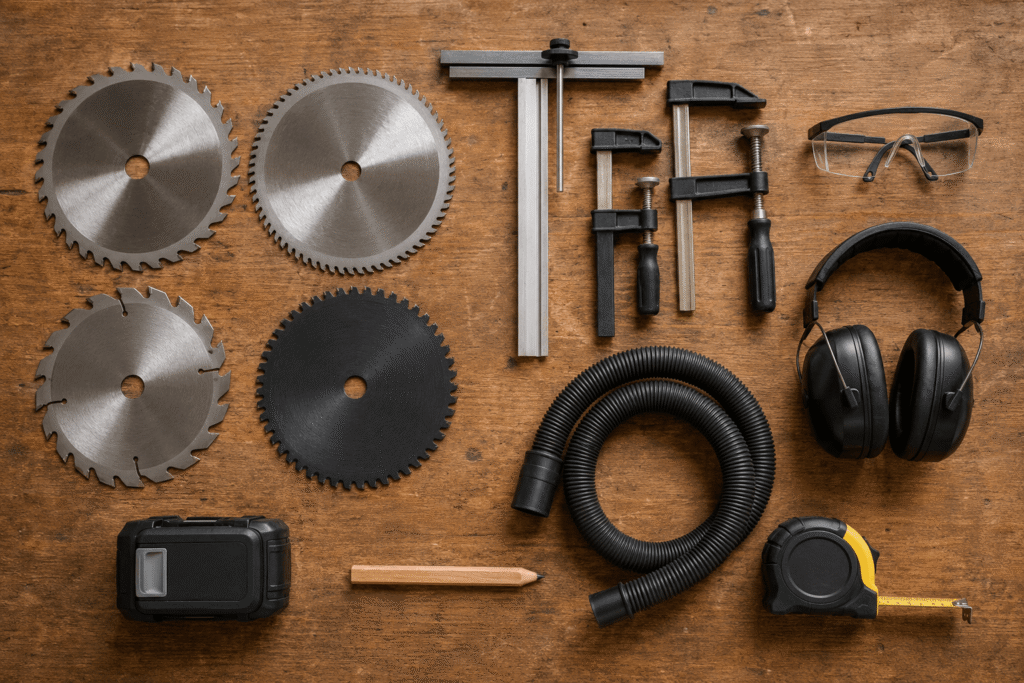
The most useful circular saw accessories are quality blades, a rip guide, track or straight-edge guide, clamps, safety glasses, hearing protection, dust collection adapters, a stable workhorse, extra batteries, and a storage case. Accessories often improve cut quality more than upgrading the saw itself.
Extra Blades
Buy blades based on the material and finish quality you need.
- 24T framing blade: fast rough cuts
- 40T general-purpose blade: cleaner all-around cuts
- 60T fine-finish blade: plywood and finish carpentry
- Specialty blades: laminate, metal, fiber cement, masonry, plastic
Rip Guide
A rip guide helps make parallel cuts along boards or sheet goods. It is useful for shelves, trim strips, and repeated same-width cuts.
Track Guide or Straight Edge
A track guide or clamped straight edge helps make long, straight cuts in plywood. This is one of the best upgrades for accuracy.
Dust Collection
Dust collection improves visibility, cleanliness, and respiratory safety. It matters especially when cutting MDF, plywood, OSB, or treated material.
Clamps
Good clamps keep the workpiece stable. Unstable stock increases the chance of blade binding and poor cuts.
Safety Glasses and Hearing Protection
Eye and hearing protection are non-negotiable. Circular saws throw chips and create high noise levels.
Workhorse or Sawhorse
A stable support surface helps prevent pinching, binding, and dangerous offcuts.
Storage Case
A case protects the saw, blade, wrench, batteries, and accessories.
Battery Upgrades
For cordless saws, larger batteries often improve runtime and cutting performance. Avoid underpowering a high-performance cordless saw with a tiny compact battery.
Blade Cleaning Kit
Resin buildup makes blades cut hotter and rougher. Cleaning blades extends their useful life.
Circular Saw Maintenance Tips
Maintain a circular saw by keeping the blade sharp and clean, checking the guard, inspecting the cord or battery, cleaning dust from vents, storing the tool dry, verifying blade alignment, and replacing damaged blades immediately. Good maintenance improves safety, accuracy, motor life, and cutting performance.
Blade Cleaning
Clean pitch, resin, and dust from blades. A dirty blade overheats more easily and can wander during cuts.
Blade Replacement
Replace blades that are dull, chipped, warped, cracked, or burning wood. OSHA states cracked saws should be removed from service.
Lubrication
Most modern sidewinders do not need user lubrication. Some worm drive systems may require oil checks, while some hypoid systems are sealed. Follow the manufacturer manual.
Battery Care
For cordless saws:
- Store batteries in a dry place
- Avoid extreme heat
- Do not run batteries fully dead repeatedly
- Use manufacturer-approved chargers
- Match high-demand saws with high-output batteries
Cord Inspection
For corded saws, inspect the cord before use. Do not use a saw with exposed wires, cracked insulation, or unreliable plugs.
Storage
Store the saw dry, clean, and unplugged or without battery. Keep the blade protected.
Calibration
Check that the shoe sits flat, bevel scale reads correctly, and the blade is square to the base.
Safety Inspection
Before each use, check:
- Lower guard moves freely
- Blade is sharp and undamaged
- Blade is installed in the correct rotation
- Depth and bevel locks are tight
- Cord or battery is safe
- Workpiece is supported
- Cut path is free of nails or screws
Maintenance Checklist
| Task | Frequency |
|---|---|
| Check lower blade guard | Before every use |
| Inspect blade condition | Before every use |
| Clean dust from vents | After dusty work |
| Check cord or battery | Before every use |
| Clean blade | When pitch builds up |
| Verify bevel/depth locks | Before angled cuts |
| Replace dull blade | When cutting slows or burns |
| Store dry | After every use |
Frequently Asked Questions
What size circular saw is best?
A 7-1/4 inch circular saw is best for most users because it offers strong cutting depth, wide blade availability, and versatility for framing, plywood, decking, and general woodworking. A 6-1/2 inch saw is better if you want lighter cordless handling for smaller DIY and remodeling tasks.
Is cordless better than corded?
Cordless is better for portability, quick cuts, remodeling, outdoor jobs, and worksites without outlets. Corded is better for continuous power, long cutting sessions, and lower cost. For most DIYers, either works. For professionals, owning both is often the most practical setup.
Can a beginner use a circular saw?
Yes, a beginner can use a circular saw safely with proper setup, protective gear, stable work support, the correct blade, and careful technique. Beginners should start with straight cross cuts, use two hands, keep the guard functioning, stand to the side of the blade path, and avoid forcing the saw.
What blade should I buy?
Buy a 24-tooth carbide blade for fast framing cuts, a 40-tooth general-purpose blade for cleaner everyday cuts, and a 60-tooth or higher fine-finish blade for plywood, trim, and furniture projects. Always match blade diameter, arbor size, tooth design, and material rating to your saw and project.
How much should I spend?
Most DIYers should spend around $60–$180 for a reliable circular saw. Beginners can get excellent value from a corded 15-amp model. Serious woodworkers and professionals may spend $180–$500 or more for brushless cordless kits, rear-handle saws, track-compatible systems, or premium construction tools.
Can one saw cut all materials?
One circular saw can cut many materials only if you use the correct blade, but no single setup is perfect for everything. Wood, plywood, laminate, metal, masonry, plastic, and fiber cement often require different blades. Cutting the wrong material with the wrong blade can damage the blade and increase risk.
How long do circular saws last?
A good circular saw can last many years with proper blade care, clean storage, safe handling, and regular inspection. Corded saws often last longer because they avoid battery aging, while cordless saw life depends on motor quality, battery care, and workload.
Which safety features matter most?
The most important circular saw safety features are a working lower blade guard, trigger lock, electric brake, stable shoe, clear blade visibility, and correct blade installation. Technique matters too: support the workpiece, avoid twisting the saw, keep hands away from the cut line, and never pin the guard open.
Final Buying Advice
Choose your circular saw by starting with the work, not the brand. A DIY homeowner usually needs a lightweight 6-1/2 inch cordless saw or a budget-friendly 7-1/4 inch corded saw. A professional carpenter needs power, durability, depth capacity, bevel range, and fast blade changes.
If you want one practical recommendation: buy a 7-1/4 inch circular saw with a 15-amp motor or a brushless cordless motor, at least 2-3/8 inch cutting depth, a comfortable grip, a stable shoe, an electric brake if budget allows, and widely available replacement blades.
For beginners, the safest smart buy is usually a simple full-size corded saw plus a quality blade and clamps. For professionals, choose based on your battery platform and whether you prefer sidewinder speed or rear-handle torque.
The saw is only half the story. The blade, support setup, guide, and safety habits decide whether your cuts look clean or like they were negotiated during an earthquake.


